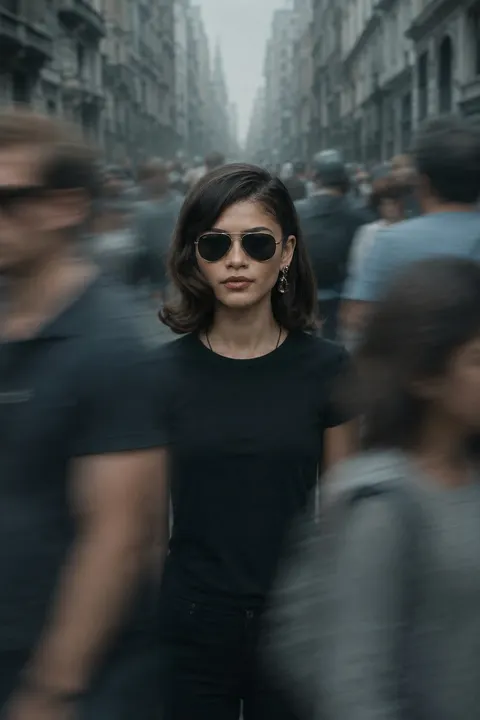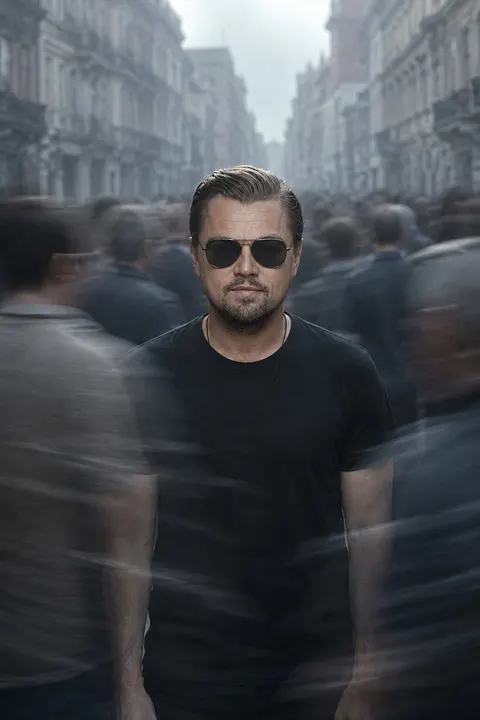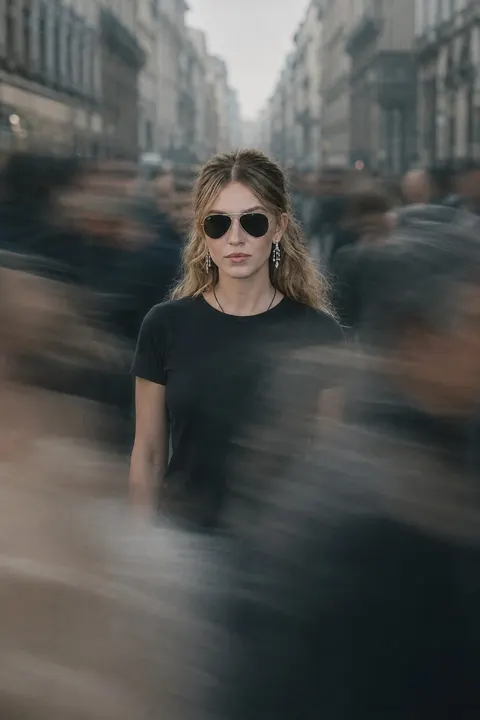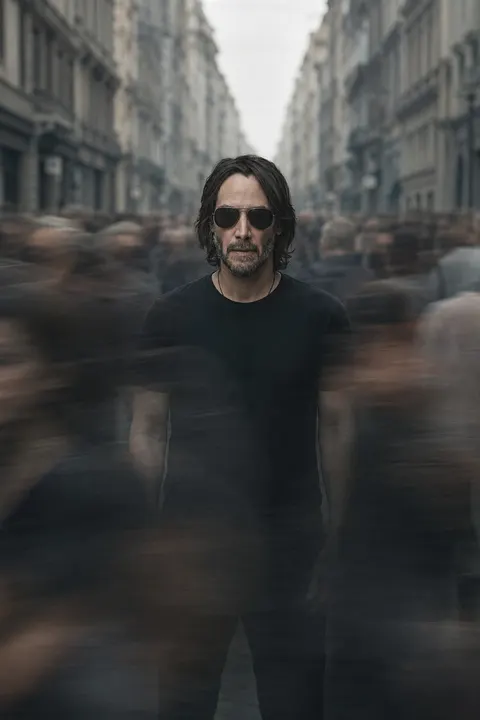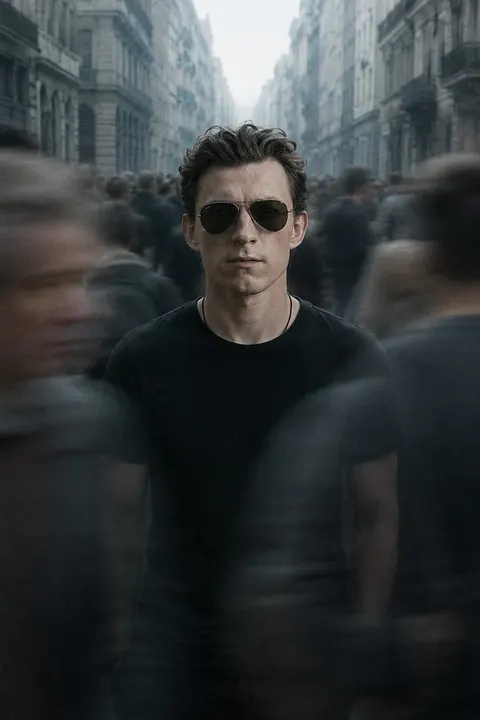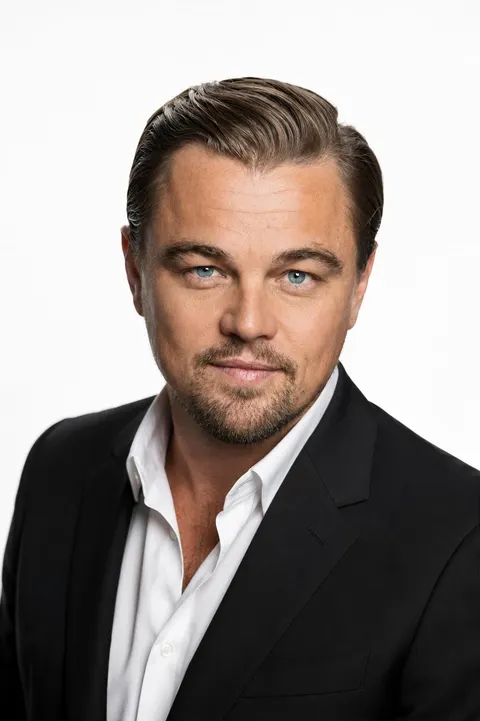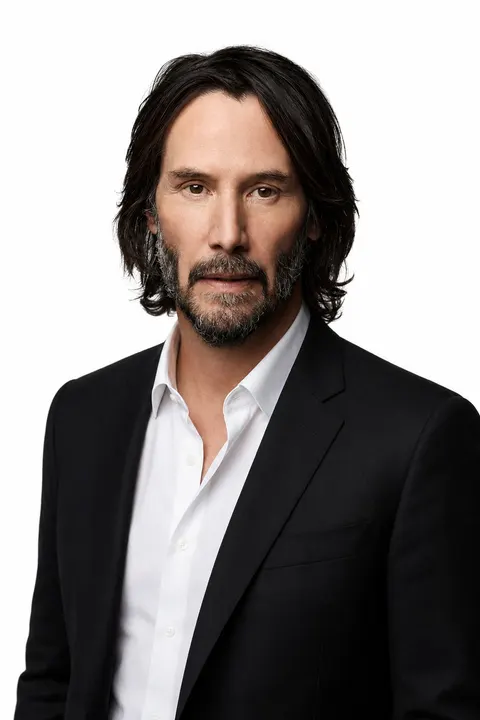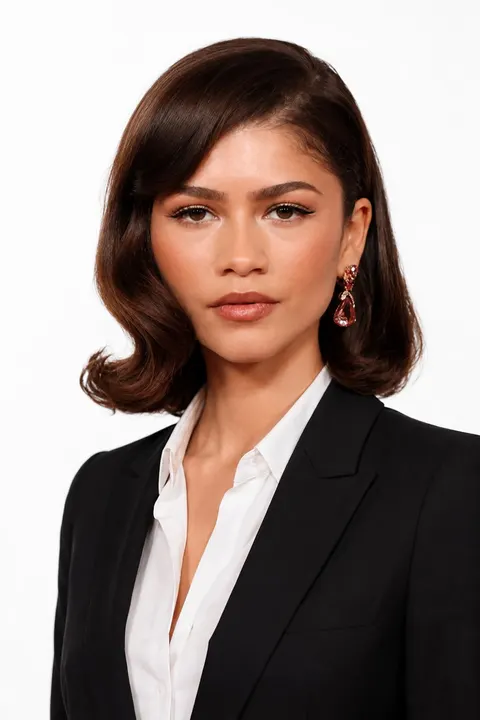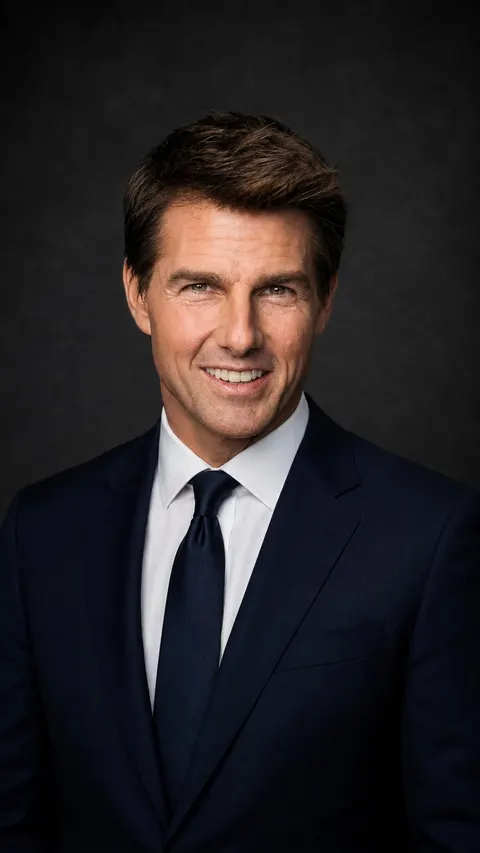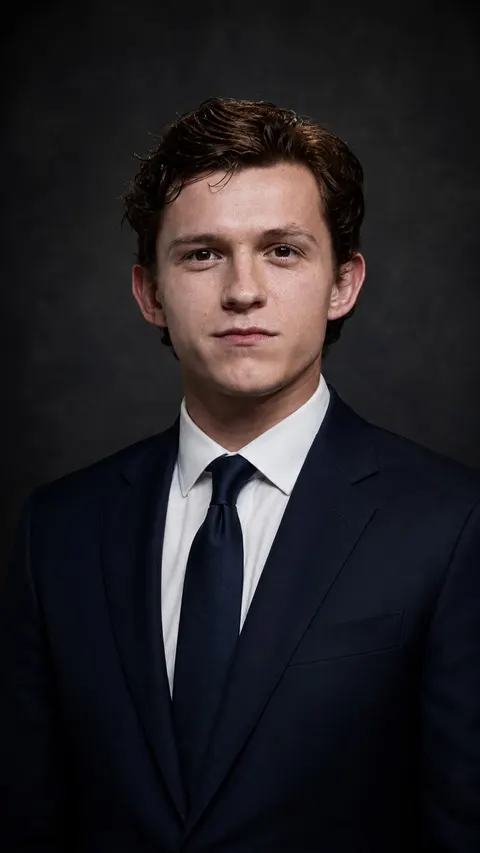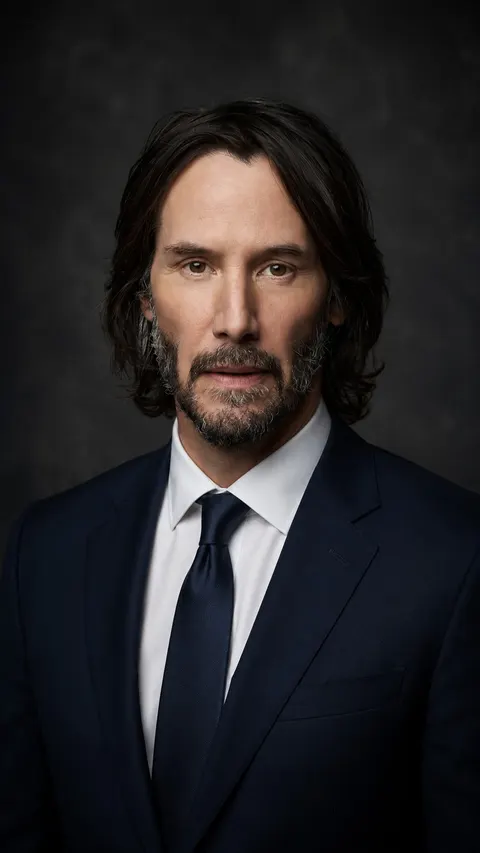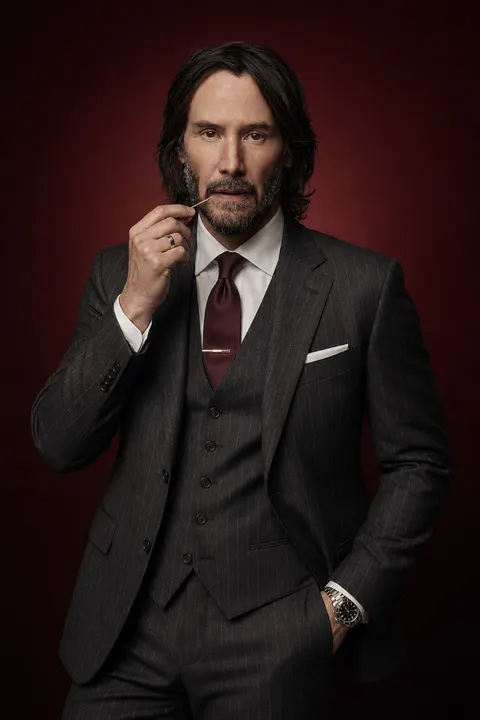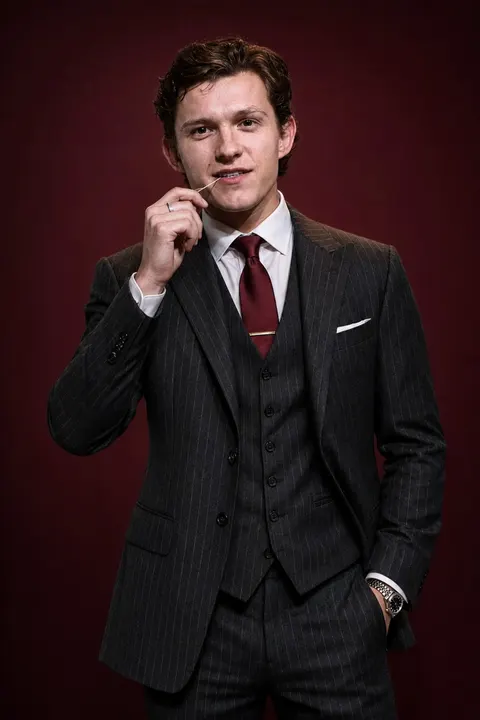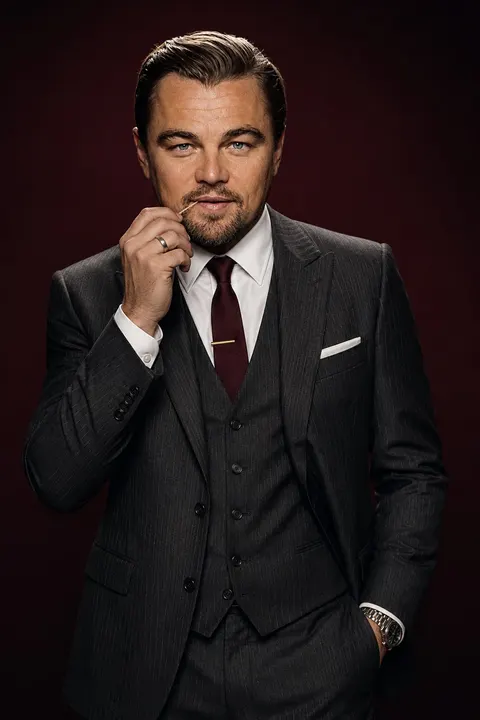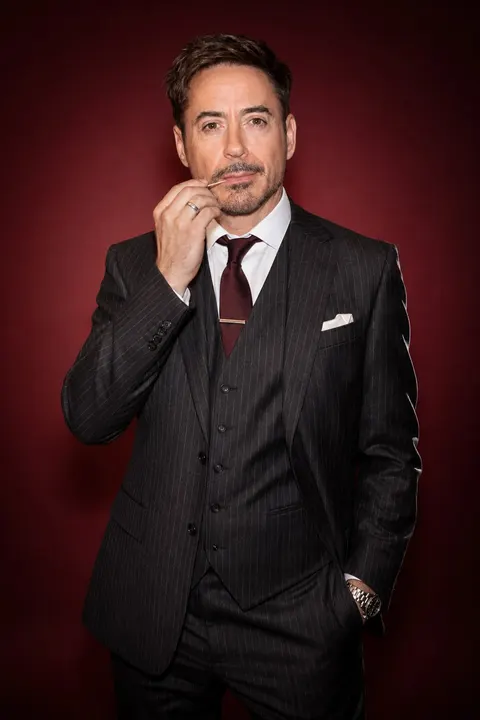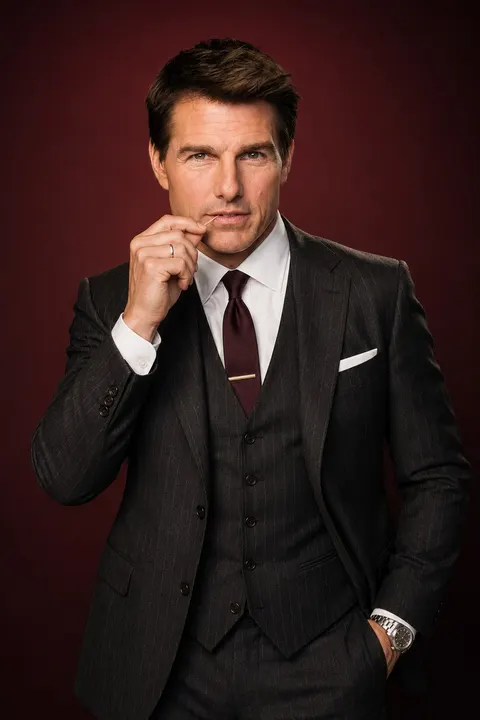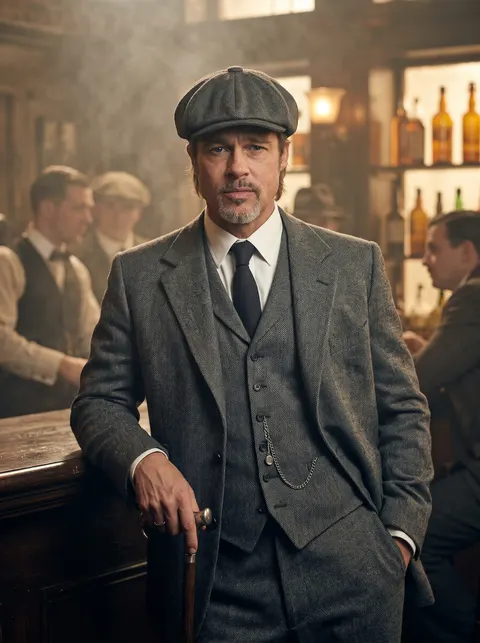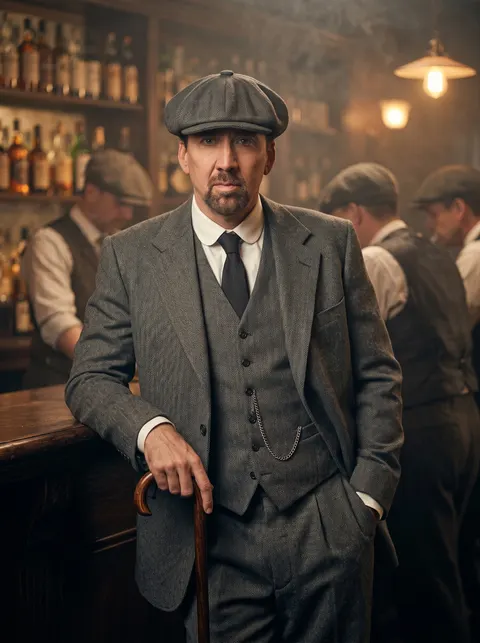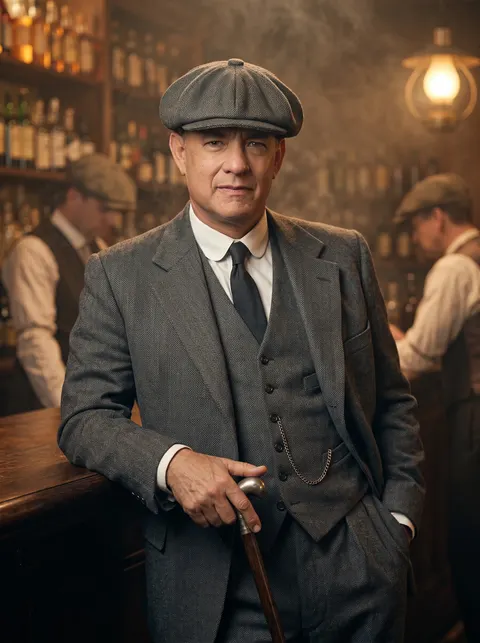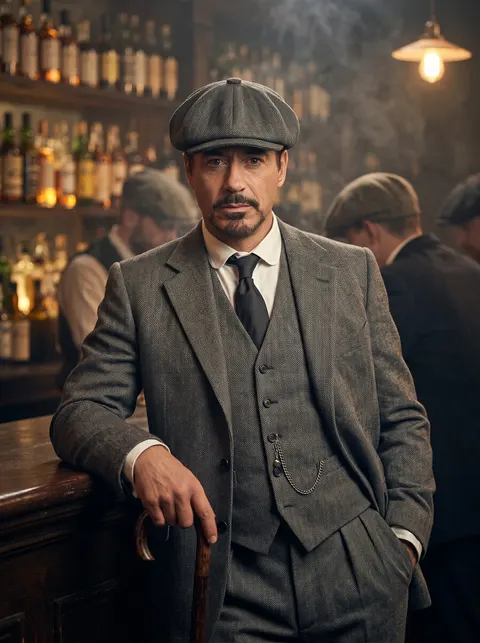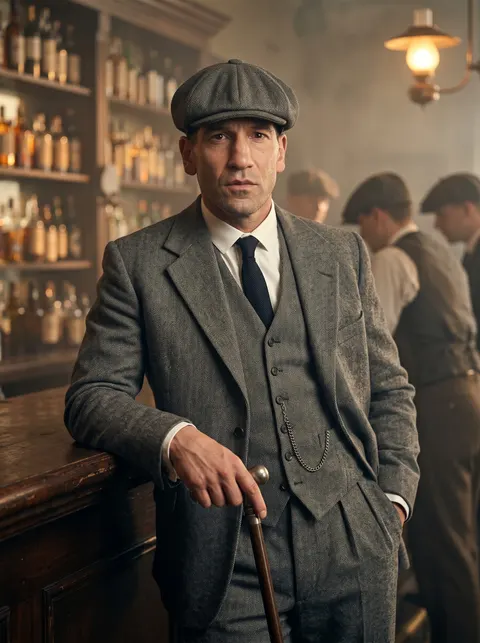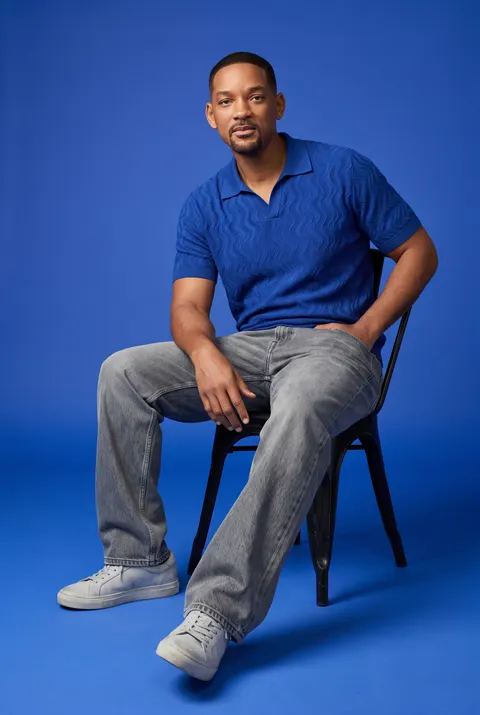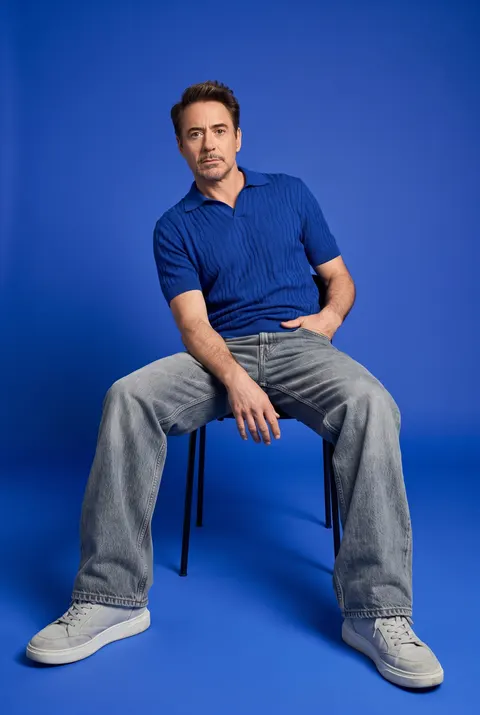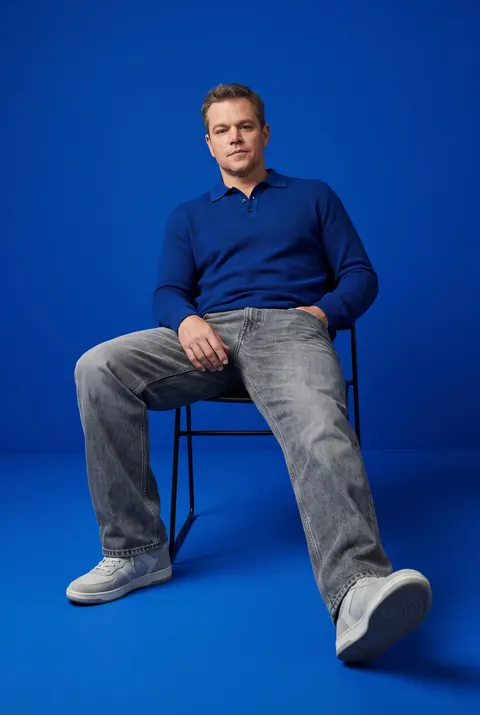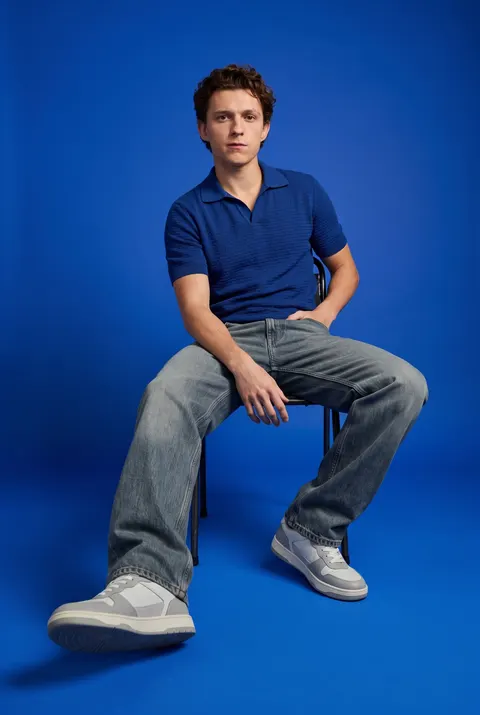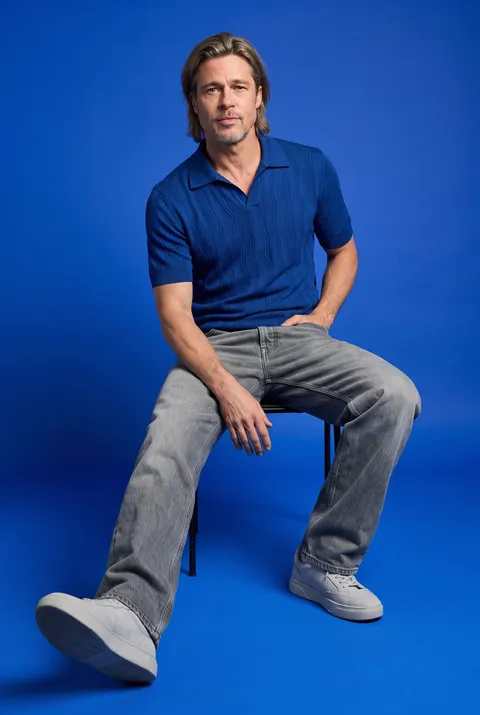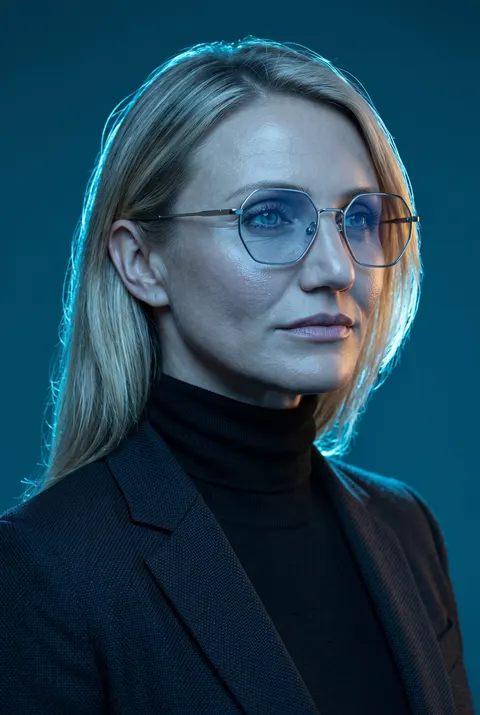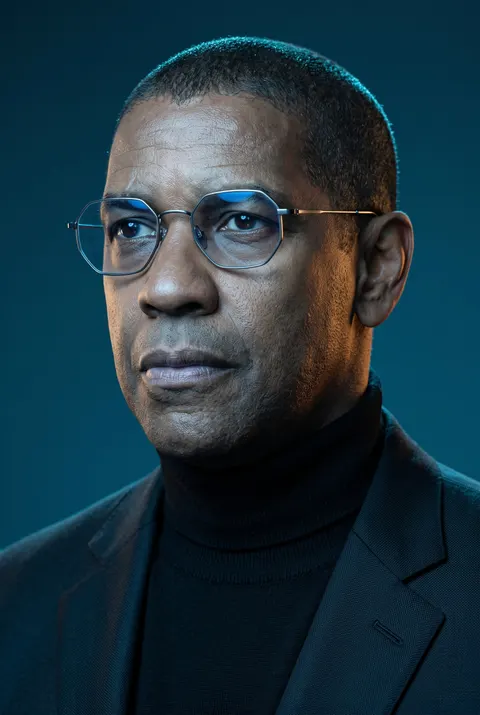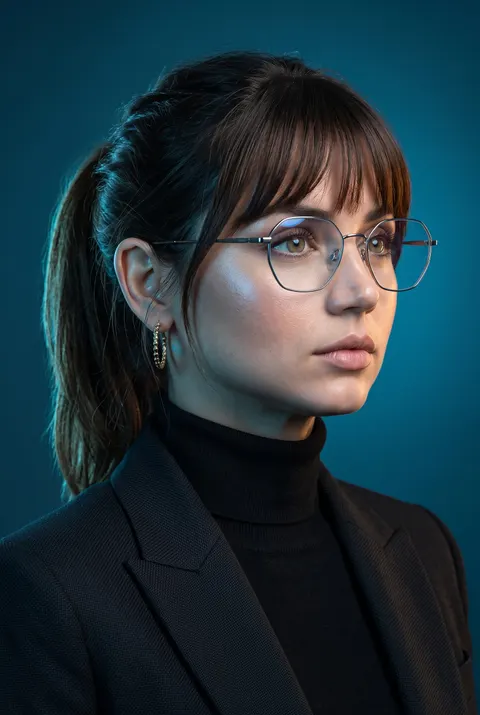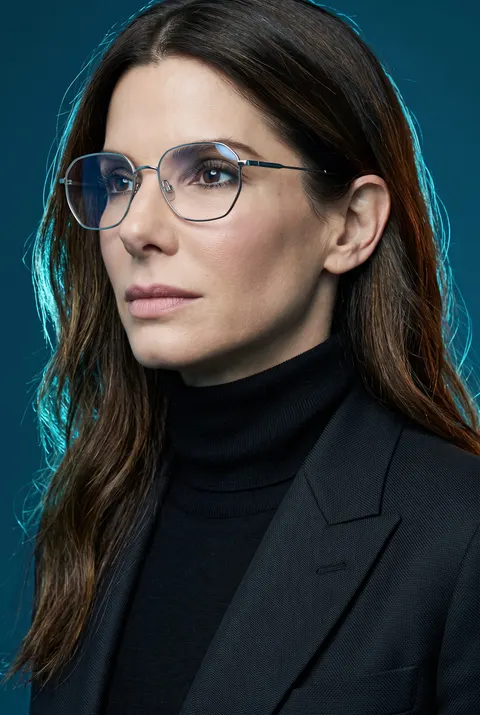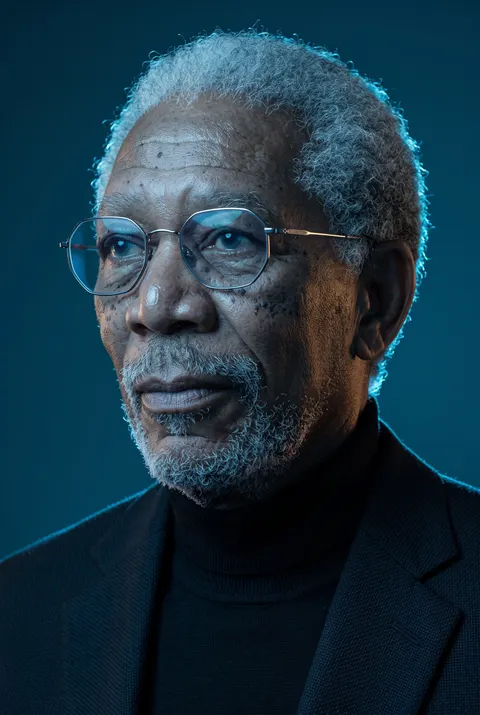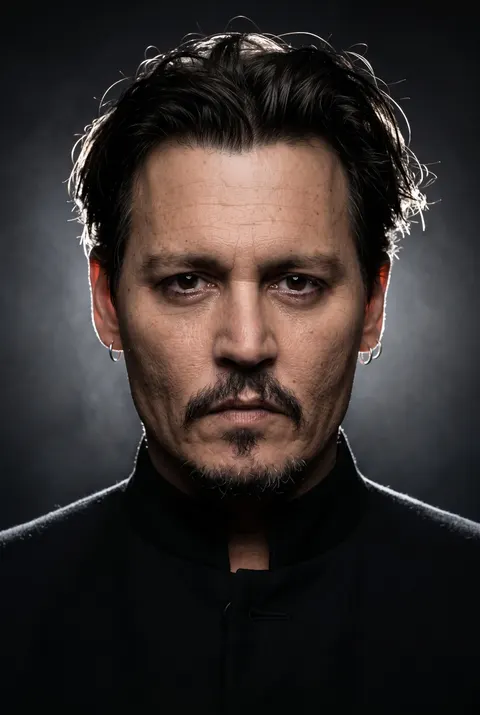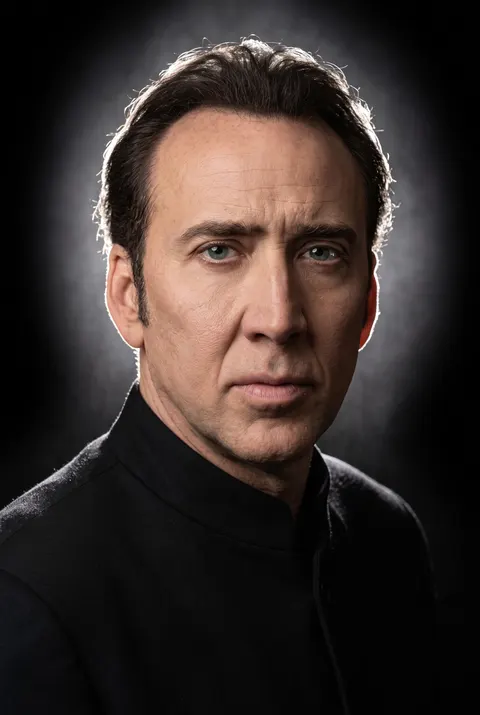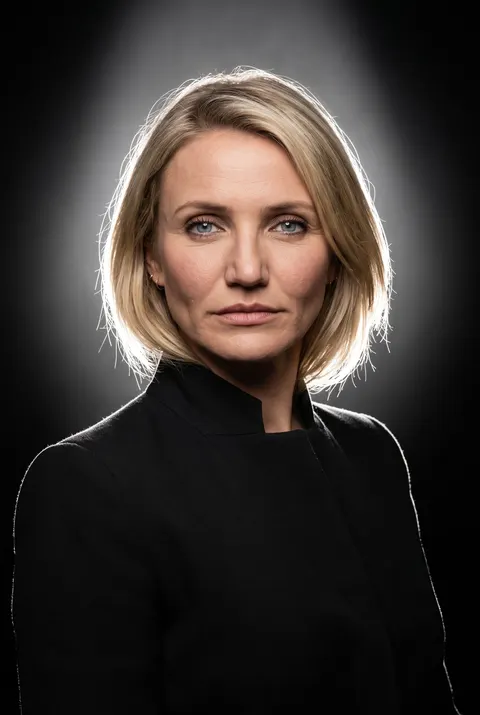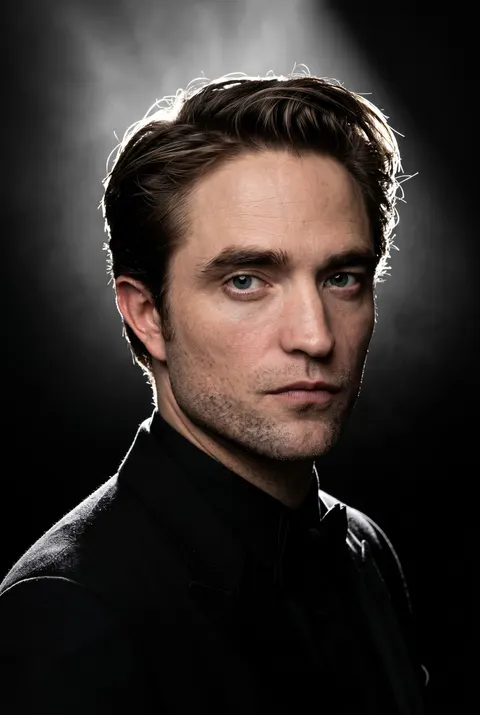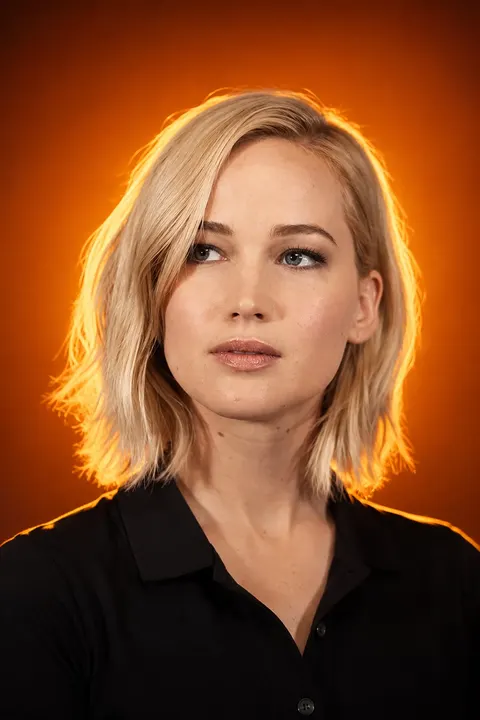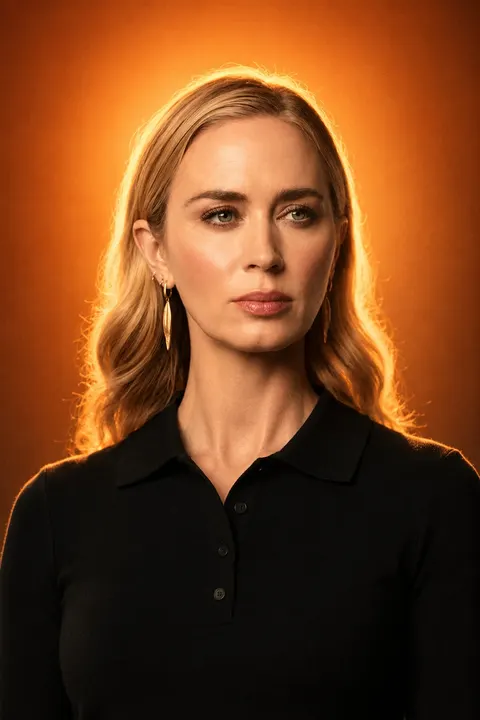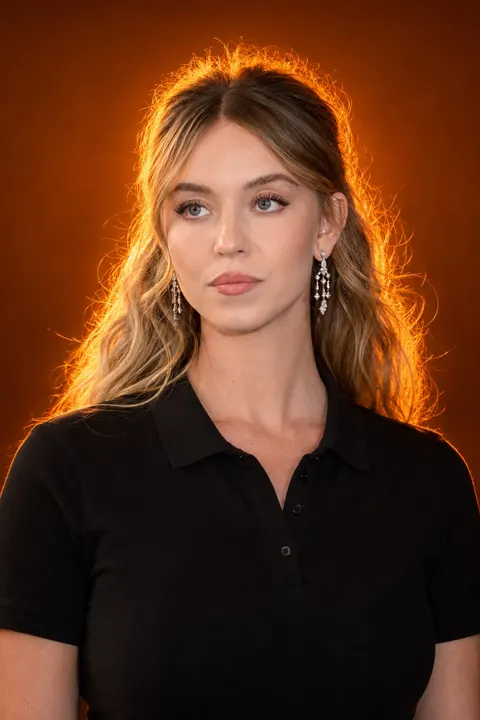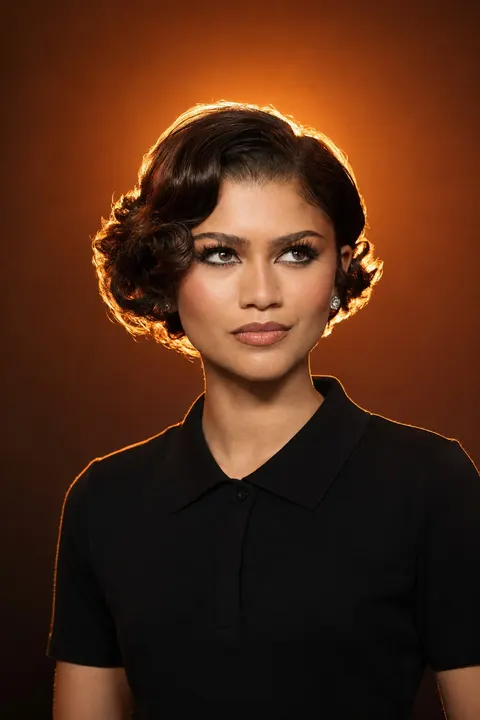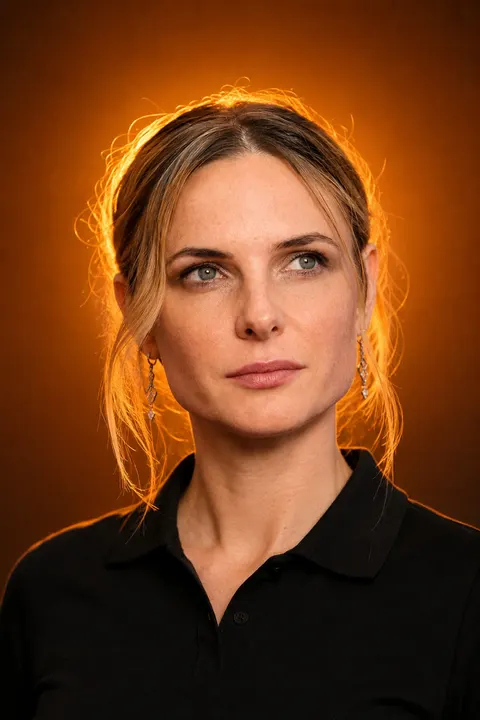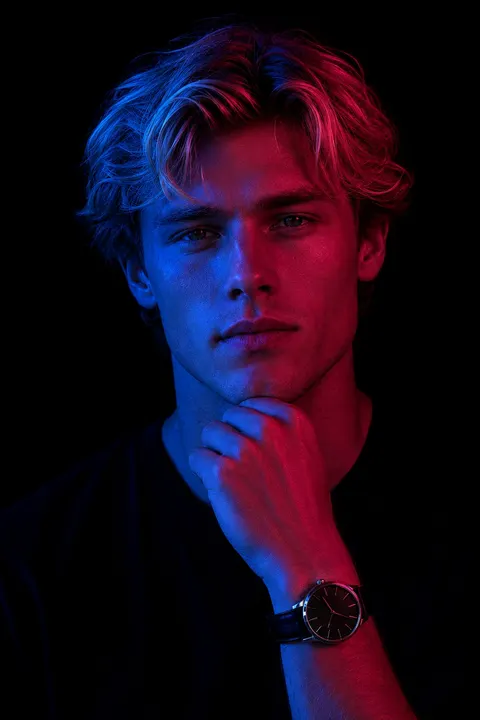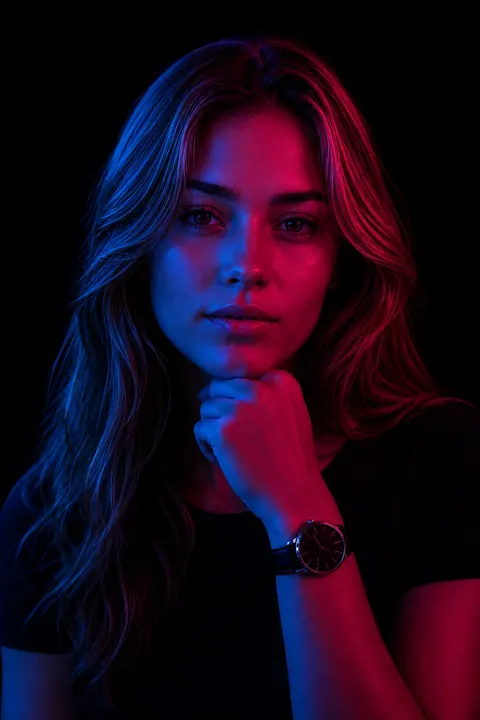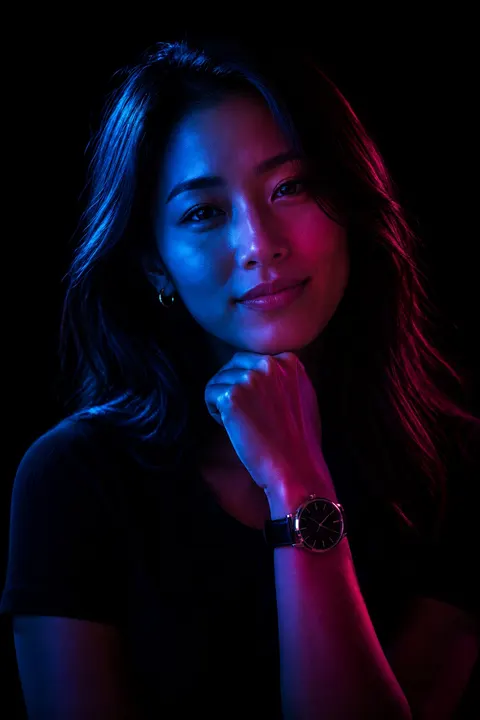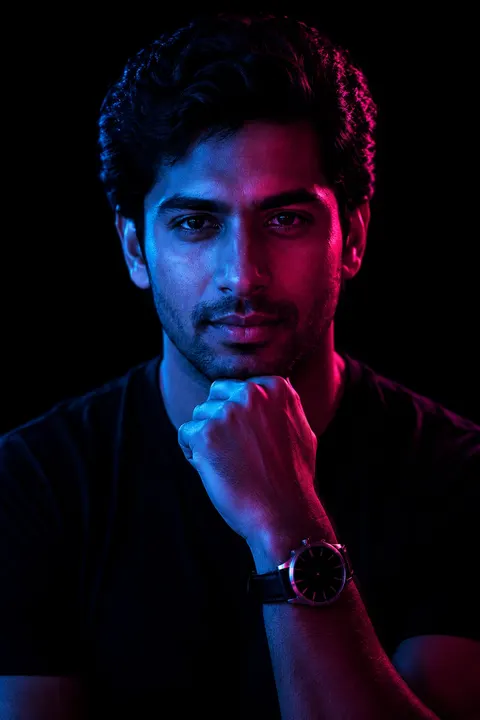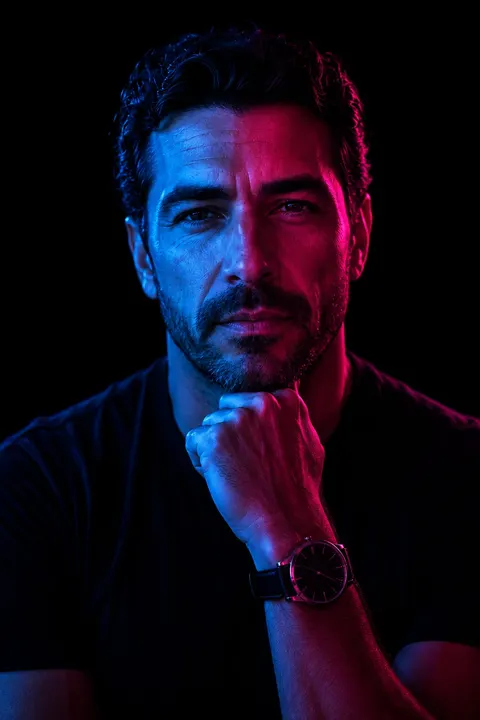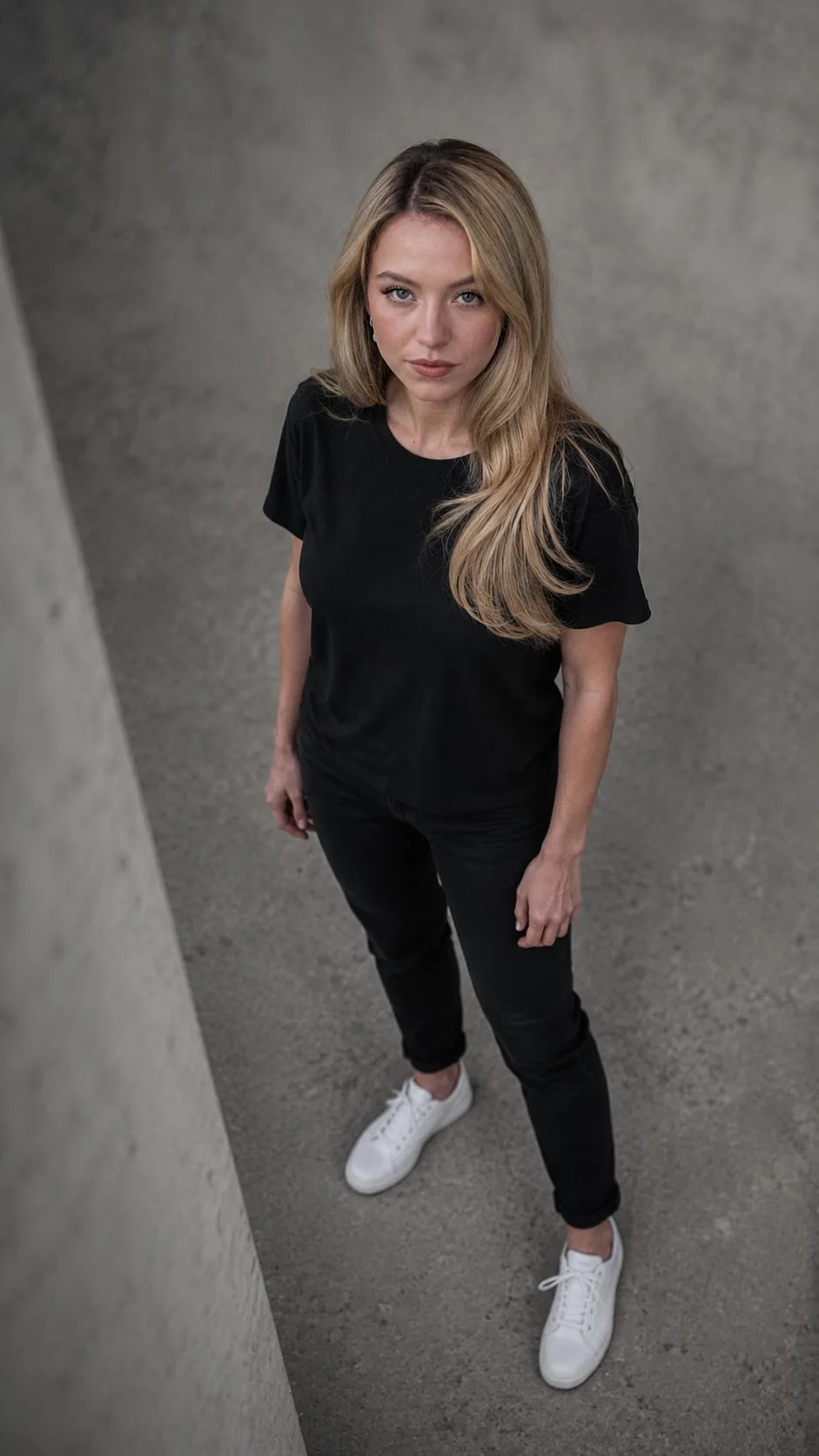
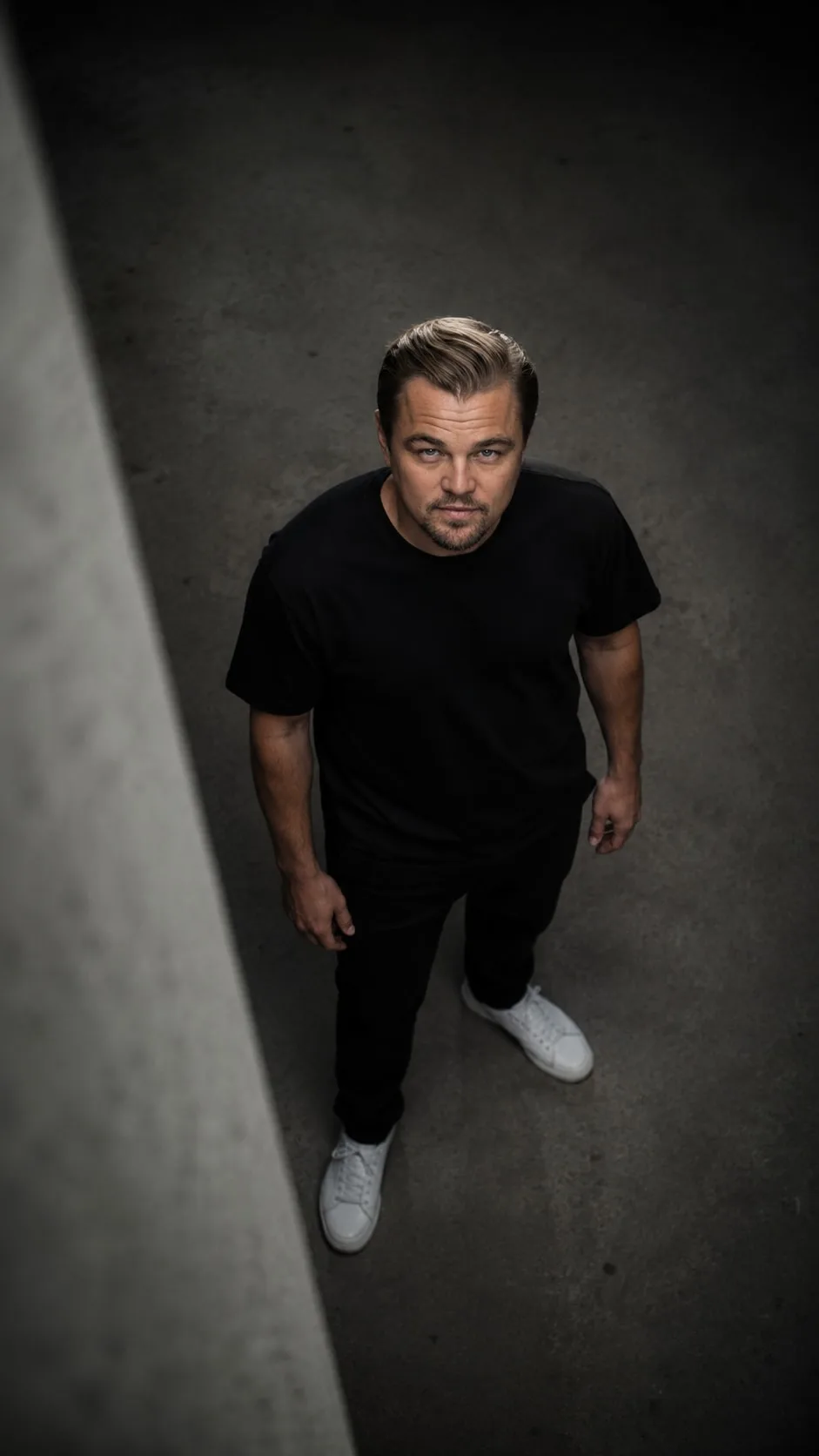
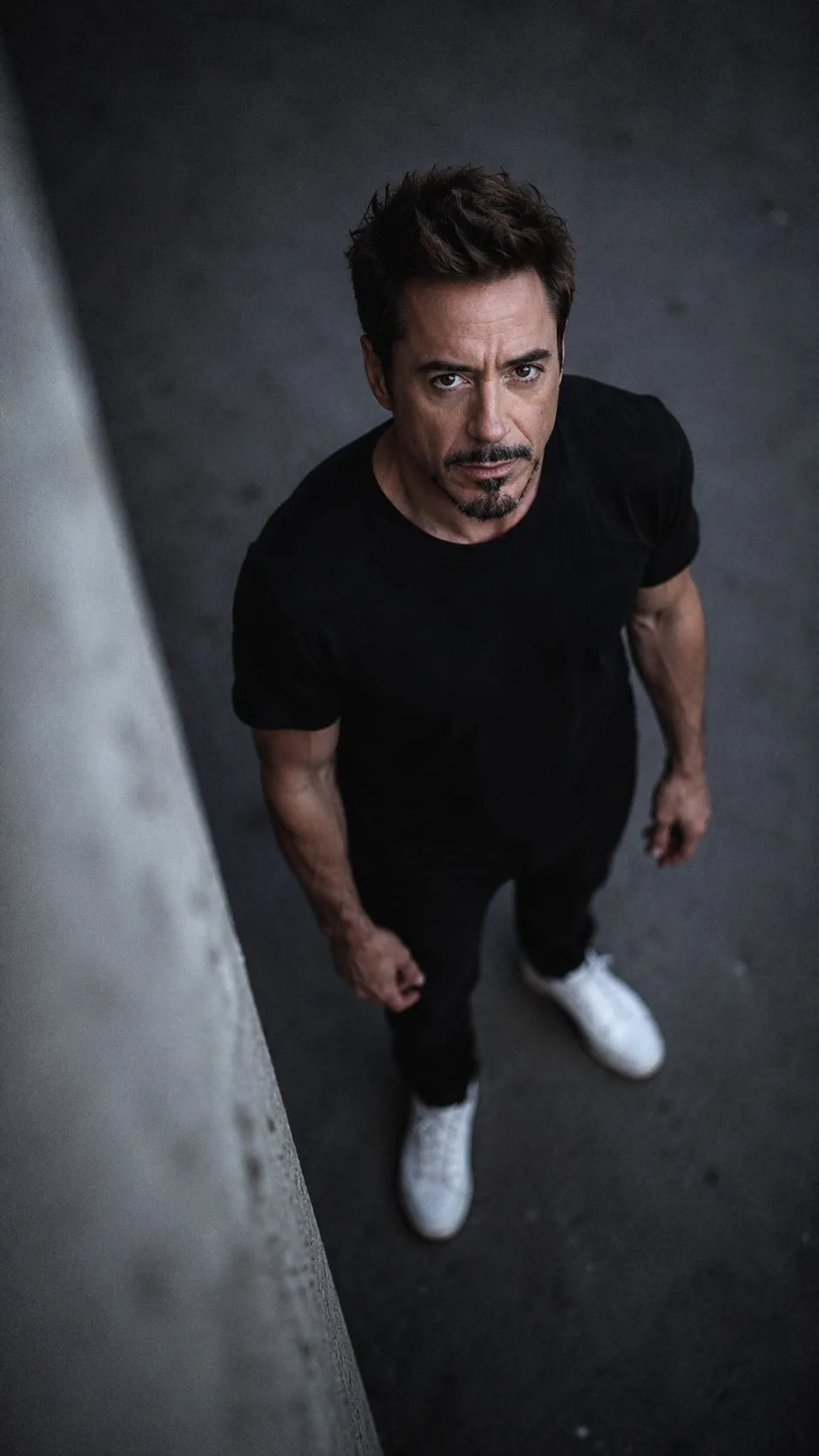
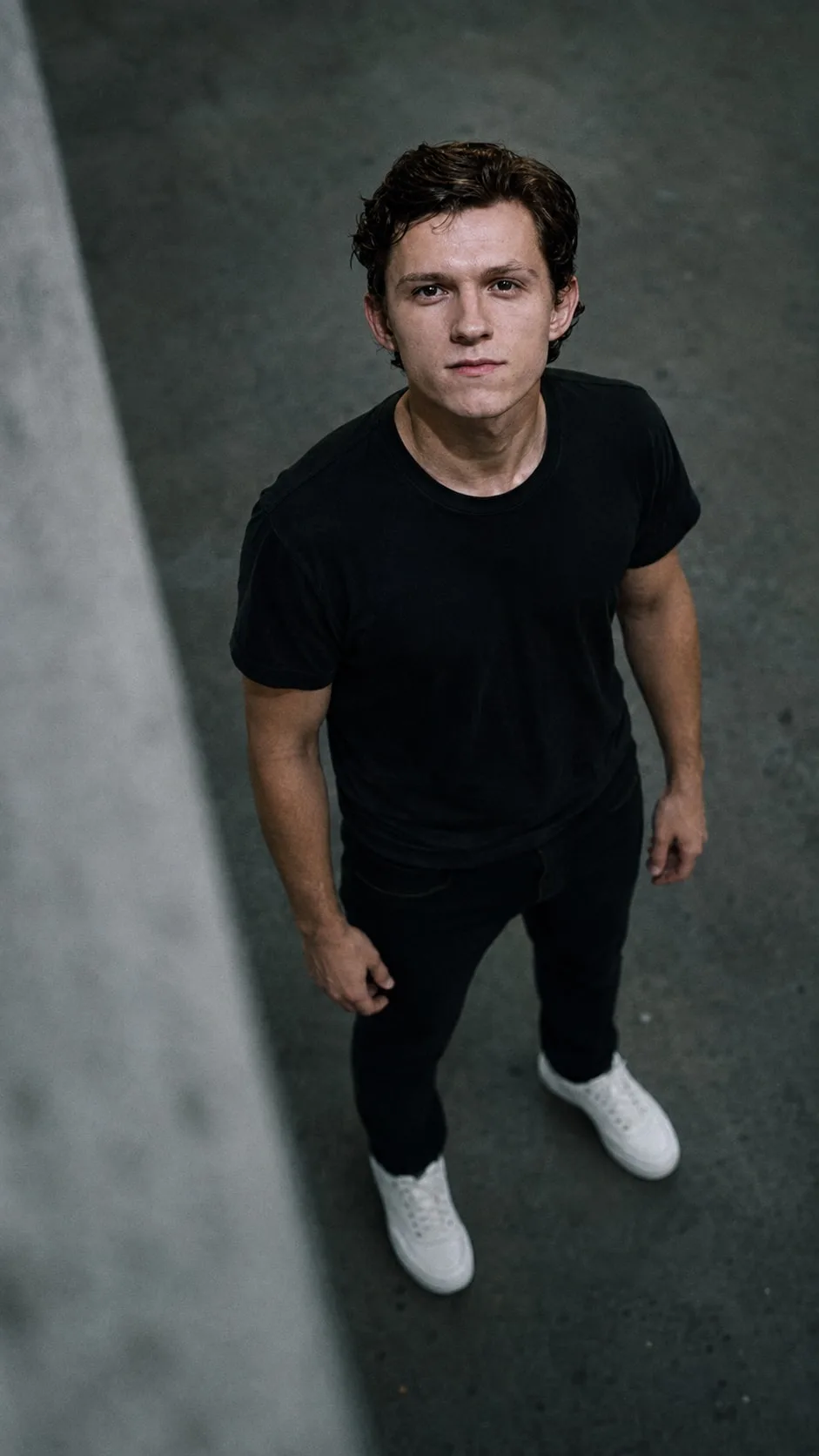
High-Angle Looking-Up Moody Portrait
Moody full-figure prompt: steep high-angle camera, subject staring up into the lens, only face and sneakers lit. Examples: Sydney Sweeney, DiCaprio, Downey Jr.
Prompt
# LOCKED MASTER PROMPT — HIGH-ANGLE LOOKING-UP MOODY FULL-FIGURE PORTRAIT

## ROLE

You are a world-class cinematic fashion and street portrait photographer shooting available light in a bare concrete environment.
Create a premium, photorealistic high-angle portrait using the **ATTACHED REFERENCE IMAGE as the identity source**.

The defining idea of this image: the camera is **high above the subject looking steeply down**, while the subject **tilts his head back and stares straight up into the lens**. Strong perspective foreshortening shrinks the body toward the bottom of the frame. Only the **face and the white sneakers** carry light; everything else sinks into darkness. A large defocused wall edge crowds the left side of the frame.

The output must look like a film still or a muted editorial fashion frame captured on a high-end full-frame camera — NOT like an AI-generated image, a 3D render, a studio shot, or a phone-app filter.

Aspect ratio: **9:16 vertical.**

---

# 1. IDENTITY LOCK — ABSOLUTE PRIORITY

Use the person from the **ATTACHED REFERENCE IMAGE**.
Preserve the person's identity with maximum fidelity.
DO NOT redesign, beautify, reinterpret, slim, widen, or idealize the person.

Preserve exactly:

* Facial geometry and skull proportions
* Face shape and width-to-height ratio
* Forehead height and hairline shape, including temple recession
* Brow ridge projection — pronounced in this downward view
* Eyebrow shape, thickness, density and spacing
* Eye shape, size, spacing, eyelid structure, **iris color** and under-eye character
* Nose bridge, tip and nostril structure
* Cheekbone height and projection
* Jawline definition and angle
* Chin shape and projection
* Lip shape, thickness and proportions
* Ear size, shape, position and attachment
* Natural facial asymmetry
* Skin tone and undertone
* Natural skin texture, pores, fine lines and surface irregularity
* Hair color, density, growth pattern, hairline position and existing short haircut
* Facial hair, if present
* Neck thickness, shoulder width and overall body build
* Height and limb proportions
* Age and apparent age
* Any moles, scars or distinguishing marks

The person must remain unmistakably the same individual as the reference.

**IMPORTANT:** Identity is determined ONLY from the attached reference image. Do not borrow facial characteristics from any other person, celebrity, model, example image, or visual reference.

### EYE COLOR NOTE
Because the face is the only brightly lit area, the eyes are the most conspicuous detail in the frame. Preserve the reference person's **exact iris color and pattern**. Do NOT lighten, brighten, saturate or change them.

### HAIRCUT NOTE
Preserve the reference haircut exactly, including crop length, taper and hairline edge. Seen from above, the crown and the top of the head are fully exposed — the hair's growth pattern and density across the crown must match the reference.

---

# 2. CAMERA POSITION LOCK — CRITICAL

The camera is **elevated well above the subject**, looking steeply down.

* Camera elevation is approximately **40–55 degrees above** the subject's eye level
* The lens axis points downward at the subject's upturned face
* The camera is positioned close enough that perspective is clearly active, not a flat telephoto compression
* The subject is standing on the ground; the camera is roughly one storey or a stairwell landing above him

Do NOT shoot from eye level.
Do NOT shoot from a low angle.
Do NOT flatten the perspective into a straight-on view.
Do NOT tilt the camera (no dutch angle).
Do NOT exceed 55 degrees into a true overhead top-down shot.

---

# 3. BODY & HEAD ORIENTATION LOCK — CRITICAL

### Body
* The subject stands upright, feet roughly shoulder-width apart, weight settled
* The torso is rotated approximately **10–20 degrees** toward camera-left, close to frontal
* Both arms hang loosely at the sides, slightly away from the body, hands unclenched and low in the frame
* Shoulders are relaxed and level, not raised or braced
* The body is presented top-down, so the shoulders read as the widest part of the figure and the hips, legs and feet taper away toward the bottom of the frame

### Head
* The head is **tilted back**, chin raised approximately **20–30 degrees**, so the face points up toward the elevated camera
* The face is close to square with the lens axis; the head is rotated no more than **10–15 degrees** horizontally
* The head is tilted laterally by approximately **5–10 degrees**, crown leaning toward camera-left
* Because of the raised chin and the downward camera, the **forehead and the top of the head read large** while the jaw and chin are compressed and foreshortened
* The neck is extended and partially visible beneath the jaw

Do NOT lower the chin.
Do NOT keep the head level.
Do NOT turn the head into a three-quarter or profile position.
Do NOT crane the neck unnaturally or exceed 30 degrees of chin lift.
Do NOT raise or fold the arms.

---

# 4. FRAMING LOCK — CRITICAL

Use a **near-full-figure vertical composition** with heavy perspective foreshortening.

Show:

* The whole head with the crown visible
* Shoulders, chest and the full torso, dominating the middle of the frame
* Both arms hanging at the sides
* The legs, strongly foreshortened and narrowing toward the bottom
* Both **white sneakers** at the very bottom of the frame

The head (top of hair to chin) occupies approximately **26–31% of the total frame height**.
The eye line sits approximately **23–28% down from the top of the frame**.
The chin sits at approximately **34–38%** down from the top.
The shoulders span approximately **60–70% of frame width** at their widest.
The sneakers sit at approximately **92–98%** down from the top.

### HEADROOM LOCK
Leave approximately **7–11% of the total frame height** as ground space above the top of the head.
The head must be fully inside the frame and must NOT be clipped by the upper edge.

### CROP LOCK
Do NOT crop the top of the head.
Do NOT crop either sneaker out of the frame.
Do NOT tighten into a head-and-shoulders portrait.
Do NOT pull back so far that the figure becomes small in a wide environment.

---

# 5. SUBJECT POSITION

Place the head at approximately **44–50% of frame width**, marginally left of center.
The figure runs down the frame at a slight lean, the feet finishing marginally right of the head's vertical axis.
The body occupies the center and right of the frame; the left is taken by the foreground element described in Section 6.

Do NOT center the figure with symmetrical margins.
Do NOT place the figure on the left of the frame.

---

# 6. FOREGROUND FRAMING LOCK — CRITICAL

A large **defocused vertical wall edge** occupies the left side of the frame, close to the camera.

Geometry:

* It is a **wedge that widens as it descends**: approximately **6–10% of frame width** at the top edge, opening to **30–36%** at the bottom edge
* Its inner boundary is a near-vertical line leaning right as it descends, roughly **8–12 degrees** off vertical
* It runs the full height of the frame, unbroken

Character:

* A rough, aged **concrete, plaster or stone surface**, pale grey with faint mottling and darker patches
* **Heavily out of focus** — its texture is suggested as soft tonal variation, with no resolvable grain, crack, chip or edge detail
* It is the **lightest large area in the frame**, roughly 1 to 1.5 stops above the ground plane but still muted, never bright white
* Its inner boundary against the scene is a soft, out-of-focus transition, never a hard line

Do NOT bring the foreground into focus.
Do NOT render resolvable surface detail, cracks, graffiti, signage or joints.
Do NOT let it overlap or occlude any part of the subject's body.
Do NOT place it on the right side of the frame.
Do NOT make it a uniform-width vertical bar — it must widen downward.
Do NOT remove it.

---

# 7. GAZE & EXPRESSION

The subject looks **directly up into the lens** with a steady, unbroken stare.
Both eyes are fully open and clearly readable, each carrying a soft, broad catchlight from the open sky above.
Because the chin is raised and the camera is high, the gaze reads as level and confrontational rather than submissive.

Expression:

* Serious and unsmiling
* Cool, composed, faintly challenging
* Brow lowered very slightly, with a faint tension between the eyebrows
* Lips closed and relaxed, mouth neutral to marginally downturned
* Jaw relaxed

Do NOT smile.
Do NOT open the mouth or show teeth.
Do NOT produce a warm, friendly or approachable expression.
Do NOT produce an exaggerated scowl, snarl or theatrical anger.
Do NOT direct the gaze away from the lens.
Do NOT squint or close the eyes.

---

# 8. WARDROBE LOCK

### Top
A **plain black relaxed-fit short-sleeve cotton crew-neck t-shirt**.

* Matte black jersey cotton, slightly oversized through the body and sleeve
* Ribbed crew neckline sitting flat at the base of the neck
* Sleeves ending at mid-bicep, hanging loose rather than fitted
* Soft, natural drape with a small number of broad, low-contrast folds across the chest and shoulder
* No collar, no buttons, no zips, no pockets

### Bottom
**Plain dark trousers or jeans**, near-black, merging almost completely with the t-shirt so that the figure reads as one continuous dark mass.

### Footwear
**Plain white low-profile sneakers**.

* Clean white leather or canvas upper with a white midsole
* Minimal detailing, no visible branding, logos or contrast panels
* They are the **second brightest element in the frame** after the face, and the only bright note in the lower half

Do NOT add prints, graphics, patterns or legible logos anywhere.
Do NOT add a jacket, shirt, hoodie or layered garment.
Do NOT use a white, grey or brightly colored top.
Do NOT use light-colored trousers.
Do NOT use colored, patterned, high-top or heavily branded sneakers.
Do NOT add jewelry, watch, chain, bag or accessories unless present in the identity reference.

---

# 9. GROUND & ENVIRONMENT LOCK

Because the camera looks down, the **ground plane is the background**.

* A bare, flat **concrete or asphalt surface**, smooth to lightly mottled
* Desaturated dark grey with a faint cool green-teal cast
* Subtle, irregular tonal variation and staining, but no readable pattern
* Moderately out of focus, softer than the subject but less blurred than the foreground wedge
* Progressive darkening toward all four corners

NO objects, furniture, vehicles or street furniture.
NO road markings, tiles, grates, drains, kerbs, seams or joints.
NO grass, gravel, leaves, litter or debris.
NO architecture, walls, doors, windows or horizon line.
NO other people.
NO cast shadow of the subject strong enough to become a shape — only a faint, soft darkening beneath him.
NO text, watermark, logo, border or graphic element.

---

# 10. LIGHTING LOCK — CRITICAL

Use **soft ambient daylight from above** as the only light source — open shade or a lightly overcast sky. There is no artificial light, no flash, no reflector and no fill.

### KEY — the sky
* The light comes from **directly above and marginally in front of** the subject, on the camera side
* Quality is **soft and broad**, with wide, gentle shadow transitions and no hard-edged shadows anywhere
* Because the face is tilted up toward the sky, it acts as the surface most directly presented to the light source and is therefore the **brightest skin in the frame by a wide margin**

It illuminates:

* The forehead, brow ridge, nose bridge, cheekbones, upper lip and the front of the chin
* The crown and top of the hair, at low intensity
* The tops of the shoulders, very faintly
* The upper surfaces of the white sneakers

### FALLOFF
* The eye sockets, the area beneath the brow and the underside of the nose hold soft, open shadow with full detail
* The neck beneath the jaw falls into deeper shadow
* The torso, arms and legs — angled away from the sky and clothed in black — sit **3 to 4 stops below the face**
* Falloff down the body is gradual and continuous, never a hard edge

Do NOT add a reflector, bounce card or artificial fill.
Do NOT add flash, a rim light, a hair light or a backlight.
Do NOT add a second light direction.
Do NOT introduce hard-edged shadows.
Do NOT light the torso or the legs.
Do NOT light the ground unevenly with a visible pool or beam.

---

# 11. EXPOSURE & TONAL BALANCE LOCK

This is a **dark, muted image with a single bright anchor**.

Approximate distribution of the frame:

* Near-black clothed body: **35–42%**
* Dark grey ground plane: **28–35%**
* Defocused pale foreground wedge: **14–20%**
* Lit face and neck: **4–7%**
* White sneakers: **2–4%**

The **face is the only well-exposed area in the image**, sitting in the upper mid-tones.
The white sneakers are the only other bright note, slightly below the face in value.
The clothed body sits close to black but is **not fully crushed** — broad fold structure and the shoulder-to-arm separation must remain faintly readable.
Corners are darkened by a soft natural vignette.

Do NOT expose the body evenly with the face.
Do NOT crush the clothing into a flat black silhouette with no fold structure.
Do NOT lift the overall image into a bright, open exposure.
Do NOT clip the highlights on the face or the sneakers.
Do NOT produce a high-contrast, punchy result.

---

# 12. LIGHTING DIRECTION LOCK

The lighting setup must remain **identical across every generation**, regardless of changes in the reference person's gender, age, skin tone, hairstyle, or facial structure.

The identity changes.
The **lighting does NOT change.**
Light direction, softness, the absence of fill, the face-to-body falloff of 3–4 stops and the overall exposure level stay fixed.
Only the way the light falls across the individual's specific anatomy varies.

---

# 13. CAMERA LOOK — CRITICAL

Available-light editorial photography on a fast standard lens, handheld from an elevated position.

Focal length: approximately **35–50mm**.
Aperture: **f/2.0 to f/2.8**.

### PERSPECTIVE — MANDATORY
The short focal length and the steep downward angle together produce visible foreshortening:

* The head and shoulders read **large** and dominate the upper half of the frame
* The torso narrows through the middle
* The legs compress dramatically and the feet appear **small and distant** at the bottom
* Vertical lines of the body converge slightly toward the bottom of the frame

This convergence is the structural signature of the image and must be present.

### FOCUS
* Critical focus on the **eyes**
* Brows, nose, lips, skin texture and the hair crop fully sharp
* Gentle focus falloff down the torso, with the legs and sneakers soft but clearly readable
* The foreground wedge is far outside the focal plane and heavily defocused
* The ground plane is moderately soft

Do NOT flatten the perspective with a telephoto look.
Do NOT introduce wide-angle facial distortion — the face must remain naturally proportioned despite the perspective on the body.
Do NOT stop down to a deep depth of field.
Do NOT render busy, nervous or double-line bokeh.
Do NOT introduce lens flare, starbursts or anamorphic artifacts.

---

# 14. IMAGE QUALITY & GRAIN LOCK

Photorealistic.
Ultra-detailed natural skin with clearly visible pores across the lit planes of the face.
Fine facial texture including natural surface irregularity, faint lines and a realistic low sheen on the forehead, nose bridge and cheekbones.
Individually resolvable short hairs across the crop, with the taper and hairline edge cleanly defined.
Realistic light stubble where present in the reference, rendered as discrete hairs rather than a painted area.
Soft, natural fabric drape with broad low-contrast folds in the t-shirt.
Physically believable soft shadow falloff with wide penumbra everywhere.
Natural highlight roll-off on the face and the sneakers, with detail retained inside both.

### GRAIN — MANDATORY
The image carries **pronounced, organic film grain**.

* Grain is clearly visible at normal viewing size, not a subtle texture
* It is strongest in the mid-tones and the darker areas — the ground plane, the clothing and the foreground wedge
* Grain structure is fine and irregular, in the character of pushed 35mm film
* It must read as **film grain, not digital noise**: no colored speckle, no blotchy chroma noise, no uniform gaussian pattern

Do NOT produce a clean, noise-free digital image.
Do NOT render grain as colored digital noise.
Do NOT apply grain only as a flat overlay in the highlights.
No plastic, waxy or airbrushed skin.
No skin smoothing or blemish removal.
No excessive sharpening or edge halos.
No artificial HDR tone-mapped appearance.
No beauty-filter effect.
No CGI, 3D-render or video-game surface quality.

---

# 15. COLOR GRADING

A **heavily desaturated, cool cinematic grade**.

Palette:

* Ground plane and foreground: desaturated grey with a distinct **green-teal cast**
* Clothing: near-black, faintly cool
* Skin: muted warm neutral, the only warmth in the frame, and even that is restrained
* Sneakers: cool off-white, not pure white

Tonal structure:

* Overall saturation is low; nothing in the frame reads as vivid
* Blacks are deep but very slightly **lifted and milky**, not absolute
* Contrast is moderate, with a long, soft shoulder into the highlights
* A soft natural vignette darkens all four corners

Do NOT produce a saturated or vivid color image.
Do NOT produce a black-and-white image.
Do NOT push the skin toward orange, tan or red.
Do NOT push the environment toward blue, purple or strong green.
Do NOT introduce a third color family or a colored accent.
Do NOT render the sneakers as pure clipped white.
Do NOT increase contrast into a punchy, crushed look.
Do NOT allow banding or posterization in the ground plane or the defocused foreground.

---

# 16. VISUAL HIERARCHY

The viewer's attention should move in this order:

**Eyes → Face → Crown and hairline → The dark mass of the body → White sneakers at the bottom → Defocused wall edge on the left**

The face is the single bright anchor in a dark frame; the eyes hold it.
The white sneakers are a deliberate counterweight that pulls the eye down the length of the figure and completes the composition.
The foreground wedge is compositional pressure, not subject matter — it must remain unreadable.

---

# 17. NON-NEGOTIABLE RULES

These must NEVER change between generations:

1. Camera elevated 40–55 degrees above the subject, looking down.
2. Never a true overhead top-down view.
3. Chin raised 20–30 degrees, face tilted up toward the lens.
4. Head close to square with the lens, rotated no more than 10–15 degrees.
5. Lateral head tilt of 5–10 degrees, crown toward camera-left.
6. Direct, unbroken eye contact looking up into the lens.
7. Serious, composed, faintly challenging expression; no smile.
8. Standing upright, arms hanging loose at the sides.
9. Near-full-figure framing from head to sneakers.
10. Head occupies 26–31% of frame height; eye line at 23–28% from the top.
11. 7–11% headroom; head never clipped by the top edge.
12. Both white sneakers visible at 92–98% down the frame.
13. Head at 44–50% of frame width.
14. Defocused pale wall wedge on the left, widening from 6–10% at the top to 30–36% at the bottom.
15. Foreground never in focus and never overlapping the subject.
16. Plain black relaxed crew-neck t-shirt with no branding.
17. Near-black trousers merging with the top into one dark mass.
18. Plain white unbranded low-profile sneakers.
19. Bare concrete or asphalt ground plane, desaturated grey-green, no markings or objects.
20. Soft ambient daylight from directly above; no flash, fill, reflector or rim light.
21. No hard-edged shadows anywhere.
22. Face 3–4 stops brighter than the clothed body.
23. Face and sneakers the only bright elements; body near-black but with readable folds.
24. 35–50mm at f/2.0–f/2.8 with visible downward perspective convergence.
25. Head and shoulders large, legs and feet strongly foreshortened.
26. Pronounced organic film grain, strongest in the mid-tones and shadows.
27. Heavily desaturated cool green-teal grade with slightly lifted blacks and a soft vignette.
28. 9:16 vertical aspect ratio.

---

# 18. REFERENCE PRIORITY SYSTEM

When interpreting the attached reference image:

### PRIORITY 1 — IDENTITY
The person's facial structure, iris color, skin character, haircut, build and natural likeness come exclusively from the attached reference.

### PRIORITY 2 — CAMERA ANGLE AND PERSPECTIVE
The elevated 40–55 degree camera, the raised chin and the downward foreshortening of the body remain unchanged.

### PRIORITY 3 — LIGHTING AND EXPOSURE
The soft overhead ambient light, the absence of fill, the 3–4 stop face-to-body falloff and the dark overall exposure remain unchanged.

### PRIORITY 4 — COMPOSITION
The near-full-figure crop, the subject placement and the left foreground wedge remain unchanged.

### PRIORITY 5 — WARDROBE AND ENVIRONMENT
The black t-shirt, dark trousers, white sneakers and bare concrete ground remain unchanged.

### PRIORITY 6 — GRADE, GRAIN AND CAMERA
The desaturated cool grade, the pronounced film grain and the 35–50mm perspective remain unchanged.

If the reference image conflicts with any of these instructions, **preserve the person's identity, anatomy, build and natural likeness from the reference, and preserve the camera angle, lighting, composition, wardrobe, environment, grade and grain specification from this prompt.**

---

# 19. NEGATIVE CONSTRAINTS

### Camera angle and pose errors
Do NOT generate:

* An eye-level or low-angle camera
* A true overhead top-down view
* A flattened, non-perspective composition
* A lowered or level chin
* A three-quarter or profile head position
* A gaze directed away from the lens
* An unnaturally craned neck or a chin lift beyond 30 degrees
* Raised, folded or crossed arms
* Hands in pockets or gesturing
* A seated, leaning or reclining posture
* A dutch or tilted camera angle
* Wide-angle facial distortion

### Composition and framing errors
Do NOT generate:

* A head-and-shoulders portrait crop
* A wide shot where the figure becomes small in the environment
* A cropped top of head
* A sneaker cropped out of the frame
* A symmetrically centered figure
* The figure placed on the left of the frame
* A foreground element in focus
* Resolvable cracks, graffiti, signage or joints on the foreground surface
* A foreground element overlapping or occluding the subject
* A foreground element on the right side of the frame
* A uniform-width vertical foreground bar
* A removed foreground element
* Excessive headroom or none at all

### Lighting and exposure errors
Do NOT generate:

* Flash, a reflector, bounce or artificial fill
* A rim light, hair light or backlight
* A second light direction
* Hard-edged shadows anywhere
* A strong, shaped cast shadow on the ground
* A lit torso or lit legs
* A visible light pool or beam on the ground
* A body exposed evenly with the face
* Clothing crushed into a flat black silhouette with no fold structure
* A bright, open, evenly exposed image
* Clipped highlights on the face or the sneakers
* A high-contrast or punchy result
* Absolute crushed blacks

### Environment and content errors
Do NOT generate:

* Road markings, tiles, grates, drains, kerbs, seams or joints on the ground
* Grass, gravel, leaves, litter or debris
* Architecture, walls, doors, windows or a horizon line
* Objects, furniture, vehicles or street furniture
* Additional people
* Prints, graphics, patterns or legible logos on any garment
* A jacket, shirt, hoodie or layered garment
* A white, grey or brightly colored top
* Light-colored trousers
* Colored, patterned, high-top or heavily branded sneakers
* Jewelry, watch, chain, bag or accessories unless present in the identity reference
* Hats, glasses or headphones
* Watermarks, borders, frames or captions

### Grade, grain and rendering errors
Do NOT generate:

* A saturated or vivid color image
* A black-and-white image
* Orange, tan or red skin
* A blue, purple or strongly green environment
* A third color family or a colored accent
* Pure clipped white sneakers
* Banding or posterization in the ground plane or foreground
* A clean, noise-free digital image
* Colored digital noise or blotchy chroma noise
* A flat, uniform grain overlay
* Grain visible only in the highlights

### AI artifacts and anatomy errors
Do NOT generate:

* Plastic, waxy or airbrushed skin
* Beauty-filter smoothing or blemish removal
* Facial reshaping, face slimming or face widening
* Exaggerated or idealized jawline and cheekbones
* Altered, brightened or recolored irises
* Different haircut, crop length, taper or hairline than the reference
* Different apparent age or build than the reference
* Added stubble or beard on a clean-shaven reference
* Asymmetrical or misaligned eyes caused by generation error
* Mismatched, missing or duplicated catchlights
* Deformed or malformed ears
* Distorted teeth or unnatural dental geometry
* Extra, missing, fused or bent-backward fingers
* Arms of mismatched length or thickness
* Legs of mismatched length, or feet pointing in impossible directions
* A body whose proportions do not resolve under the stated perspective
* Melted, smeared or discontinuous hair
* Loss of pore and skin texture on the lit face
* Oversharpened edges with visible halos
* Artificial HDR appearance
* CGI, 3D render or video-game character look
* Illustration, painting, cartoon or stylized rendering

---

# FINAL INSTRUCTION

Create the image as if the **same photographer, same elevated position, same overcast daylight, same location, same camera, same lens, same wardrobe, same upward stare, same crop, same grade and same film stock** photographed a completely different person.

Only the **identity of the subject** should change.

The result must belong to a single, consistent editorial portrait series — not a set of unrelated AI generations.

**IDENTITY CHANGES. EVERYTHING ELSE STAYS LOCKED.**
Prompt copied — just paste it (Ctrl/Cmd+V) in the chat.