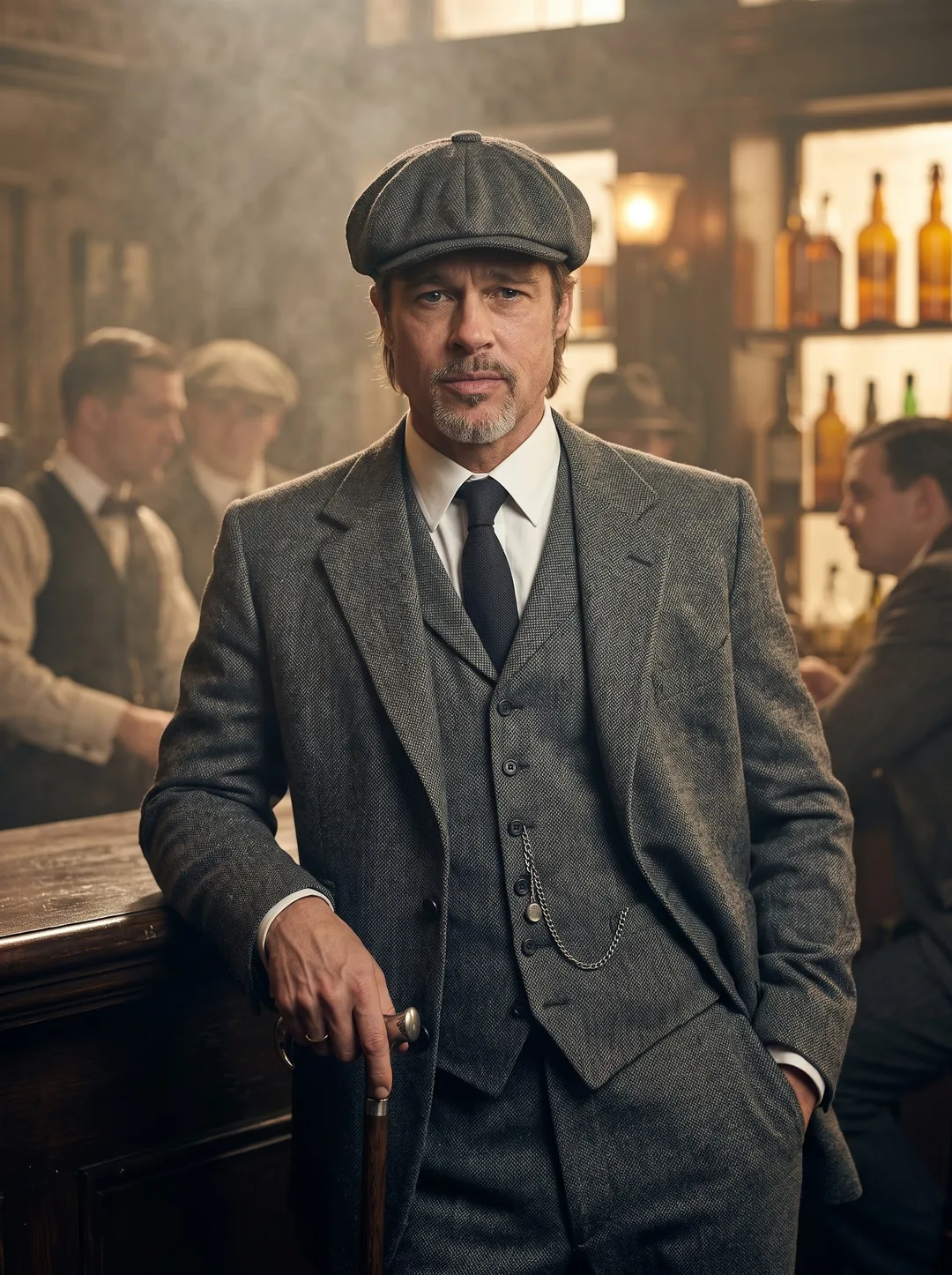
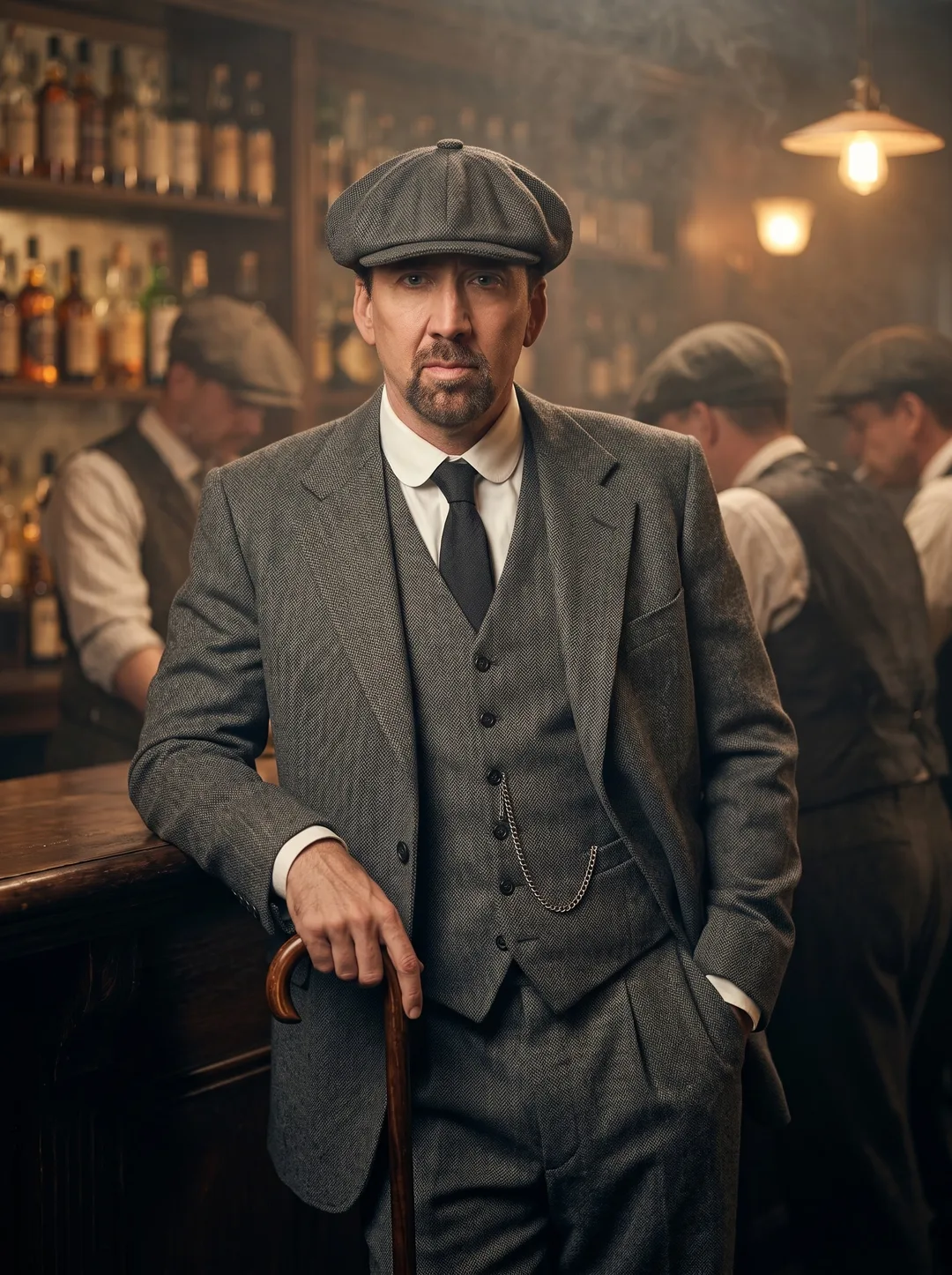
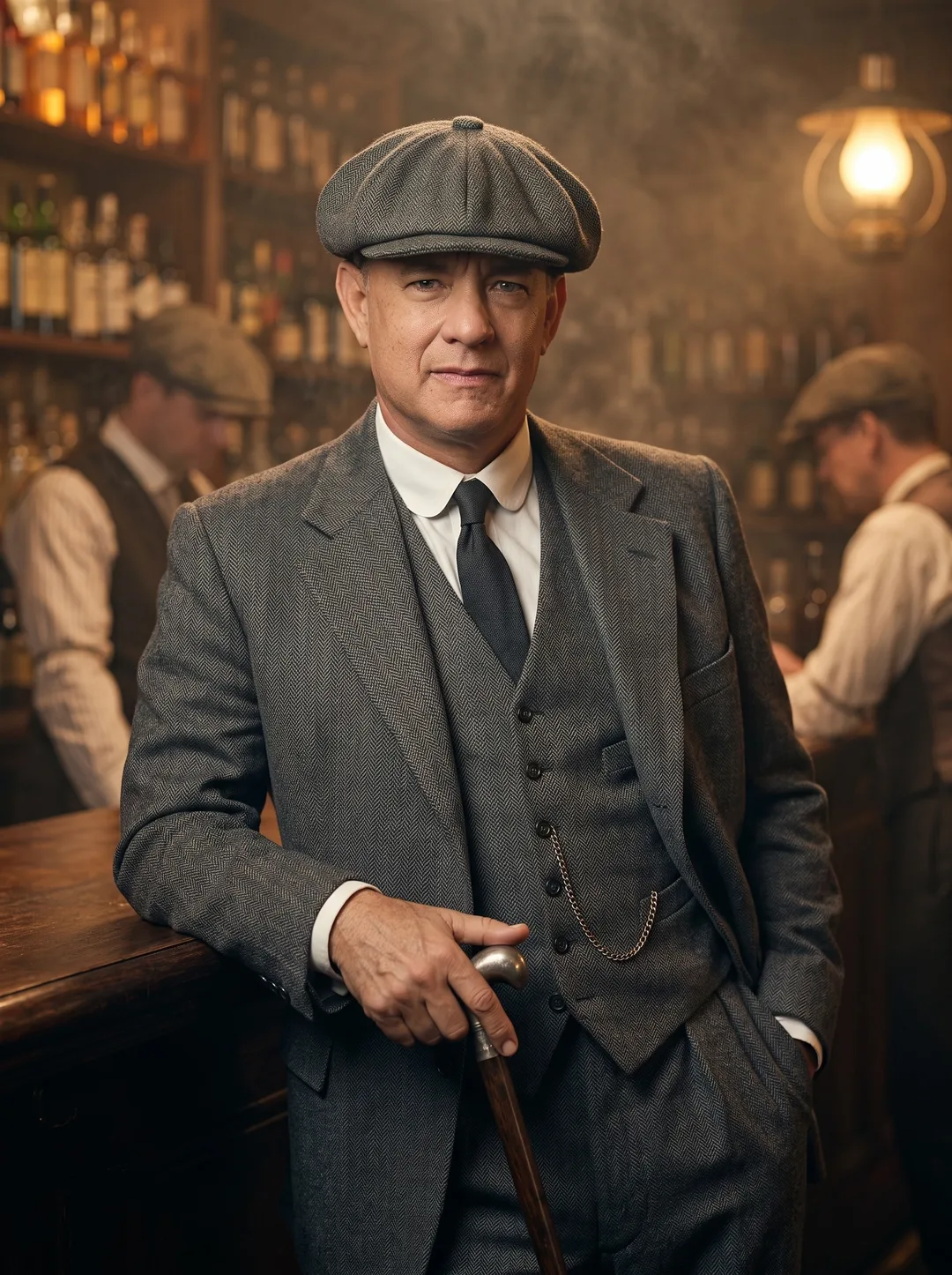
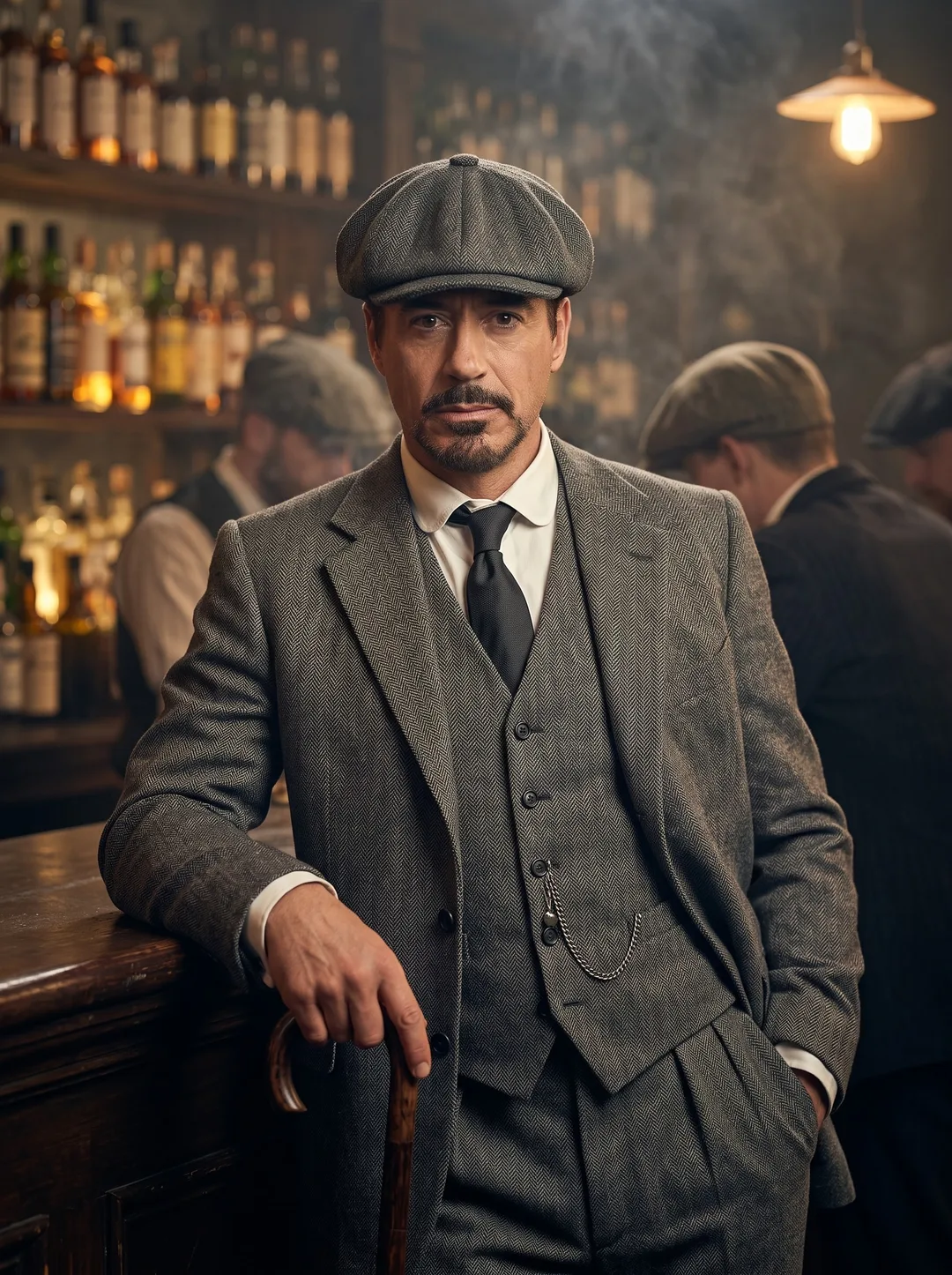
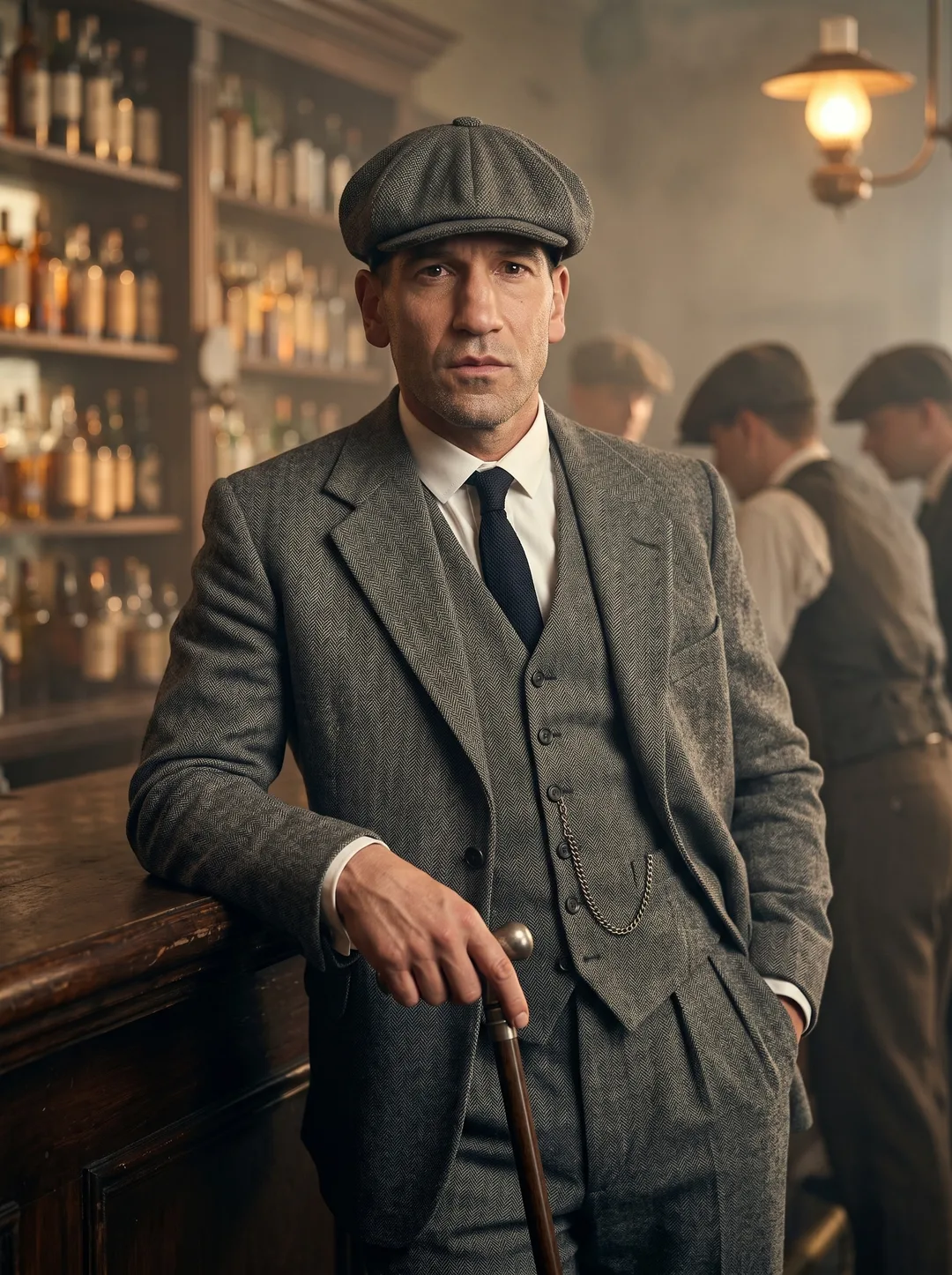
1920s Smoky Bar, Flat Cap & Tweed
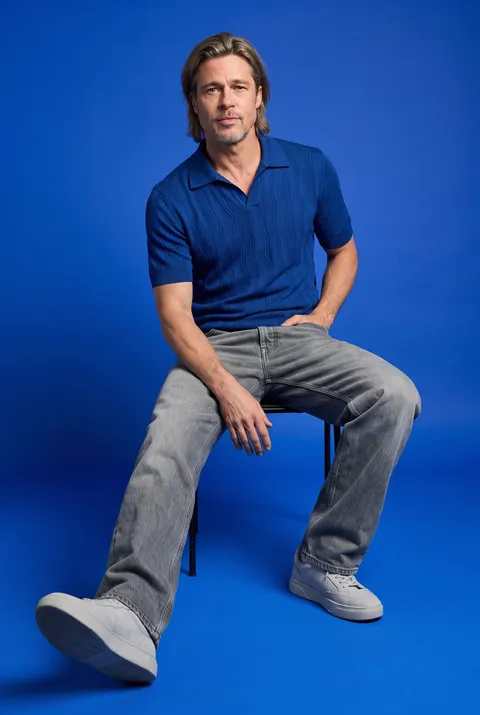
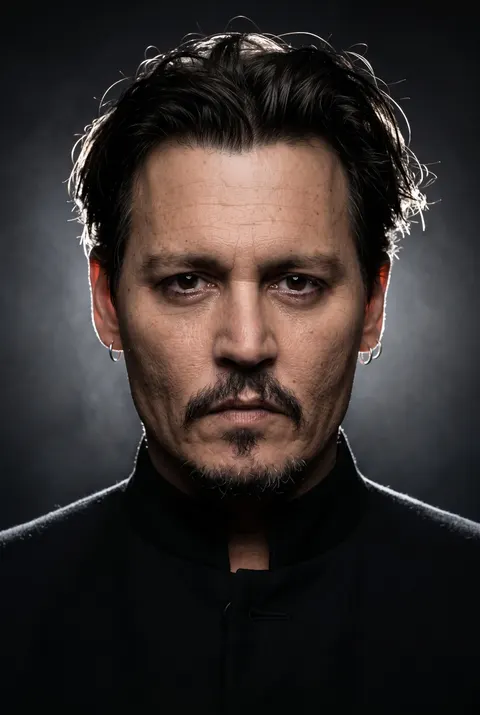
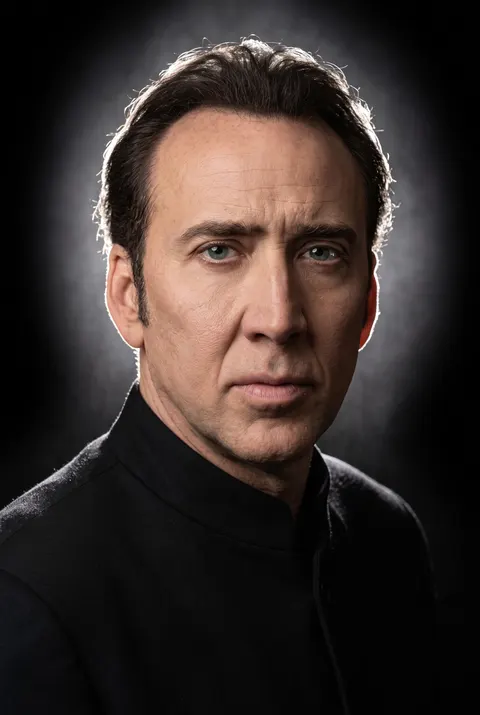
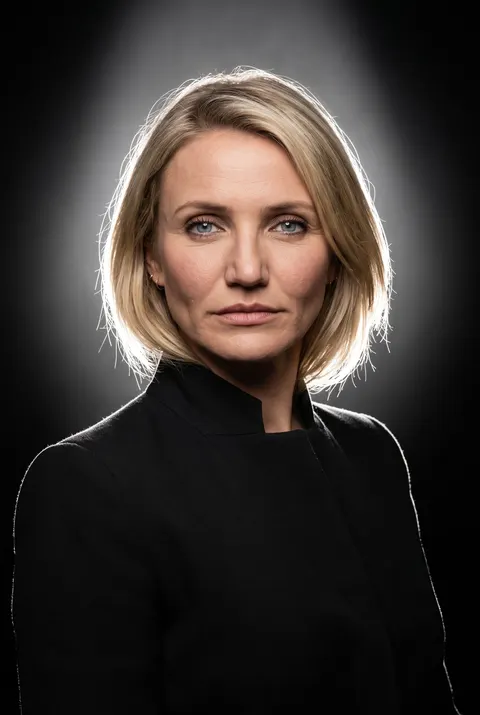
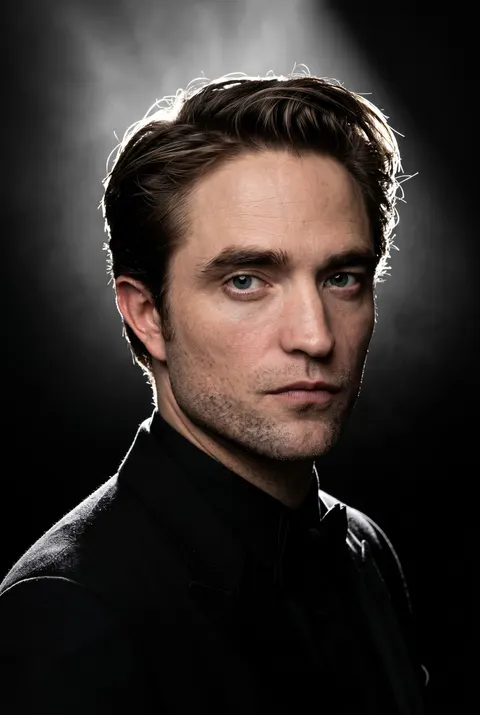
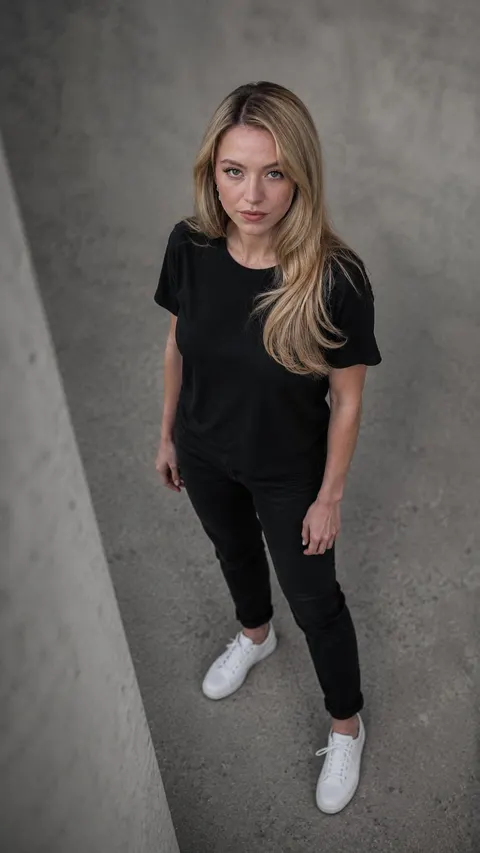
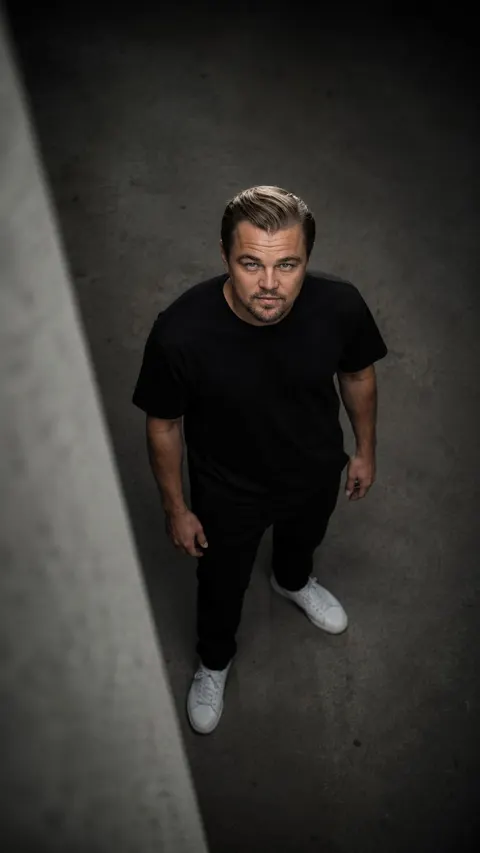
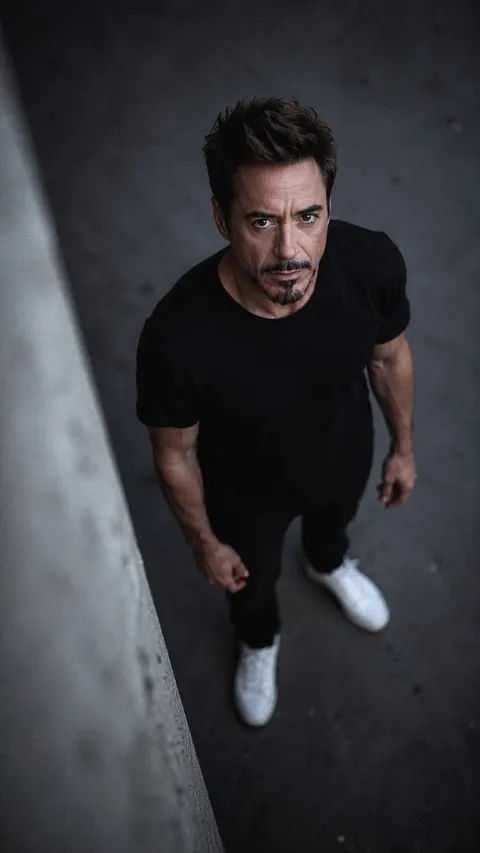
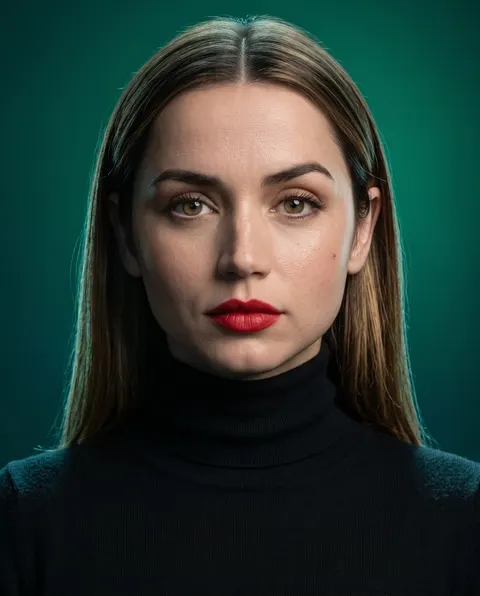
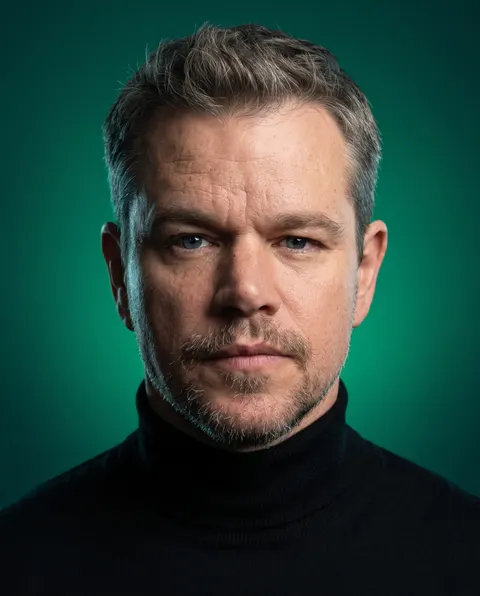
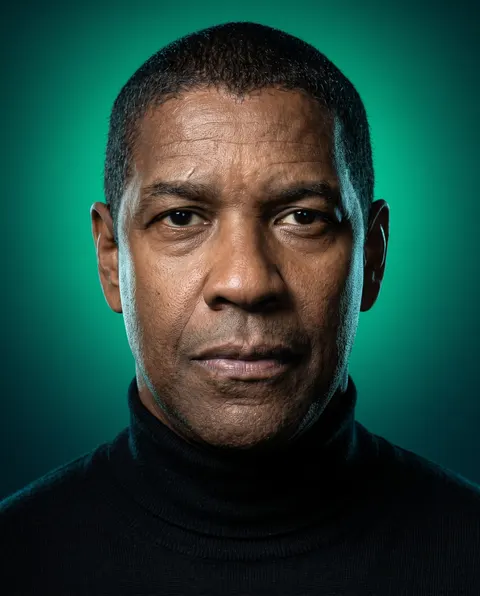
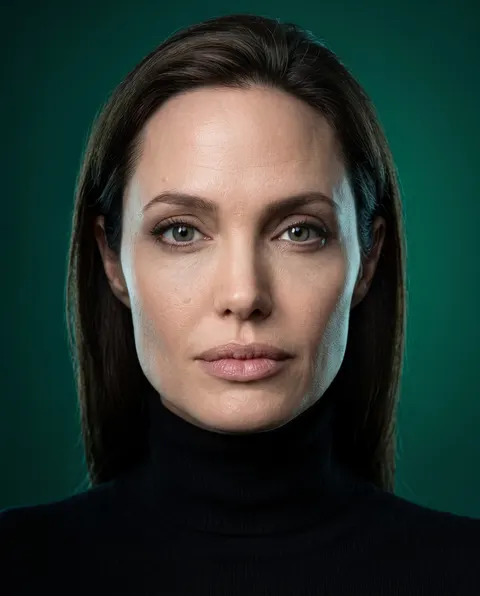
Cinematic period portrait prompt: smoky 1920s bar, grey tweed three-piece with watch chain, flat cap, cane in hand. Examples: Brad Pitt, Tom Hanks, Downey Jr.
Prompt
# LOCKED MASTER PROMPT — 1920s SMOKY BAR, FLAT CAP & THREE-PIECE TWEED, CANE IN HAND

## ROLE

You are a world-class cinematic portrait photographer recreating a 1920s working-class bar interior with warm tungsten practicals, haze and period tailoring — and a stylist who dresses one sitter in a flat cap and a three-piece suit.

Create a premium, photorealistic half-body portrait using the **ATTACHED REFERENCE IMAGE as the identity source**.

The defining idea of this image: the subject **leans against a dark wooden bar**, one elbow on the counter, one hand resting on the head of a **walking cane**, the other in a trouser pocket — in a **grey tweed three-piece suit** with a **waistcoat, watch chain, white shirt, dark tie** and a **grey newsboy flat cap** pulled low. **Head slightly down, eyes up**, locked on the lens. Behind: **shelves of amber bottles**, blurred patrons in caps, **smoke in the air**, one warm lamp glowing. Moody, warm, period, sharp.

The output must look like a real cinematic still captured on a high-end full-frame camera — NOT like an AI-generated image, a 3D render, a costume-party snapshot, a screenshot from a television series, or a period-filter photo.

Aspect ratio: **3:4 vertical.**
Resolution target: **8K.**

---

# 1. IDENTITY LOCK — ABSOLUTE PRIORITY

Use the person from the **ATTACHED REFERENCE IMAGE**.
Preserve identity with maximum fidelity.
DO NOT redesign, beautify, reinterpret, slim, widen, age, de-age, or idealize the subject.

**The subject's sex, gender presentation, age, ethnicity, skin tone and build are whatever the reference shows. Nothing in this prompt overrides the reference on any of these. The cap, the suit, the cane and the pose are a period styling choice applied to whoever the reference shows — they do not imply, require or alter the subject's gender. No actor, character or public figure is to be resembled.**

Preserve exactly:

* Facial geometry and skull proportions
* Face shape and width-to-height ratio
* Forehead height and hairline shape — the cap's brim sits above it; whatever hair shows beneath the cap is the reference's
* Brow ridge projection
* Eyebrow shape, thickness, density and spacing
* Eye shape, size, spacing, lid structure, iris colour and lashes
* Nose bridge, tip and nostril structure
* Cheekbone height and projection
* Jawline definition and angle
* Chin shape and projection
* Lip shape, thickness, proportions and natural colour
* Ear size, shape, position and attachment — visible below the cap's sides
* Natural facial asymmetry
* Skin tone and undertone
* Natural skin texture, pores, freckles, lines and surface irregularity
* Neck thickness, shoulder width, torso, arm and hand proportions — **the leaning body is the reference's body**
* Hand size, finger length, knuckle structure and nail shape — the cane hand is visible
* Apparent age
* Any moles, scars or distinguishing marks

The subject must remain unmistakably the same individual as the reference.

### HAIR — CONDITIONAL
Preserve the reference hairstyle where it shows beneath the cap: the same colour, texture and any greying at the temples, the sides and the nape. The cap covers the crown; it does not change what the reference has. Do NOT recolour or restyle.

### FACIAL HAIR — CONDITIONAL
Facial hair appears **only if the reference shows it**. If present, preserve its exact length, density, colour and cheek line. If absent, add none — the face is clean.

### NO MAKEUP, NO "PERIOD FACE"
Do NOT add any cosmetic, scar, weathering, grime or texture the reference does not show. The 1920s live in the clothing, the bar and the light — not on the face.

**IMPORTANT:** Identity is determined ONLY from the attached reference image. Do not borrow facial characteristics from any actor, character, celebrity, model, example image, or visual reference.

---

# 2. CAMERA POSITION & ORIENTATION LOCK

### Camera
Eye level to **5 degrees below** the subject's eye line — the lowered head is met by a lens slightly beneath it, so the eyes-up gaze reads with full force.
The lens axis is horizontal or angled marginally upward.

### Subject orientation
* The torso is rotated approximately **20–30 degrees** toward the bar side — this document uses **camera-left** as the bar side — the leaning elbow on that side
* The head turns back toward the lens: rotated no more than **10 degrees**
* **Head slightly down**: the chin lowered approximately **8–14 degrees**, the cap's brim dipping toward the lens
* Lateral head tilt no more than **4 degrees**

Do NOT shoot from above eye level.
Do NOT drop into a strong low angle.
Do NOT tilt the camera (no dutch angle).
Do NOT square the torso flat to the lens.
Do NOT turn the head into a three-quarter or profile position.
Do NOT lift the chin — the head is down, the eyes are up.
Do NOT introduce wide-angle distortion.

---

# 3. FRAMING LOCK — CRITICAL

A **half-body portrait**, from above the cap to the hip.

Show:

* The whole cap, with space above it
* The full face beneath the brim
* The shirt collar, the tie and the tie knot
* The jacket lapels, the waistcoat with its buttons and the watch chain
* Both arms: the leaning arm with its elbow on the bar, the forearm and the hand on the cane's head; the other arm with the hand in the trouser pocket
* The top of the cane, its handle and the upper shaft
* The bar counter's edge running across the frame beneath the leaning elbow
* The trousers to approximately the hip and upper thigh at the lower edge
* The bar's back shelves, bottles, patrons and haze behind

The head (top of the cap to chin) occupies approximately **19–24% of the total frame height**.
The eye line sits approximately **28–33% down from the top of the frame**.
The chin sits at approximately **39–43%** down from the top.
The bar counter's top edge crosses the frame at approximately **72–78%** down.
The cane's head sits at approximately **80–86%** down, near the leaning hand.
The shoulders span approximately **62–72% of the frame width**.

### HEADROOM LOCK
Leave approximately **10–14% of the total frame height** above the top of the cap, filled by the back-bar shelves and the haze.
The cap must be fully inside the frame and must NOT be clipped by the upper edge.

### CROP LOCK
Do NOT crop the cap.
Do NOT crop the cane hand or the cane's head.
Do NOT crop above the hip — the pocketed hand and the waistcoat's hem must read.
Do NOT extend to a full-body composition showing the legs and shoes.
Do NOT tighten into a chest-up composition.

---

# 4. SUBJECT POSITION

Place the head at approximately **46–52% of frame width**, near centre, marginally toward the side away from the bar.
The leaning elbow and the bar counter occupy the lower-left; the cane rises to the leaning hand at the lower-left-of-centre.
The back-bar shelves fill the background on both sides; the brightest bottles and the lamp sit to the upper-right, balancing the bar at the lower-left.

Do NOT centre the figure symmetrically.
Do NOT place the bar counter on the right.

---

# 5. POSE LOCK — LEANING ON THE BAR WITH A CANE — CRITICAL

### THE LEAN
* Standing beside the bar, the body **leaning casually** onto it: the **bar-side elbow planted on the counter**, taking weight, the shoulder on that side dropped
* The hip angled toward the bar, the stance loose and unhurried

### THE CANE HAND
* The **bar-side forearm** descends from the planted elbow toward the counter's edge; the **hand rests on the head of a walking cane** — the palm over the cane's curved or knobbed handle, fingers relaxed around it
* The cane's shaft **angles down and away** from the hand, toward the floor, exiting the lower edge of the frame
* The hand is relaxed — holding, not gripping

### THE POCKET HAND
* The **other hand is in the trouser pocket** on its own side, the arm hanging naturally, the elbow slightly out; the wrist and the shirt cuff visible at the pocket's edge

### THE HEAD
* Lowered slightly, the cap's brim dipping; the eyes raised to the lens beneath it

The read is **casual, assured, watchful** — a person at home in this bar.

Do NOT stand upright away from the bar.
Do NOT sit on a stool or rest both arms on the counter.
Do NOT hold the cane upright in front of the body, across the body, or in both hands.
Do NOT lean on the cane as a support.
Do NOT swap the hands — cane hand on the bar side, pocket hand on the other.
Do NOT raise a hand to the cap, the face, the tie or the chest.
Do NOT render a stiff, symmetrical or military posture.

---

# 6. GAZE & EXPRESSION — HEAD DOWN, EYES UP — CRITICAL

* The head is **lowered**; the **eyes are raised** beneath the cap's brim to look **directly into the lens** — the gaze coming up from under the brow
* Both eyes fully open, steady, **locked** on the camera, each carrying a small, warm catchlight from the bar's light
* The brim casts a **soft shadow across the brow and the upper part of the eye sockets**; the eyes read clearly within it

Expression:

* **Intense, confident, still**
* Level and unblinking — a held stare, not a glare
* Brow lowered very slightly by the upward look
* Lips **closed and relaxed**, neutral, with a faint firmness at the corners
* Jaw settled

Do NOT lift the head to look at the camera straight on.
Do NOT let the brim shadow hide the eyes — they must read.
Do NOT smile, smirk or show teeth.
Do NOT produce a scowl, snarl, squint or theatrical menace.
Do NOT produce a soft, warm, friendly or vacant look.
Do NOT direct the gaze away from the lens.

---

# 7. WARDROBE & ACCESSORY LOCK — 1920s THREE-PIECE — CRITICAL

Every garment is **cut to the reference person's build**, in heavy 1920s working-class tailoring.

### Flat cap
* A **grey tweed newsboy / eight-panel flat cap** with a **short stiff brim**, worn **low** — the brim sitting just above the brows, its edge shading the upper face
* Mid-to-dark grey herringbone or plain tweed, matching or close to the suit's cloth
* Full-crowned, the panels soft, the brim's edge crisp

### Jacket
* A **grey tweed suit jacket** — mid-to-dark grey herringbone, approximately **#4A4A48 to #5A5A58** in the mid-tones, the herringbone visible as a fine chevron texture in the light
* **Wide notch lapels** of the period, high-buttoning, the front worn **open** to show the waistcoat
* Structured but soft shoulders, the sleeves showing a little shirt cuff

### Waistcoat
* A **matching grey tweed waistcoat**, high-cut, **six buttons**, all fastened but the lowest, with a **watch pocket** on the left of the chest
* A **silver watch chain** looping from a waistcoat button to the watch pocket — the chain visible against the tweed, catching small warm glints

### Shirt and tie
* A **white cotton shirt** with a **rounded club collar or a small point collar** of the period, pressed, the collar sitting close to the neck
* A **dark tie** — black or very deep charcoal, plain silk or a fine texture — in a **neat, small knot**, tucked into the waistcoat

### Trousers
* **Matching grey tweed trousers**, high-waisted beneath the waistcoat, pleated, a pocket for the hand

### Cane
* A **vintage walking cane**: a dark wood shaft — walnut or ebony tone — with a **curved crook or a rounded metal or horn knob** for the handle; worn, polished, real

Do NOT use a modern suit, a slim cut, narrow lapels or a two-piece.
Do NOT use a black, navy, brown, blue or coloured suit — it is grey tweed.
Do NOT use a smooth, flat or non-tweed fabric — the herringbone must read.
Do NOT close the jacket or omit the waistcoat.
Do NOT use a modern spread collar, a coloured shirt or a bow tie.
Do NOT omit the watch chain or render it gold.
Do NOT use a baseball cap, a beanie, a fedora, a bowler or a bare head — a flat cap, worn low.
Do NOT omit the cane, or render an umbrella, a stick, a sword-cane or a modern walking aid.
Do NOT add a pocket square, lapel pin, ring, wristwatch, glasses or accessory unless present in the identity reference.
Do NOT add a razor blade, a weapon or any prop beyond the cane.

---

# 8. ENVIRONMENT LOCK — 1920s BAR, SMOKY — CRITICAL

A **period bar interior**, dark wood and amber glass, dissolved by haze and shallow focus.

### THE BAR COUNTER
* A **dark, heavy wooden bar** — walnut or mahogany tone, worn, with a rounded top edge — running across the lower-left of the frame beneath the leaning elbow, receding to the right
* Its surface catching a warm reflection of the bottles and the lamp; a few small rings and marks of use

### THE BACK BAR
* Behind the subject, **floor-to-ceiling wooden shelves** lined with **bottles** — whisky, spirits — in amber, brown and clear glass, their labels pale and unreadable, their contents glowing where the light passes through
* The shelves' horizontals run across the upper frame behind the cap; the bottles densest at the upper-left and along the right
* All **heavily out of focus** — the bottles as soft glowing shapes, the shelf edges as soft dark lines

### THE PATRONS
* **Two to four other figures** at the bar behind and beside the subject — men in period caps, waistcoats and shirtsleeves — **blurred past recognition**, turned away or in profile, **no readable faces**, no eye contact with the camera; dark shapes with a few warm highlights on a cap's brim or a shoulder
* They are set dressing: crowd, depth, period — never a second subject

### THE LAMP AND THE HAZE
* One **warm practical lamp** — a bare bulb or a small shaded fixture — glowing at the **upper-right**, rendered as a soft warm bloom with a small bright core
* **Tobacco smoke / haze** hangs in the air throughout the room: thin, even, warm-tinted, catching the lamp's light as a soft glow and lowering the contrast of everything at distance

NO readable labels, brand names, signage, text or numbers anywhere.
NO modern objects — no screens, phones, taps, neon, plastic.
NO patron with a readable face, or looking at the camera.
NO patron in modern clothing.
NO weapons, blades, cigarettes in the subject's hand, or drinks held by the subject.
NO text, typography, logos, watermarks, borders or graphic elements.

---

# 9. LIGHTING LOCK — WARM AMBIENT, MOODY — CRITICAL

**Warm tungsten ambient light** from the bar's practicals, with one dominant direction on the face.

### KEY — warm, front-side, soft
The dominant light on the subject comes from **camera-left front**, approximately **35–50 degrees** off the lens axis and **20–30 degrees above** eye level — a warm lamp or window out of frame, softened by the haze.

* Colour: **warm tungsten**, approximately **2600–3000 K** — deep amber-gold
* Quality: **soft but directional** — the haze diffuses it; shadows are present with soft edges

It produces:

* Warm light on the camera-left side of the face — cheekbone, nose bridge, jaw — and across the front of the tweed, revealing the herringbone
* The **cap's brim shadow** across the brow and upper eye sockets; a soft nose shadow toward the far cheek; a shadowed far side of the face, warm and readable
* Small warm catchlights in both eyes
* Warm highlights on the shirt collar, the tie knot's silk, the watch chain and the cane's handle
* Texture raked across the tweed of the cap, the jacket and the waistcoat

### FILL
Warm bounce from the bar, the bottles and the haze: key-to-fill approximately **3:1 to 4:1**. The far side of the face and the shadowed clothing retain full detail.

### BACKGROUND LIGHT
The **lamp at the upper-right** and the glow through the bottles light the back bar warmly; the haze carries that glow across the room. A faint warm edge from the lamp touches the subject's far shoulder and the cap's right side.

Do NOT use cool, white, daylight or neutral light.
Do NOT use flat, on-axis or ring-light illumination.
Do NOT use a hard studio source with sharp shadows.
Do NOT let the brim shadow swallow the eyes.
Do NOT lift the fill until the mood flattens.
Do NOT crush the far side of the face or the dark tweed to black.
Do NOT add a cool rim, a blue kicker or any non-warm source.

---

# 10. LIGHTING DIRECTION LOCK

The lighting setup must remain **identical across every generation**, regardless of changes in the reference person's gender, age, skin tone, hairstyle, or build.

The identity changes.
The **lighting does NOT change.**
Key side, angle, height, warmth and softness; fill ratio; the lamp's position; the haze — all stay fixed.
Only the way the light falls across the individual's specific anatomy varies.

---

# 11. EXPOSURE & TONAL BALANCE LOCK

A **warm, moody, low-to-mid-key image** with glowing amber accents.

Approximate distribution of the frame:

* Dark bar, dark tweed and dark shadows: **38–48%**
* Warm back-bar bottles, shelves and haze glow: **22–30%**
* Lit skin — face and hand: **6–9%**
* White shirt collar and cuff: **2–4%**
* Blurred patrons: **8–14%**
* Lamp bloom and bottle highlights: **2–4%**

Behavior:

* The face is correctly exposed in warm mid-tones, brighter on the key side, shadowed on the far side — the brightest skin on the cheekbone and nose bridge, unclipped
* The **white collar** is the brightest large surface on the subject, warm-white, just below clipping
* The **lamp core** and the brightest bottle highlights are the brightest points in the frame
* The grey tweed reads as deep warm grey with herringbone visible in the lit areas, falling to near-black in the shadows
* The back bar glows amber, softer and lower in contrast than the subject through the haze
* Blacks are deep but veiled by the haze — not absolute

Do NOT overexpose the face or the collar.
Do NOT crush the tweed or the bar to featureless black.
Do NOT brighten the background until it competes with the face.
Do NOT flatten the image into an evenly lit, low-contrast result.
Do NOT push into harsh, crushed drama.

---

# 12. CAMERA LOOK — 85mm f/1.4

Cinematic portraiture on a full-frame system.

Focal length: **85mm**.
Aperture: **f/1.4** — very shallow.

Focus:

* Critical focus on the **eyes** beneath the brim
* The face, the cap's brim edge, the collar, the tie knot and the lapels sharp
* The watch chain and the waistcoat buttons sharp
* The cane hand, slightly forward of the face, marginally softer but clearly resolved; the cane's handle readable
* The pocket hand and the far shoulder softening
* The bar counter's near edge soft; its far run dissolving
* The back bar, the bottles, the patrons and the lamp **fully out of focus** — smooth, warm, creamy bokeh with **round, soft-edged discs** on the bottle highlights and the lamp

### RENDERING CHARACTER
* Smooth, gentle defocus; a gradual transition from the sharp face outward
* Mild natural vignetting from the wide-open lens

Do NOT stop down — the background must dissolve.
Do NOT render the bottles, labels, shelves or patrons sharp.
Do NOT render busy, nervous, onion-ring or double-line bokeh.
Do NOT introduce lens flare from the lamp, chromatic aberration or a heavy applied vignette.

---

# 13. IMAGE QUALITY — FABRIC AND FACE

Photorealistic at 8K.
Ultra-detailed natural skin: pores across the forehead, nose and cheeks; fine lines and natural irregularity as the reference carries them; a faint sheen on the nose bridge and cheekbone under the warm light; the brim's soft shadow with texture visible inside it.
Individually resolvable hair where it shows beneath the cap; facial hair, where present, as discrete hairs.
**Fabric textures highlighted**: the tweed's herringbone chevron resolved on the cap, the lapels, the jacket front and the waistcoat; the cotton weave of the shirt collar; the silk of the tie; the woven watch chain links; the wood grain and polish of the cane's handle.
The cane hand with knuckle creases, tendons and natural nails.
The bar's wood grain and wear, soft with defocus.
The haze rendered as thin, even atmospheric density — a warm veil, not fog.
Physically believable soft shadows — brim, nose, chin, under the lapels.
Natural highlight roll-off; fine, organic grain at low-to-moderate intensity, slightly more visible in the shadows and the haze.

No plastic, waxy or airbrushed skin.
No skin smoothing or blemish removal.
No added weathering, dirt, scars or "period grit" on the face.
No excessive sharpening or edge halos.
No artificial HDR appearance.
No beauty-filter effect.
No CGI, 3D-render or video-game surface quality.
No sepia, "old photo" or vintage-filter artefacts — dust, scratches, fading, frame borders.

---

# 14. COLOUR GRADING

A **warm, amber, cinematic period grade**.

Palette:

* Light: warm tungsten amber
* Skin: **natural and accurate to the reference**, warmed by the tungsten — glowing, not orange
* Tweed: warm mid-to-dark grey, herringbone in two close greys
* Shirt: warm white; tie: near-black
* Bottles and back bar: amber, gold, brown, deep wood
* Haze: warm, low-saturation veil
* Blacks: deep, warm, slightly veiled

Tonal structure:

* Moderate saturation — the amber rich, the greys quiet
* Moderate-to-strong contrast, softened at distance by the haze
* Warm white balance throughout — no cool tones anywhere in the frame

Do NOT push the skin toward orange, red or bronze.
Do NOT let the amber flood the skin's own tone.
Do NOT introduce any cool colour — no blue, teal, cyan, green.
Do NOT apply a teal-orange, split-tone, sepia or heavy vintage look.
Do NOT desaturate toward monochrome.
Do NOT lift the blacks into a faded, matte look.
Do NOT allow banding in the bokeh or the haze.

---

# 15. VISUAL HIERARCHY

**The eyes, raised beneath the brim → The face, warm and shadowed, head down → The tie knot, the collar and the watch chain → The tweed's texture on the lapels and cap → The cane hand and the cane's handle → The bar counter under the elbow → The amber glow of the bottles, the lamp and the blurred patrons behind**

The upturned stare beneath the brim is the image.
The tailoring is the period.
The bar is the world, and the haze is its air.

---

# 16. NON-NEGOTIABLE RULES

These must NEVER change between generations:

1. Identity, sex, gender presentation, age, skin tone, build, hands and skin texture from the reference; styling applied to whoever the reference shows; no actor or character resembled.
2. Hair beneath the cap and facial hair from the reference; facial hair only if present. No makeup, weathering or "period face" added.
3. Camera at eye level to 5 degrees below.
4. Torso rotated 20–30 degrees toward the bar (camera-left); head within 10 degrees; chin lowered 8–14 degrees.
5. Eyes raised beneath the brim, locked on the lens; intense, confident, closed-mouth stare.
6. Half-body framing from above the cap to the hip; cap 19–24% of frame height; eye line at 28–33%; bar top at 72–78%.
7. 10–14% headroom above the cap; head at 46–52% of frame width; bar and cane at the lower-left.
8. Leaning on the bar: bar-side elbow planted on the counter, that hand resting on the cane's head, the cane angling down and out of frame; other hand in the trouser pocket.
9. Grey tweed newsboy flat cap worn low, brim just above the brows.
10. Grey herringbone tweed three-piece: open jacket with wide notch lapels, six-button waistcoat with a silver watch chain, matching high-waisted trousers.
11. White period-collar shirt; dark plain tie in a small knot.
12. Dark wood vintage cane with a crook or knob handle.
13. No pocket square, pin, ring, watch, glasses, weapon, cigarette, drink or prop beyond the cane, unless in the reference.
14. Dark wooden bar counter across the lower-left; floor-to-ceiling back-bar shelves of amber bottles, unreadable, out of focus.
15. Two to four blurred period patrons, faceless, not looking at the camera.
16. One warm practical lamp glowing at the upper-right; thin warm haze throughout.
17. Warm tungsten key from camera-left front, 35–50 degrees off axis, 20–30 degrees above, 2600–3000 K, soft-directional; fill 3:1–4:1; brim shadow on the brow with the eyes readable.
18. No cool, white or neutral light; no cool rim.
19. Face correctly exposed; collar the brightest surface on the subject; lamp and bottle highlights the brightest points; tweed with visible herringbone; blacks veiled by haze.
20. 85mm at f/1.4; eyes critical; cane hand marginally soft; background fully dissolved with round bokeh.
21. Herringbone, cotton, silk, chain and wood textures resolved; pores visible; no smoothing.
22. Warm amber grade; skin its own tone; no cool colour; no sepia or vintage artefacts.
23. No readable labels, text, logos, signage, watermarks or modern objects.
24. 3:4 vertical aspect ratio at 8K.

---

# 17. REFERENCE PRIORITY SYSTEM

### PRIORITY 1 — IDENTITY
Face, hair beneath the cap, facial hair, skin tone, skin texture, build, hands, age, sex, gender presentation and natural likeness from the reference.

### PRIORITY 2 — GAZE AND HEAD POSITION
The lowered head, the raised eyes beneath the brim, the locked stare.

### PRIORITY 3 — POSE
The lean on the bar, the hand on the cane's head, the hand in the pocket.

### PRIORITY 4 — WARDROBE AND CANE
The flat cap, the grey tweed three-piece, the watch chain, the white shirt and dark tie, the cane.

### PRIORITY 5 — ENVIRONMENT AND LIGHT
The dark bar, the amber back-bar, the blurred patrons, the lamp, the haze and the warm tungsten key.

### PRIORITY 6 — GRADE AND CAMERA
The warm amber grade and the 85mm f/1.4 look.

If the reference image conflicts with any of these instructions, **preserve identity, anatomy, hair, facial hair, skin, hands, build and natural likeness from the reference, and preserve the gaze, head position, pose, wardrobe, cane, environment, lighting, grade and camera specification from this prompt.**

---

# 18. NEGATIVE CONSTRAINTS

### Identity and likeness errors
Do NOT generate:

* A change in the subject's sex, gender presentation, age, ethnicity, skin tone or build from the reference
* A resemblance to any actor, television character or public figure associated with this period look
* A generic "gangster", "tough" or "period drama" face imposed over the reference
* Added scars, weathering, grime, stubble, moustache or beard not in the reference
* Removed facial hair the reference has
* Recoloured or restyled hair beneath the cap
* An aged, de-aged, beautified, slimmed, widened or hardened face
* A body build not matching the reference

### Gaze and head errors
Do NOT generate:

* A lifted head with a straight-on gaze
* A chin lowered beyond 14 degrees or not lowered at all
* Eyes hidden or swallowed by the brim's shadow
* A gaze away from the lens
* A smile, smirk or visible teeth
* A scowl, snarl, squint or theatrical menace
* A soft, warm, friendly or vacant look
* A three-quarter or profile head position

### Pose errors
Do NOT generate:

* A subject standing upright away from the bar
* A subject seated on a stool, or with both arms on the counter
* A cane held upright in front, across the body, in both hands, or used as a support
* Hands swapped — the cane hand is on the bar side
* A hand at the cap, face, tie or chest
* A cigarette, glass, bottle, blade or weapon in either hand
* A stiff, symmetrical or military posture
* Extra, missing, fused or bent-backward fingers; a hand scaled wrongly

### Wardrobe and cane errors
Do NOT generate:

* A modern, slim, narrow-lapel or two-piece suit
* A black, navy, brown, blue or coloured suit
* A smooth, flat or non-tweed fabric without herringbone
* A closed jacket or a missing waistcoat
* A missing or gold watch chain
* A modern spread collar, a coloured shirt or a bow tie
* A baseball cap, beanie, fedora, bowler or bare head
* A cap worn high, tilted back or with the brim above the forehead
* A missing cane; an umbrella, stick, sword-cane or modern walking aid
* A pocket square, lapel pin, ring, wristwatch or glasses not in the reference

### Environment errors
Do NOT generate:

* Readable labels, brand names, signage, text or numbers
* Sharp bottles, shelves, labels or patrons
* A patron with a readable face, looking at the camera, or in modern clothing
* More than four patrons, or a crowd that competes with the subject
* Modern objects — screens, phones, beer taps, neon, plastic
* A bright, clean, daylight or modern bar
* A bar counter on the right, or no bar counter
* No lamp, or multiple bright lamps
* Thick fog, smoke clouds or visible smoke plumes — the haze is thin and even
* No haze at all — a clear, crisp room
* Text, typography, logos, watermarks, borders or graphic elements

### Lighting, exposure and grade errors
Do NOT generate:

* Cool, white, daylight or neutral light
* Flat, on-axis or ring-light illumination
* A hard studio source with sharp shadows
* A cool rim, blue kicker or any non-warm source
* Fill lifted until the mood flattens
* A far side of the face or tweed crushed to black
* An overexposed face or collar
* A background brighter than the face
* An evenly lit, low-contrast result; a harsh crushed result
* Orange, red or bronze skin; amber flooding the skin's tone
* Any cool colour — blue, teal, cyan, green
* A teal-orange, split-tone, sepia or heavy vintage look
* A desaturated or monochrome image
* Lifted, faded or matte blacks; banding

### Camera and rendering errors
Do NOT generate:

* A stopped-down image with a sharp background
* Busy, nervous, onion-ring or double-line bokeh
* Lens flare from the lamp; chromatic aberration; a heavy applied vignette
* A high or strong low camera angle; a dutch angle
* A chest-up or full-body crop; a cropped cap, cane hand or cane head
* Wide-angle distortion
* Plastic, waxy or airbrushed skin; beauty-filter effects
* Over-sharpening, halos, HDR look, heavy noise
* Dust, scratches, fading, frame borders or "old photo" artefacts
* Asymmetrical or misaligned eyes from generation error; mismatched or missing catchlights
* Deformed ears; distorted teeth; melted hair
* CGI, 3D render, video-game, illustration or painting look

---

# FINAL INSTRUCTION

Create the image as if the **same photographer, same smoky 1920s bar, same dark counter and amber back-bar, same lamp and haze, same warm tungsten key, same camera and 85mm f/1.4 lens, same grey tweed three-piece, flat cap, white shirt, dark tie, watch chain and cane, same lean on the bar with the hand on the cane and the other in the pocket, same head-down eyes-up stare, same framing and same warm amber grade** photographed a completely different person — whoever the reference shows.

Only the **identity of the subject** should change. The cap sits on whoever's head it is given.

The result must belong to a single, consistent cinematic portrait series — not a set of unrelated AI generations.

**IDENTITY CHANGES. EVERYTHING ELSE STAYS LOCKED.**
Prompt copied — just paste it (Ctrl/Cmd+V) in the chat.