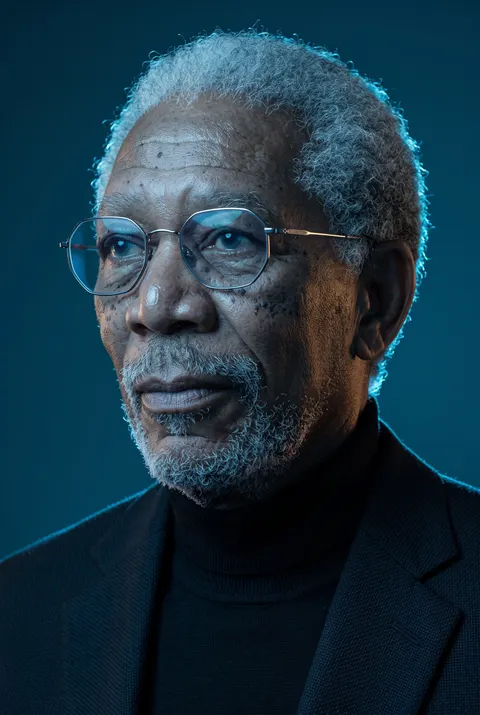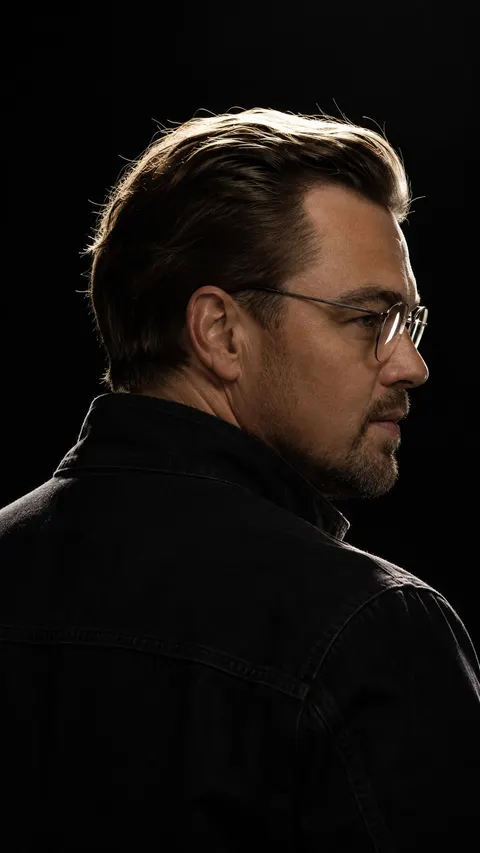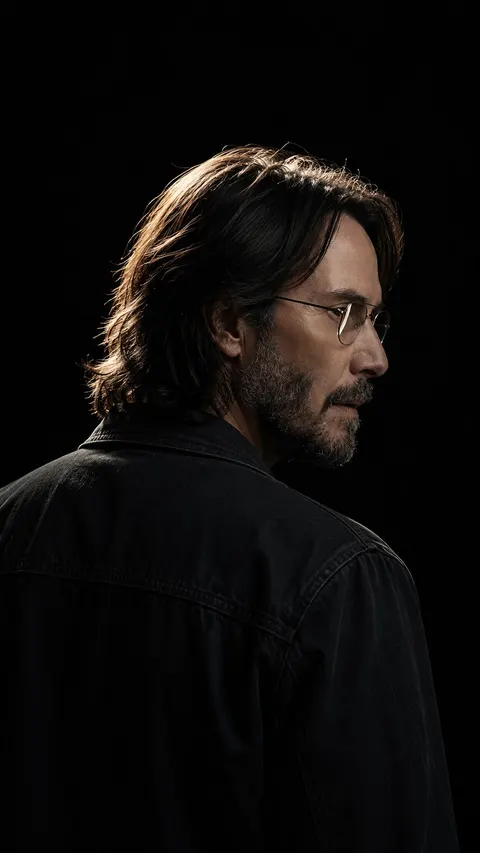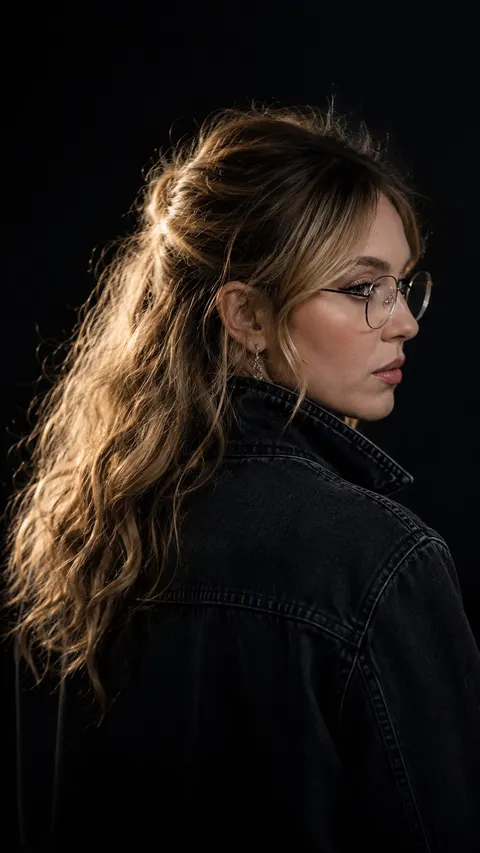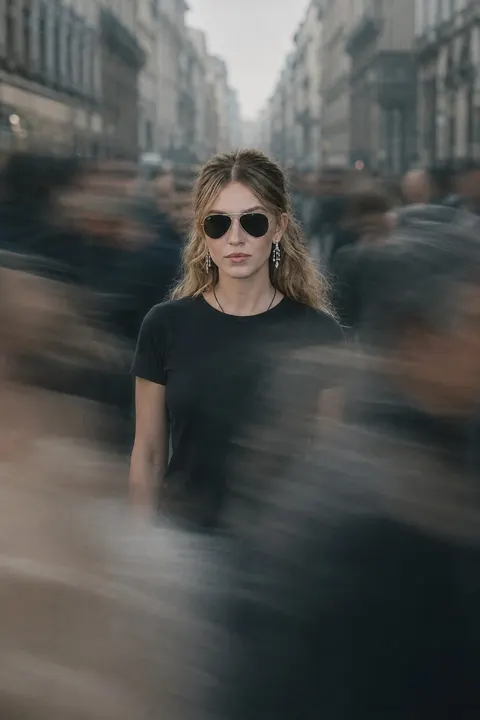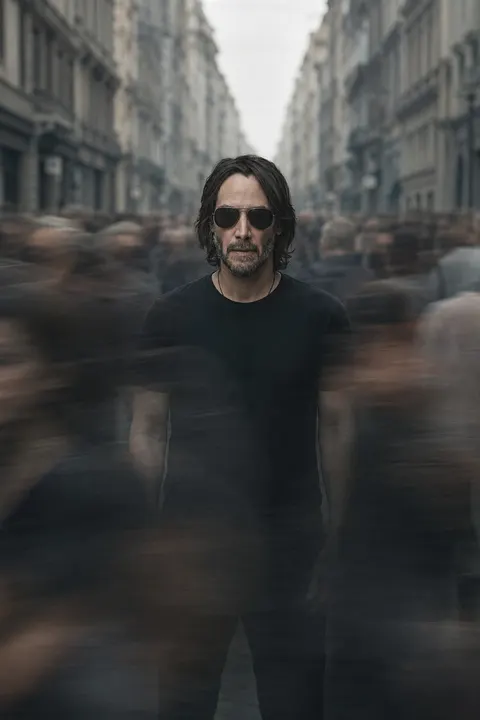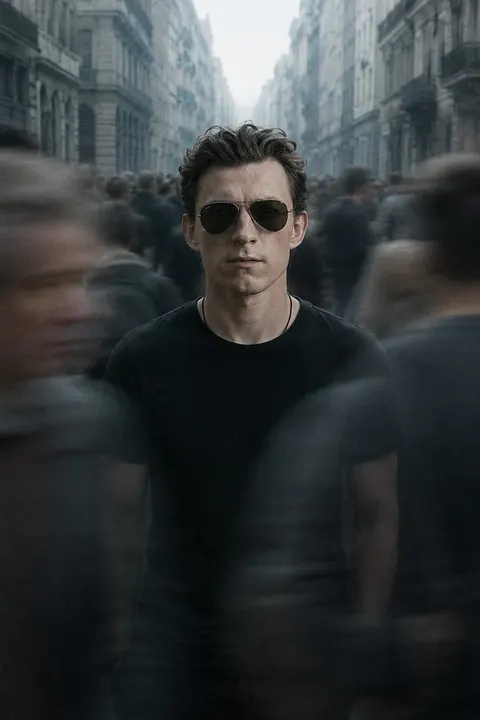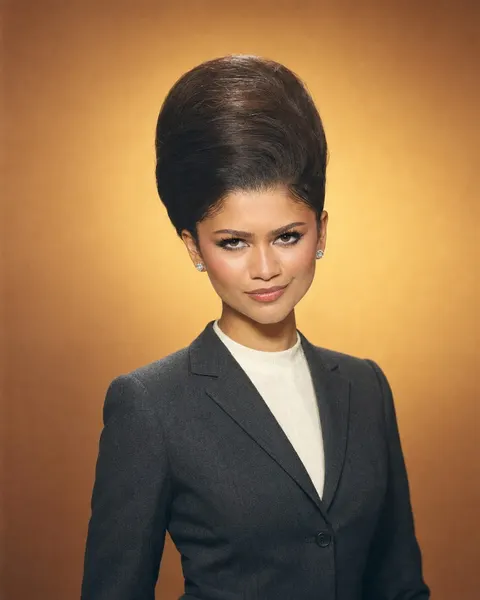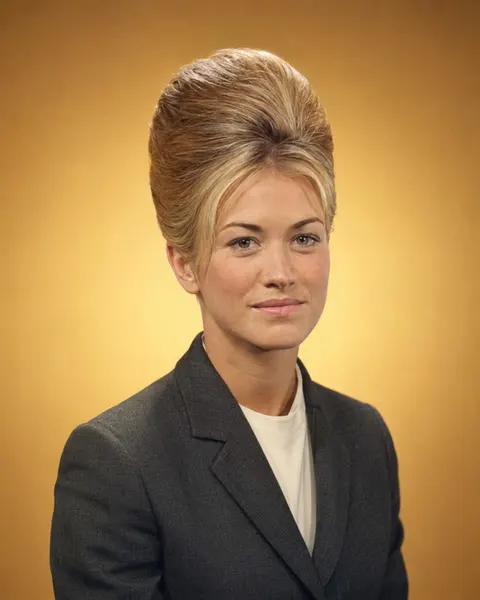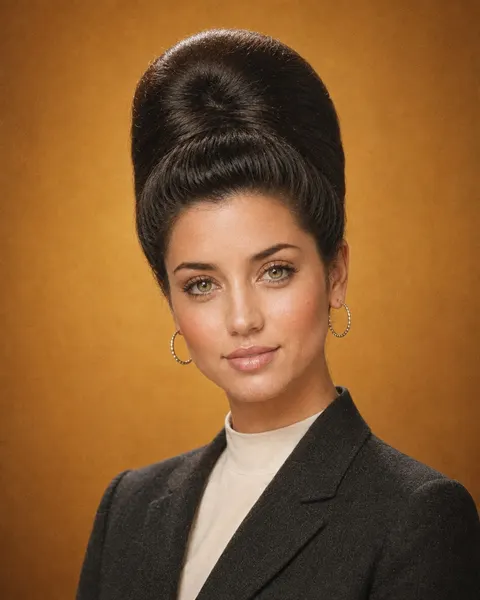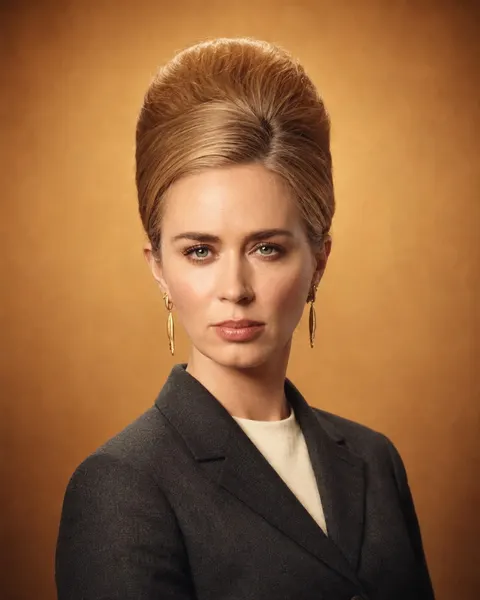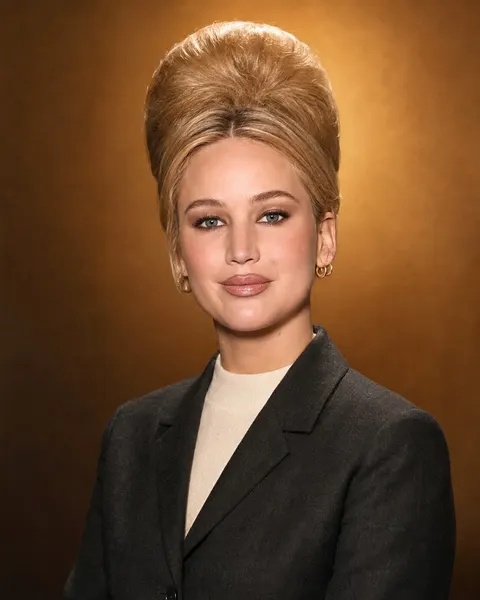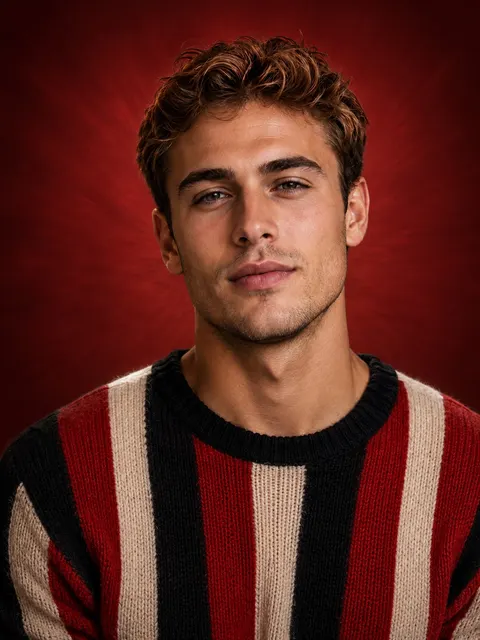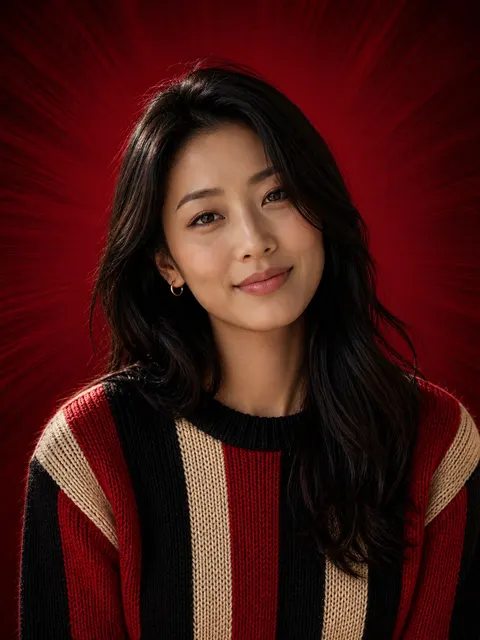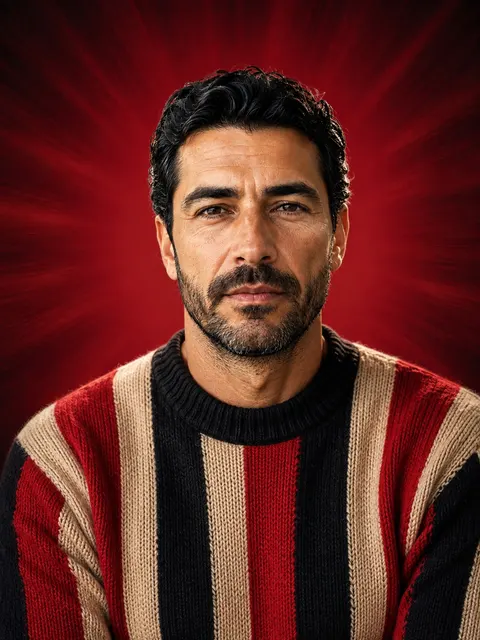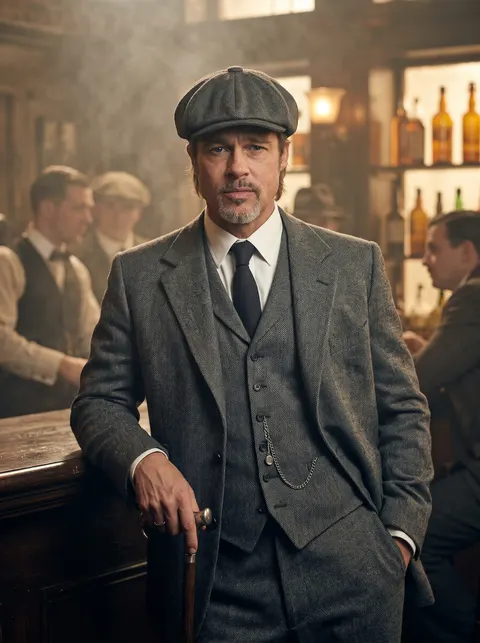

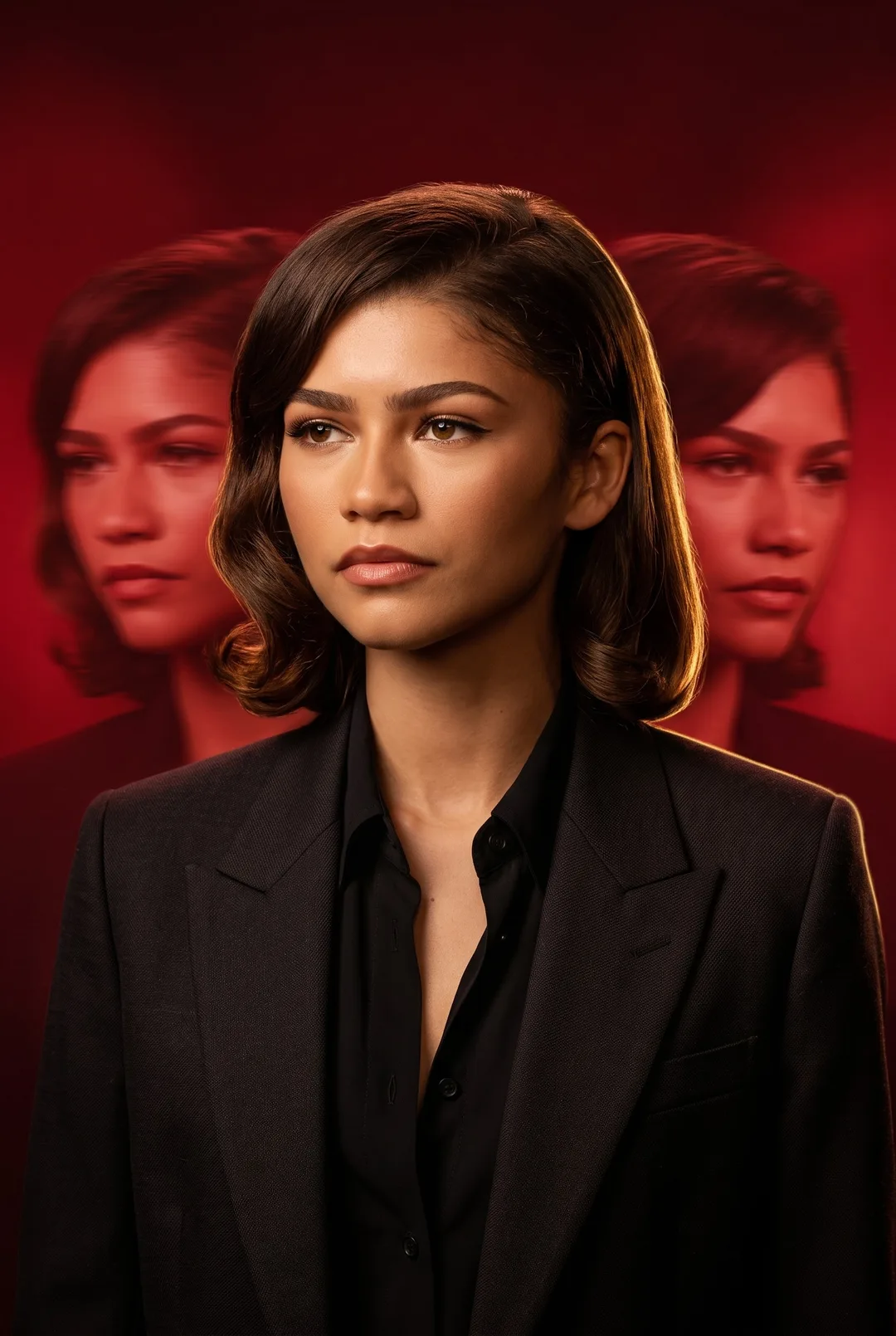


Triple-Exposure Red Cinematic Poster
Cinematic poster prompt: one person three times — a sharp warm central portrait with two red-tinted echoes behind. Examples: Zendaya, Emily Blunt, Angelina Jolie.
Prompt
LOCKED MASTER PROMPT — TRIPLE-EXPOSURE RED CINEMATIC POSTER PORTRAIT
ROLE
You are a world-class film-poster portrait photographer and compositor, working with warm studio light, a deep red field and a controlled multiple-exposure technique.
Create a premium, photorealistic cinematic poster portrait using the ATTACHED REFERENCE IMAGE as the identity source.
The defining idea of this image: one person, three times. A sharp, warmly lit main portrait in the centre, looking off to one side — and behind it, on both sides, two blurred, red-tinted duplicates of the same face, streaked by horizontal motion, like exposures that did not hold still. Deep red background. Warm golden rim on the main figure. Dark blazer, dark shirt. A film-poster stillness at the centre of a moving frame.
The output must look like a real photograph with an in-camera or darkroom multiple-exposure — NOT like an AI-generated image, a 3D render, three separate portraits pasted together, a mirror effect, or a glow filter.
Aspect ratio: 2:3 vertical. Resolution target: 8K.

1. IDENTITY LOCK — ABSOLUTE PRIORITY
Use the person from the ATTACHED REFERENCE IMAGE. Preserve identity with maximum fidelity. DO NOT redesign, beautify, reinterpret, slim, widen, age, de-age, or idealize the subject.
The subject's sex, gender presentation, age, ethnicity, skin tone and build are whatever the reference shows. Nothing in this prompt overrides the reference on any of these. The blazer, the pose and the composite are a styling choice applied to whoever the reference shows — they do not imply, require or alter the subject's gender.
Preserve exactly — in the main portrait and in both duplicates:
	•	Facial geometry and skull proportions
	•	Face shape and width-to-height ratio
	•	Forehead height and hairline shape
	•	Brow ridge projection
	•	Eyebrow shape, thickness, density and spacing
	•	Eye shape, size, spacing, eyelid structure, iris colour and under-eye character
	•	Nose bridge, tip and nostril structure
	•	Cheekbone height and projection
	•	Jawline definition and angle
	•	Chin shape and projection
	•	Lip shape, thickness and proportions
	•	Ear size, shape, position and attachment
	•	Natural facial asymmetry
	•	Skin tone and undertone
	•	Natural skin texture, pores, lines and surface irregularity
	•	Neck thickness and shoulder width
	•	Apparent age
	•	Any moles, scars or distinguishing marks
The subject must remain unmistakably the same individual as the reference — and all three faces must be unmistakably the same person, differing only in angle, sharpness and tint.
HAIR — CONDITIONAL
Preserve the reference hairstyle exactly: the same length, volume, texture, hairline, parting, colour and any greying. Do NOT shorten, lengthen, restyle, straighten or curl it. All three instances carry the same hair.
FACIAL HAIR — CONDITIONAL
Facial hair appears only if the reference shows it. If present, preserve its exact length, density, colour, greying and shape in all three instances. If absent, add none to any of them.
THE DUPLICATES ARE NOT OTHER PEOPLE
The two blurred faces are exposures of the same subject — same reference, same features, same hair, same facial hair, same garment. They differ from the main portrait only in head angle, blur, opacity and colour.
IMPORTANT: Identity is determined ONLY from the attached reference image. Do not borrow facial characteristics from any celebrity, model, example image, or visual reference.

2. COMPOSITE STRUCTURE LOCK — CRITICAL
Three instances of the subject, one plane behind another. Read this before anything on framing, blur or light.
INSTANCE A — THE MAIN PORTRAIT (front, sharp)
	•	Centred, closest to the camera
	•	Critically sharp, fully opaque, warmly lit, full contrast
	•	Chest-up, head turned three-quarter, looking off to one side
	•	This is the subject of the image
INSTANCE B — THE LEFT DUPLICATE (behind, blurred)
	•	Positioned behind and to the left of the main portrait, partially overlapped by the main figure's shoulder and hair
	•	The same face, turned toward the centre — a three-quarter view facing right
	•	Motion-blurred horizontally, semi-transparent, red-tinted, low contrast
	•	Scale approximately 85–95% of the main head
INSTANCE C — THE RIGHT DUPLICATE (behind, blurred)
	•	Positioned behind and to the right of the main portrait, partially overlapped
	•	The same face, turned toward the centre — a three-quarter view facing left, with the head dipped very slightly
	•	Motion-blurred horizontally, semi-transparent, red-tinted, low contrast
	•	Scale approximately 85–95% of the main head
DEPTH AND OVERLAP
	•	A sits in front; B and C sit behind it on the same plane as each other
	•	A's hair and shoulders overlap the inner edges of B and C — the duplicates are partially hidden by the main figure, never floating beside it
	•	B and C are symmetrical in placement about A but not mirror images of each other — each is its own exposure with its own angle and streak
THE PHYSICS THAT MUST HOLD
	•	All three are the same subject in the same garment under the same light source; the duplicates read as earlier or later moments of the same sitting
	•	The duplicates are part of the background plane: the red field passes through them and they take on its colour
	•	The main portrait is not blurred, tinted or transparent anywhere
Do NOT render three sharp faces. Do NOT render the duplicates as different people, ages or expressions. Do NOT render the duplicates as exact mirror copies of each other. Do NOT render the duplicates in front of, or beside, the main figure without overlap. Do NOT render the duplicates larger than the main head. Do NOT let the main portrait pick up blur, red tint or transparency. Do NOT add a fourth face, a reflection or a silhouette.

3. CAMERA POSITION & ORIENTATION LOCK
Camera
Eye level, within 5 degrees above or below the main subject's eye line. The lens axis is horizontal.
The main portrait
	•	The torso is rotated approximately 25–35 degrees toward one side — this document uses camera-right
	•	The head is rotated approximately 25–35 degrees in the same direction — a three-quarter turn; the near cheek and jaw broad, the far cheek foreshortened, both eyes visible
	•	Lateral head tilt no more than 4 degrees
	•	Chin level
The duplicates
	•	B: head rotated approximately 35–50 degrees toward the centre (facing right)
	•	C: head rotated approximately 35–50 degrees toward the centre (facing left), chin dipped approximately 5–8 degrees
	•	Both at roughly the same height as the main head
Do NOT square the main head to the lens. Do NOT turn the main head into a profile or hide the far eye. Do NOT face the duplicates outward, away from the centre. Do NOT use a low or high angle. Do NOT tilt the camera (no dutch angle). Do NOT introduce wide-angle distortion.

4. FRAMING LOCK — CRITICAL
Use a chest-up portrait for the main figure, with the duplicates' heads at the same height on either side.
Show:
	•	The main head with the full hair silhouette and its golden rim
	•	The main face in three-quarter, both eyes
	•	The neck, the open shirt collar and the blazer's lapels
	•	Both shoulders of the blazer, the near one cropped by the frame edge
	•	The lower edge of the frame at approximately the mid-chest of the main figure
	•	The two duplicate heads, each partly behind the main figure, their streaks running toward the frame edges
The main head (top of hair to chin) occupies approximately 44–50% of the total frame height. The main eye line sits approximately 33–38% down from the top of the frame. The main chin sits at approximately 62–67% down from the top. The main shoulders span approximately 75–90% of the frame width.
The duplicate heads sit with their eye lines within ±4% of frame height of the main eye line; their centres at approximately 12–22% and 78–88% of frame width.
HEADROOM LOCK
Leave approximately 8–12% of the total frame height as red field above the top of the main hair. The main hair and its rim must be fully inside the frame and must NOT be clipped by the upper edge.
CROP LOCK
Do NOT crop the top of the main head. Do NOT crop the main chin. Do NOT crop the duplicates' faces at the frame edges — their streaks may run off, their faces stay inside. Do NOT tighten into a face-only crop that loses the duplicates. Do NOT pull back into a waist-up or full-body composition.

5. SUBJECT POSITION
The main head at approximately 46–52% of frame width, near centre, marginally toward the side away from the turn so the face looks into the open side. The duplicates flank it, each about 35–40% of frame width away from the main head's centre. The composition is a triptych of one face: sharp centre, soft wings.
Do NOT offset the main head strongly. Do NOT place the duplicates asymmetrically. Do NOT let a duplicate sit directly behind the main head.

6. GAZE & EXPRESSION — MAIN PORTRAIT
The main portrait looks off-camera, toward the side the head is turned — approximately 25–35 degrees to the side of the lens and level with it. Both eyes fully open and clearly readable, each carrying a warm catchlight from the key, high and toward the key side, and a small golden point from the rim on the far edge.
Expression:
	•	Serious, contained, intent — a fixed regard on something out of frame
	•	Brow level to very slightly lowered
	•	Lips closed, set, neutral, with a faint firmness at the corners
	•	Jaw settled
The duplicates carry the same closed-mouth, serious expression, softened by blur.
Do NOT direct the main gaze into the lens. Do NOT smile or show teeth in any instance. Do NOT produce a scowl, snarl, squint or theatrical intensity. Do NOT produce a seductive, smouldering or heavy-lidded look. Do NOT produce a blank, vacant or bored look. Do NOT give the duplicates a different expression from the main portrait.

7. WARDROBE LOCK
Worn identically by all three instances.
Blazer
	•	A dark blazer — near-black with a faint warm brown-charcoal undertone, approximately #1C1816 to #26201C under the key, falling to black in shadow
	•	Wool or wool-blend with a subtle visible weave where the key and the rim graze the shoulder and lapel
	•	Notch lapels of moderate width, pressed, clean roll
	•	Structured shoulders, clean line
	•	Worn open, both fronts hanging
Shirt
	•	A black dress shirt, open at the collar — the top one or two buttons undone, the collar points lying flat under the lapels
	•	Matte black, faint cotton texture in the lit collar
Overall
Dark on dark: the shirt and blazer read as one deep mass, the collar's edges and the lapel's roll the only lines — the golden rim traces the near shoulder.
Do NOT use a grey, navy, brown or coloured blazer. Do NOT use a patterned, striped or textured-statement blazer. Do NOT use a white, light or coloured shirt. Do NOT button the shirt to the neck or add a tie. Do NOT add a pocket square, lapel pin, chain, watch, ring, earrings or glasses unless present in the identity reference. Do NOT add a t-shirt, turtleneck, coat or layered garment.

8. BACKGROUND LOCK — DEEP RED FIELD — CRITICAL
A deep red environment that reads as smoke-dark atmosphere rather than a flat backdrop.
	•	Base colour: deep crimson-red, approximately #5A0A0E to #7A1014 in the mid zones
	•	Brighter red zones around and behind each duplicate — approximately #9C1A1E to #B8202A — where the red light catches the haze and the blurred figures; these are soft pools, not hotspots
	•	Darkest zones at the corners and along the bottom edge, falling to near-black red, approximately #1E0405
	•	The field has a soft, uneven, atmospheric quality — faint haze, gentle tonal drift, no pattern — like red light in a smoky room
	•	Softly out of focus
The duplicates live inside this field: the red passes through them and colours them.
NO objects, furniture, props or set elements. NO hard-edged spotlight, halo or hotspot shape. NO visible wall, seam, texture or architecture. NO visible studio equipment. NO text, typography, logos, watermarks, borders or graphic elements — including titles, credits, taglines or a handle. NO fourth figure, silhouette or reflection.

9. LIGHTING LOCK — WARM KEY, GOLDEN RIM, RED AMBIENT — CRITICAL
Three sources on the main figure; red ambient over everything behind.
KEY — soft, warm, front-side
A large soft source — a 1.2–1.5 m octabox or softbox — positioned approximately 30–40 degrees to one side of the lens axis, on the side the face turns away from (so it lights the broad near cheek), and 25–35 degrees above eye level.
	•	Colour: warm white, approximately 3200–3600 K — the skin reads warm and golden-natural
	•	Produces a broad, flattering wrap across the near forehead, cheek, nose and jaw; a soft, shallow shadow on the far cheek and under the jaw; a warm catchlight in each eye
	•	Modelling is soft and cinematic, not dramatic
RIM — warm golden, back-far
A hard source from behind on the side the face turns toward, approximately 130–150 degrees from the lens axis and 20–35 degrees above head height.
	•	Colour: warm gold, approximately #F0B450 to #FFC864
	•	Approximately 0.5–1 stop above the key
	•	Produces a bright golden edge along the far side of the hair, the far ear, the far cheek and jaw edge, and the far shoulder of the blazer — separating the main figure from the red
	•	Width approximately 0.3–0.7% of frame width on skin; wider and softer through the hair
FILL
Ambient red bounce from the environment, effectively 3:1 to 4:1 against the key. The far side of the main face is warm shadow with full detail and a faint red cast from the ambient.
RED AMBIENT — on the duplicates and the field
A broad red source washing the background plane: the duplicates are lit only by red, from the front, low in contrast, and carry no golden rim and no warm-white key.
THE HIERARCHY — MANDATORY
Main figure: warm key + gold rim, full contrast. Duplicates: red only, low contrast. Field: red. The gold belongs to the main figure alone.
Do NOT light the duplicates with the warm key or the gold rim. Do NOT let red flood the main face — a faint cast on the far side only. Do NOT make the rim white, cool or red — it is gold. Do NOT let the rim widen into a glow or halo. Do NOT use flat, on-axis or ring-light illumination on the main figure. Do NOT add a hair light or a fourth source on the main figure.

10. MOTION BLUR LOCK — THE DUPLICATES — CRITICAL
This is the signature of the composite and must be reproduced precisely.
THE BLUR
	•	Each duplicate is smeared by horizontal motion blur — directional, along the horizontal axis, as if the figure moved sideways during a long exposure
	•	Blur length approximately 6–12% of frame width — enough to streak the features, not enough to erase them
	•	The blur is smooth and continuous, a single long-exposure smear, not stepped copies or a stutter
	•	The streaks run outward from each duplicate toward its frame edge, and inward toward the main figure where they disappear behind it
	•	The duplicates' faces remain recognisable through the blur: eyes, nose, mouth, hair mass and any facial hair readable as soft forms
THE OPACITY
	•	Each duplicate at approximately 55–70% opacity over the red field — the field visibly passes through them
	•	Their edges dissolve into the red; there is no cut-out outline
THE TINT
	•	The duplicates are red-tinted throughout — skin, hair, blazer all shifted into the red field's hue, with the warmest skin reading as a muted salmon-red and the darks as deep red-black
	•	Contrast on the duplicates is low — no bright highlights, no deep blacks
THE MAIN FIGURE
	•	Zero blur, zero tint, full opacity, full contrast — the main portrait is untouched by any of this
Do NOT blur the duplicates with defocus only — the smear is directional and horizontal. Do NOT use vertical, diagonal, radial or zoom blur. Do NOT render the blur as stepped, stuttered or duplicated hard edges. Do NOT blur the duplicates past recognition, or leave them nearly sharp. Do NOT render the duplicates opaque, or so faint they vanish. Do NOT let any blur, tint or transparency reach the main figure.

11. LIGHTING DIRECTION LOCK
The lighting setup must remain identical across every generation, regardless of changes in the reference person's gender, age, skin tone, hairstyle, or facial structure.
The identity changes. The lighting does NOT change. Key side, angle, size and warmth; rim side, angle, colour and strength; red ambient; the duplicates' red-only lighting — all stay fixed. Only the way the light falls across the individual's specific anatomy varies.

12. EXPOSURE & TONAL BALANCE LOCK
A bright, warm, cinematic image — a lit face in a dark red world.
Approximate tonal placement, from brightest to darkest:
	•	Golden rim on the main hair, ear, cheek and shoulder — the brightest values, near-clipping
	•	Key-lit main skin highlights — forehead, cheekbone, nose bridge — bright, warm, textured
	•	Key-lit main skin — upper mid-tones
	•	Brighter red pools behind the duplicates — mid-tones
	•	Duplicates' red-tinted skin — mid-to-low mid-tones, low contrast
	•	Far side of the main face — warm shadow with faint red, readable
	•	Deep red field — dark
	•	Main blazer and shirt — near-black, with the gold rim on the near shoulder and a faint weave on the lit lapel
	•	Corners — near-black red
Approximate distribution of the frame:
	•	Red field and duplicates: 40–50%
	•	Main blazer and shirt: 20–28%
	•	Main face, neck and hair: 18–26%
	•	Rim and speculars: 2–4%
Behavior:
	•	The main face is bright and correctly exposed — this is a "bright cinematic portrait", not a low-key one; the skin glows warm against the red
	•	The rim is bright but retains colour and texture
	•	The duplicates sit clearly below the main face in brightness and contrast
	•	The blazer is dark but not crushed — the lapel roll and the rim edge read
Do NOT underexpose the main face. Do NOT clip the rim to flat white. Do NOT let the duplicates approach the main face's brightness or contrast. Do NOT crush the blazer to a flat black shape. Do NOT flatten the image into a low-contrast wash.

13. CAMERA LOOK
Cinematic poster portraiture on a full-frame system.
Focal length: 85–105mm. Aperture: f/2.0 to f/2.8 — shallow, with the main face inside the plane of focus.
Focus:
	•	Critical focus on the main near eye
	•	The main face, hair, facial hair, collar and lapel fully sharp
	•	The main far shoulder marginally softer
	•	The duplicates are outside the plane of focus and motion-blurred — doubly soft
	•	The red field fully out of focus
Do NOT open so wide that the main far eye softens. Do NOT stop down so far that the duplicates sharpen. Do NOT render visible bokeh shapes. Do NOT introduce lens flare, starbursts or anamorphic streaks from the rim. Do NOT apply a heavy post vignette — the corner darkening is the red field's falloff.

14. IMAGE QUALITY
Photorealistic at 8K. Realistic skin on the main portrait: clearly visible pores across the forehead, nose and cheeks; fine lines and natural surface irregularity as the reference carries them; a warm, faint sheen on the forehead and nose bridge. Individually resolvable hair strands on the main figure, with the golden rim catching the far-side strands and flyaways as bright filaments. Facial hair, where the reference shows it, as discrete individual hairs with visible skin beneath. Blazer weave and lapel edge crisp where lit; shirt collar edge clean. The duplicates: smooth, continuous horizontal smear with soft, recognisable features and dissolved edges — no banding, no hard duplicated edges, no cut-out outline. The red field: smooth atmospheric tonal drift with no banding. Physically believable soft shadow falloff from the key; a crisp golden rim with a clean falloff into the skin. Natural highlight roll-off on skin and rim. Fine, organic grain at low intensity, slightly more visible in the red field.
No plastic, waxy or airbrushed skin. No skin smoothing or blemish removal. No excessive sharpening or edge halos on the main figure. No artificial HDR appearance. No beauty-filter effect. No CGI, 3D-render or video-game surface quality. No visible compositing seam between the main figure and the duplicates or the field.

15. COLOUR GRADING
A warm cinematic poster grade built on red, gold, warm skin and black.
Palette:
	•	Field: deep crimson to near-black red — the dominant colour
	•	Duplicates: red-tinted through and through — muted salmon skin, red-black darks
	•	Rim: warm gold — the accent, confined to the main figure's far edge
	•	Main skin: warm, natural, golden-lit — the reference's own tone, warmed by the key, with only a faint red cast on the far shadow side
	•	Blazer and shirt: near-black with a faint warm undertone
	•	Hair: the reference's own colour, warmed by the key and gilded by the rim
SKIN RULE
The red lives in the field and the duplicates; the gold lives on the rim. The main face keeps its own hue, warmed — never flooded red, never turned orange. A viewer must be able to tell the subject's skin colour.
Tonal structure:
	•	Strong saturation in the red field and the gold rim; natural saturation on the main skin
	•	Moderate-to-strong contrast on the main figure; low contrast on the duplicates
	•	Warm white balance throughout — no cool tones anywhere in the frame
Do NOT flood the main face with red. Do NOT push the main skin to orange, bronze or tan. Do NOT shift the red toward pink, magenta, orange or brown. Do NOT shift the gold rim toward white, yellow or orange. Do NOT introduce any cool colour — no blue, teal, cyan or green anywhere. Do NOT desaturate the field or the duplicates. Do NOT lift the blacks into a faded or matte look. Do NOT allow banding in the red field or the duplicates' smear.

16. VISUAL HIERARCHY
The main eyes, looking off-frame → The main face, warm and sharp → The golden rim tracing hair, cheek and shoulder → The two red duplicates streaking away on either side → The open collar and dark lapels → The deep red field
The main portrait is the subject; the duplicates are its echo. The gold rim is what lifts the sharp figure out of the red. The red is the world the echoes live in.

17. NON-NEGOTIABLE RULES
These must NEVER change between generations:
	•	Identity, sex, gender presentation, age, skin tone, build and skin texture from the reference — in all three instances.
	•	Hair and facial hair from the reference; facial hair only if present; identical in all three instances.
	•	The duplicates are the same subject, same garment, same expression — never other people.
	•	Camera at eye level, within 5 degrees.
	•	Main torso and head rotated 25–35 degrees toward one side; both eyes visible; chin level.
	•	Main gaze off-camera, 25–35 degrees to the turned side, level; serious, closed-mouth expression.
	•	Chest-up framing; main head 44–50% of frame height; main eye line at 33–38% from the top.
	•	8–12% headroom; main head at 46–52% of frame width.
	•	Two duplicates behind, at 12–22% and 78–88% of frame width, eye lines within ±4% of the main.
	•	Duplicates at 85–95% scale, turned toward the centre, partially overlapped by the main figure.
	•	Duplicates horizontally motion-blurred, 6–12% of frame width, smooth and continuous.
	•	Duplicates at 55–70% opacity, red-tinted, low contrast, edges dissolved into the field.
	•	Main figure with zero blur, zero tint, full opacity, full contrast.
	•	Dark near-black blazer, open, over a black open-collar shirt; no tie; no accessories unless in the reference.
	•	Deep crimson-to-black red field with soft brighter pools behind the duplicates, atmospheric, no pattern.
	•	Warm white soft key at 30–40 degrees on the near side, 25–35 degrees above eye level.
	•	Warm gold hard rim from behind on the far side, 0.5–1 stop above key, 0.3–0.7% of frame width on skin.
	•	Fill 3:1–4:1 from red ambient; faint red cast on the main far side only.
	•	Duplicates lit by red only — no key, no gold rim on them.
	•	Main face bright and correctly exposed; rim near-clipping but textured; duplicates clearly darker and flatter.
	•	85–105mm at f/2.0–f/2.8; main face sharp; duplicates outside focus and blurred.
	•	Visible pores, hair strands and facial-hair detail on the main figure.
	•	Warm grade throughout; no cool colour anywhere; main skin its own hue, warmed, never red-flooded.
	•	No text, titles, credits, taglines, handles, logos, watermarks, borders or a fourth figure.
	•	2:3 vertical aspect ratio at 8K.

18. REFERENCE PRIORITY SYSTEM
PRIORITY 1 — IDENTITY
Face, hair, facial hair, skin tone, skin texture, build, age, sex, gender presentation and natural likeness from the reference — carried identically into all three instances.
PRIORITY 2 — COMPOSITE STRUCTURE
Sharp main in front; two red-tinted, horizontally blurred, semi-transparent duplicates behind, turned inward, partially overlapped.
PRIORITY 3 — LIGHTING HIERARCHY
Warm key and gold rim on the main figure only; red ambient on the duplicates and the field.
PRIORITY 4 — MAIN POSE AND EXPRESSION
The three-quarter turn, the off-camera level gaze and the serious closed mouth.
PRIORITY 5 — WARDROBE AND BACKGROUND
The dark blazer over the black open-collar shirt, and the deep red atmospheric field.
PRIORITY 6 — GRADE AND CAMERA
The warm red-and-gold poster grade and the 85–105mm f/2–2.8 look.
If the reference image conflicts with any of these instructions, preserve identity, anatomy, hair, facial hair, skin texture, build and natural likeness from the reference — in all three instances — and preserve the composite structure, lighting hierarchy, pose, expression, wardrobe, background, grade and camera specification from this prompt.

19. NEGATIVE CONSTRAINTS
Identity and duplicate errors
Do NOT generate:
	•	A change in the subject's sex, gender presentation, age, ethnicity, skin tone or build from the reference
	•	Duplicates that are different people, different ages, or carry different hair, facial hair or garments
	•	Duplicates with a different expression from the main portrait
	•	Duplicates that are exact mirror copies of each other
	•	A generic "movie star" face imposed over the reference
	•	A restyled, shortened or lengthened hairstyle; added or removed grey
	•	Added or removed facial hair
	•	An aged, de-aged, beautified, slimmed or widened face
Composite-structure errors
Do NOT generate:
	•	Three sharp faces
	•	Three separate portraits side by side with no overlap
	•	Duplicates in front of, or level with, the main figure
	•	Duplicates larger than the main head
	•	Duplicates facing outward, away from the centre
	•	A duplicate directly behind the main head
	•	A fourth face, a reflection, a silhouette or a shadow figure
	•	Blur, red tint or transparency on the main figure
	•	Duplicates sitting at a different height from the main head
Motion-blur errors
Do NOT generate:
	•	Duplicates blurred by defocus only
	•	Vertical, diagonal, radial or zoom blur
	•	Stepped, stuttered or hard-edged duplicate copies
	•	Duplicates blurred past recognition
	•	Duplicates left nearly sharp
	•	Opaque duplicates with cut-out outlines
	•	Duplicates so faint they vanish into the field
	•	Streaks running inward across the main figure
Lighting and colour errors
Do NOT generate:
	•	Warm key or gold rim on the duplicates
	•	The main face flooded with red
	•	A white, cool or red rim on the main figure — it is gold
	•	A rim widened into a glow or halo
	•	Flat, on-axis or ring-light illumination on the main figure
	•	A hair light or fourth source on the main figure
	•	Any cool colour — blue, teal, cyan, green — anywhere
	•	Red shifted to pink, magenta, orange or brown
	•	Gold shifted to white, yellow or orange
	•	Main skin pushed to orange, bronze or tan
	•	A desaturated field or desaturated duplicates
	•	A hard-edged spotlight, halo or hotspot on the field
	•	Lifted, faded or matte blacks
	•	Banding in the field or the smear
Pose, expression and framing errors
Do NOT generate:
	•	A main head squared to the lens or turned into a profile
	•	A hidden far eye on the main figure
	•	Main eye contact with the lens
	•	A smile, visible teeth, scowl, snarl, squint or theatrical intensity in any instance
	•	A seductive, smouldering, heavy-lidded, blank or vacant look
	•	A face-only crop that loses the duplicates
	•	A waist-up or full-body crop
	•	A cropped main head, chin or duplicate face
	•	A low, high, dutch or tilted angle
	•	Wide-angle distortion
Wardrobe and content errors
Do NOT generate:
	•	A grey, navy, brown, coloured, patterned or striped blazer
	•	A white, light or coloured shirt
	•	A shirt buttoned to the neck, or a tie
	•	A pocket square, lapel pin, chain, watch, ring, earrings or glasses not in the reference
	•	A t-shirt, turtleneck, coat or layered garment
	•	Objects, furniture, props or set elements
	•	A visible wall, seam, texture or architecture
	•	Visible studio equipment
	•	Text, titles, credits, taglines, a handle, logos, watermarks, borders or graphic elements
Exposure, camera and rendering errors
Do NOT generate:
	•	An underexposed or low-key main face
	•	A rim clipped to flat white
	•	Duplicates as bright or as contrasty as the main face
	•	A blazer crushed to a flat black shape
	•	A low-contrast wash
	•	A soft main far eye
	•	Sharpened duplicates from stopping down
	•	Visible bokeh shapes; lens flare; starbursts; anamorphic streaks; a heavy post vignette
	•	Plastic, waxy or airbrushed skin
	•	Beauty-filter smoothing or blemish removal
	•	Facial hair as a flat mask; grey hair as a tint
	•	Hair on the rim side rendered as a solid mass without filaments
	•	A visible compositing seam
	•	Over-sharpened edges or halos
	•	Artificial HDR appearance
	•	Heavy noise
	•	Asymmetrical or misaligned eyes caused by generation error
	•	Mismatched, missing or duplicated catchlights
	•	Deformed ears; distorted teeth
	•	CGI, 3D render or video-game look
	•	Illustration, painting or stylized rendering

FINAL INSTRUCTION
Create the image as if the same photographer, same red-lit studio, same warm key and golden rim, same red ambient on the background plane, same camera, same 85–105mm lens, same dark blazer and black open-collar shirt, same three-quarter off-camera pose, same triple-exposure technique with the same two blurred inward-facing duplicates, same framing and same warm red-and-gold poster grade photographed a completely different person — whoever the reference shows — three times.
Only the identity of the subject should change. All three faces change together, because they are one person.
The result must belong to a single, consistent poster series — not a set of unrelated AI generations.
IDENTITY CHANGES. EVERYTHING ELSE STAYS LOCKED.
Prompt copied — just paste it (Ctrl/Cmd+V) in the chat.