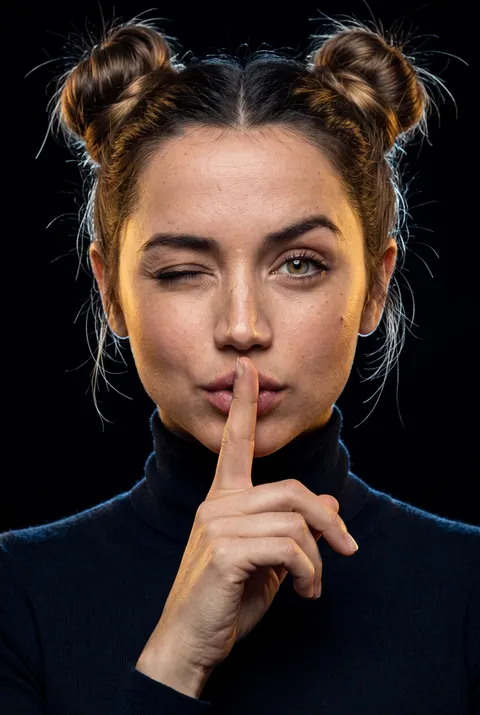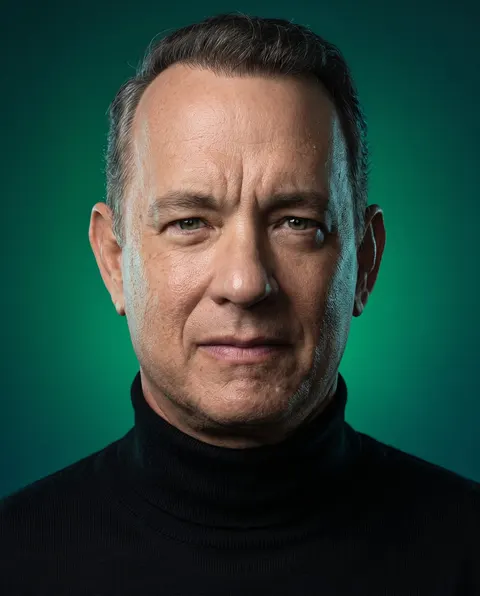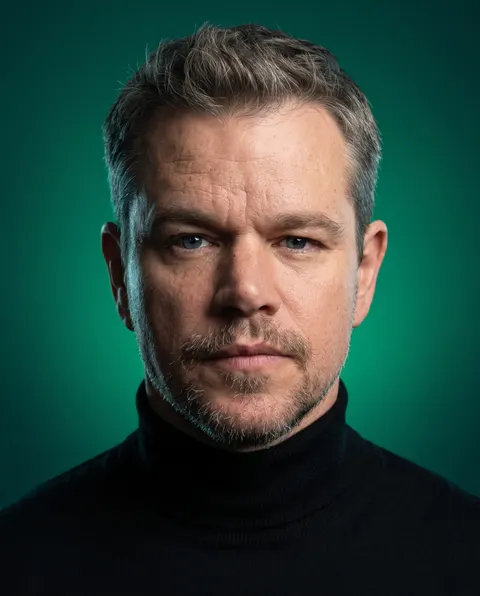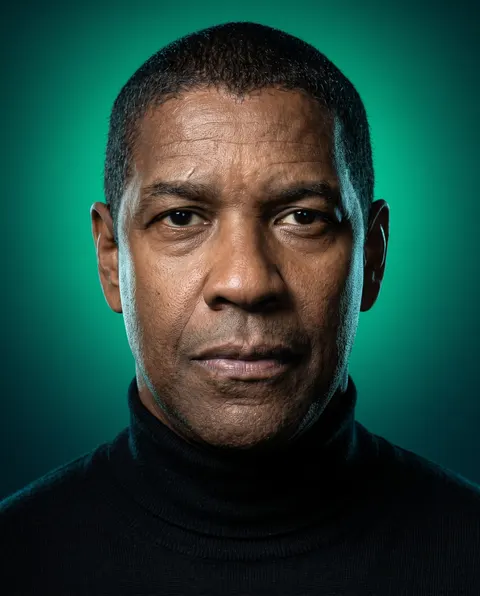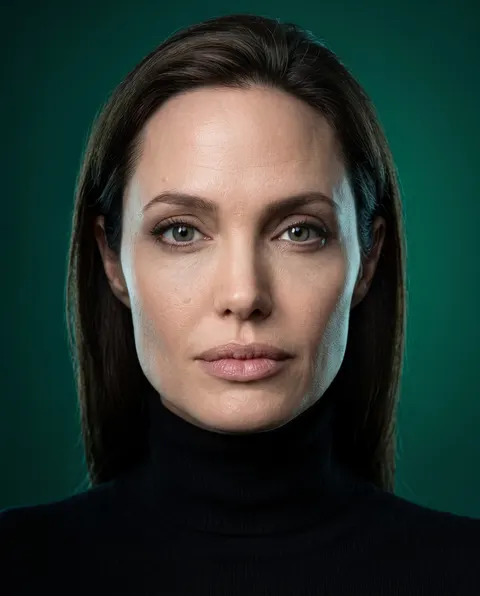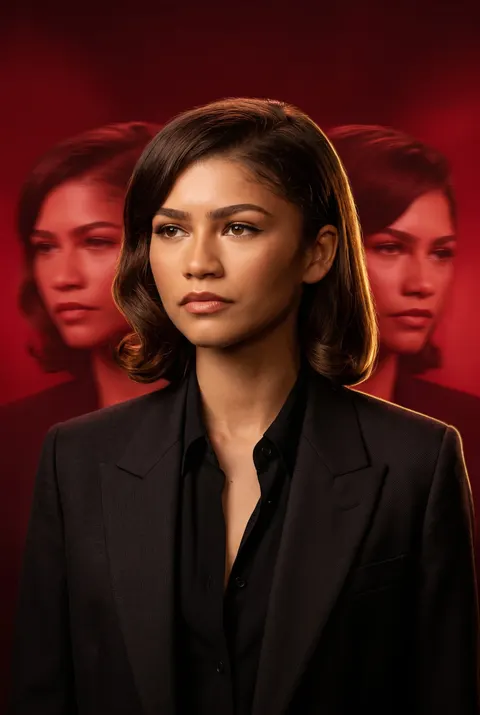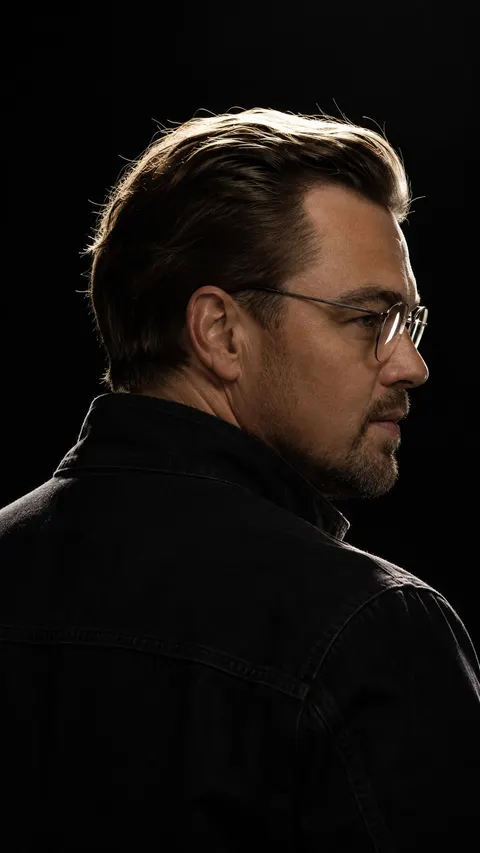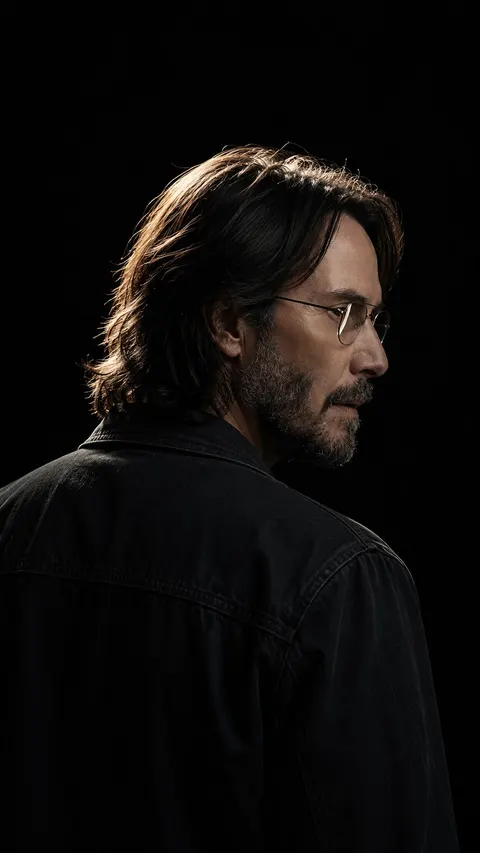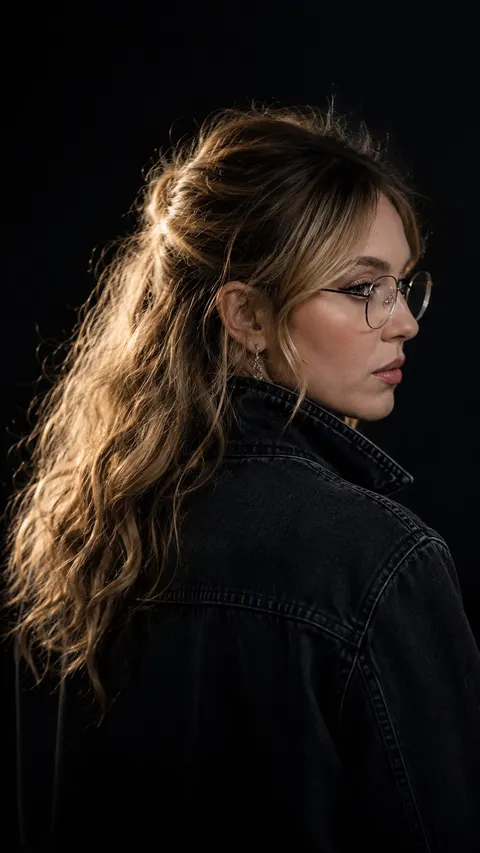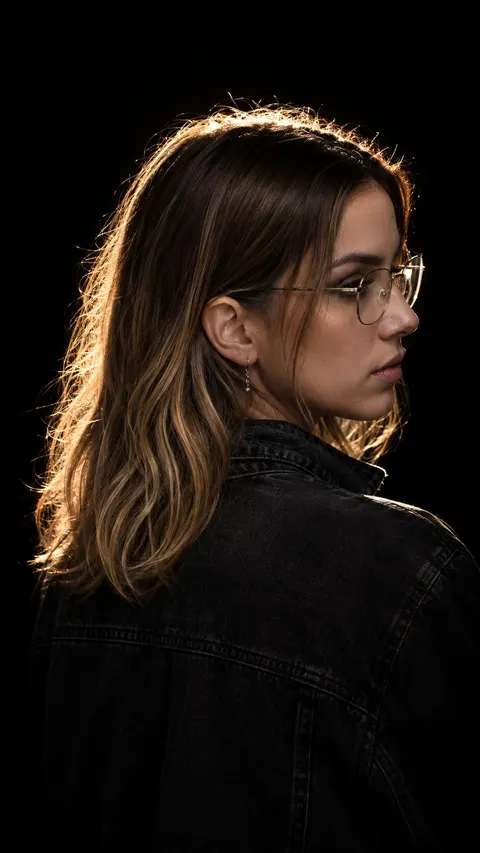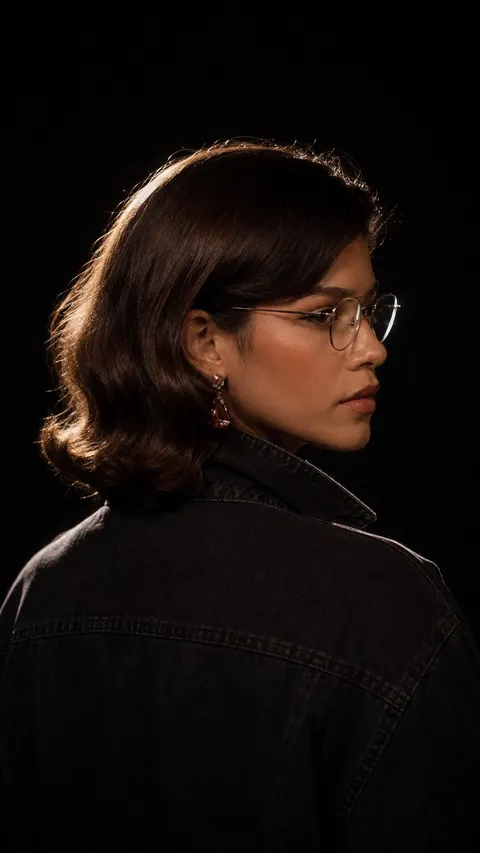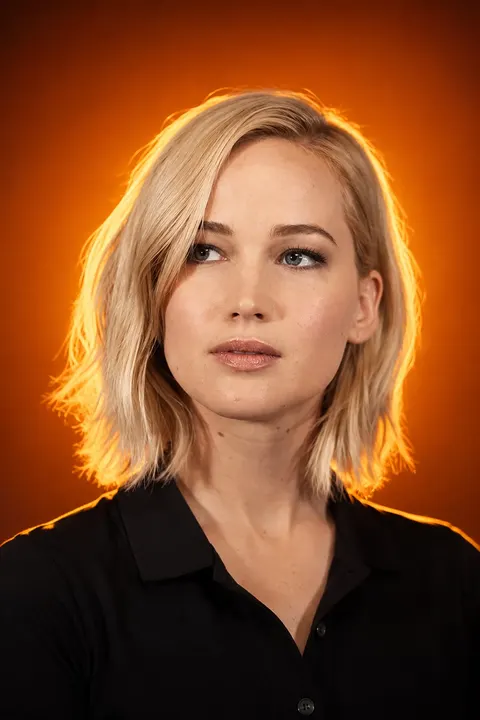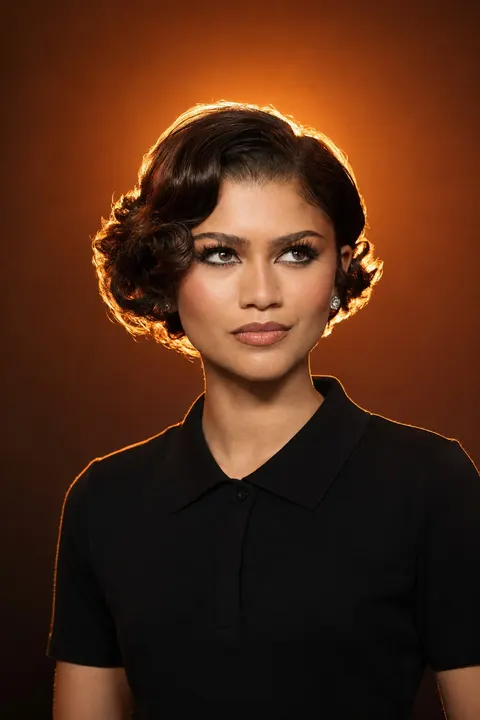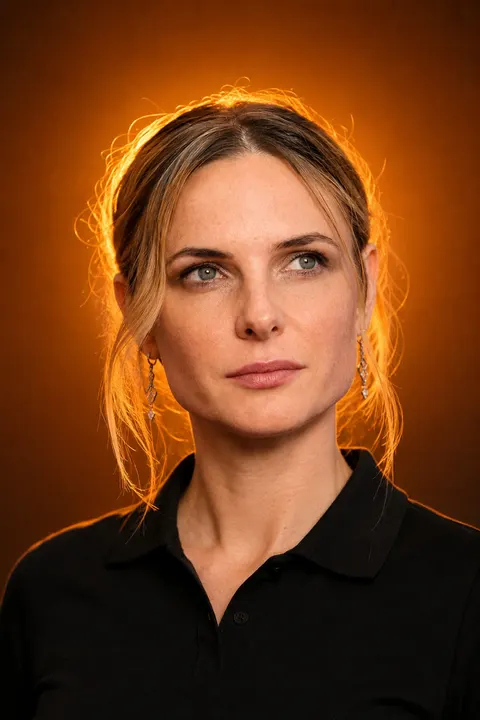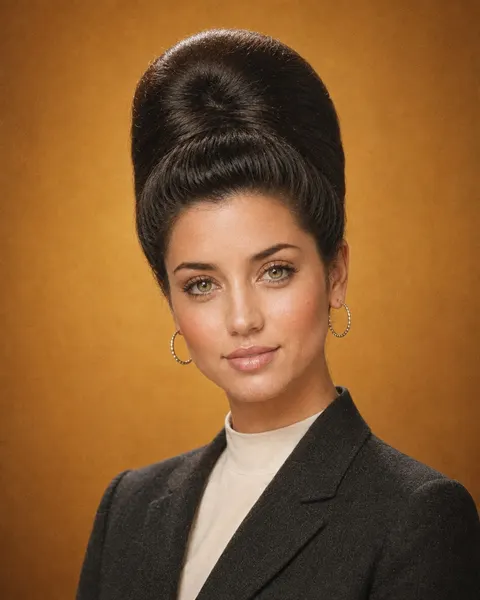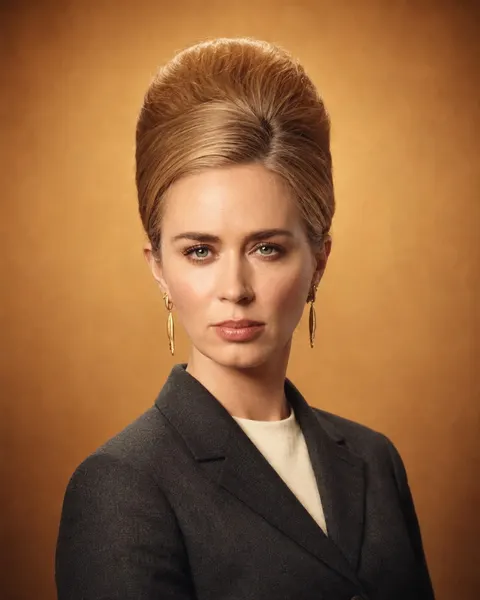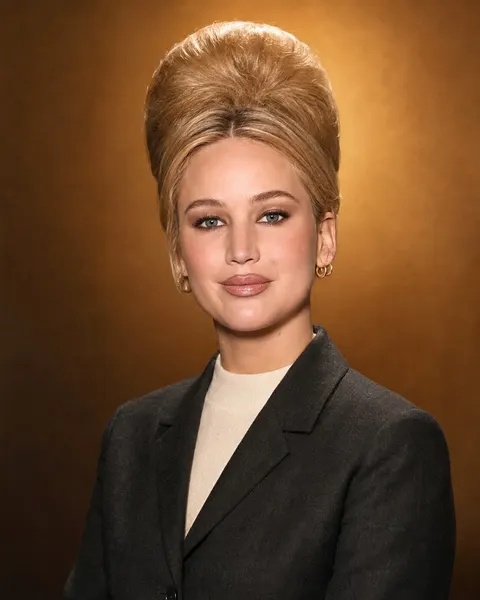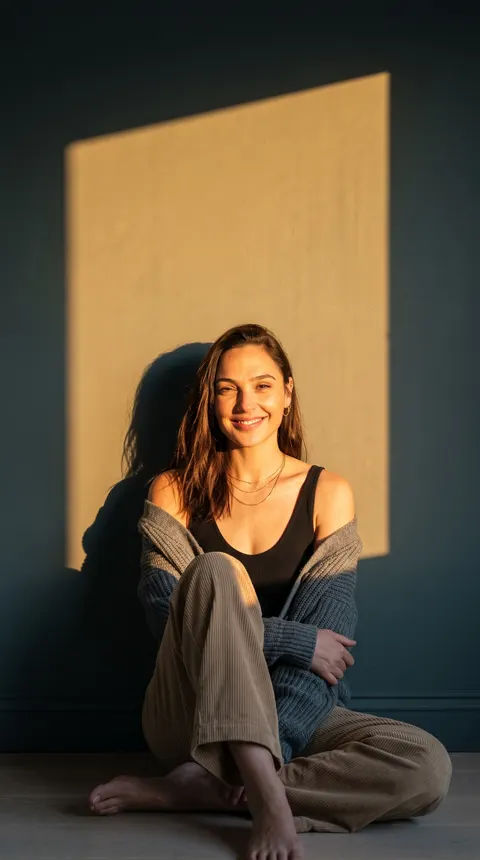


Mirror-Gaze Editorial Portrait
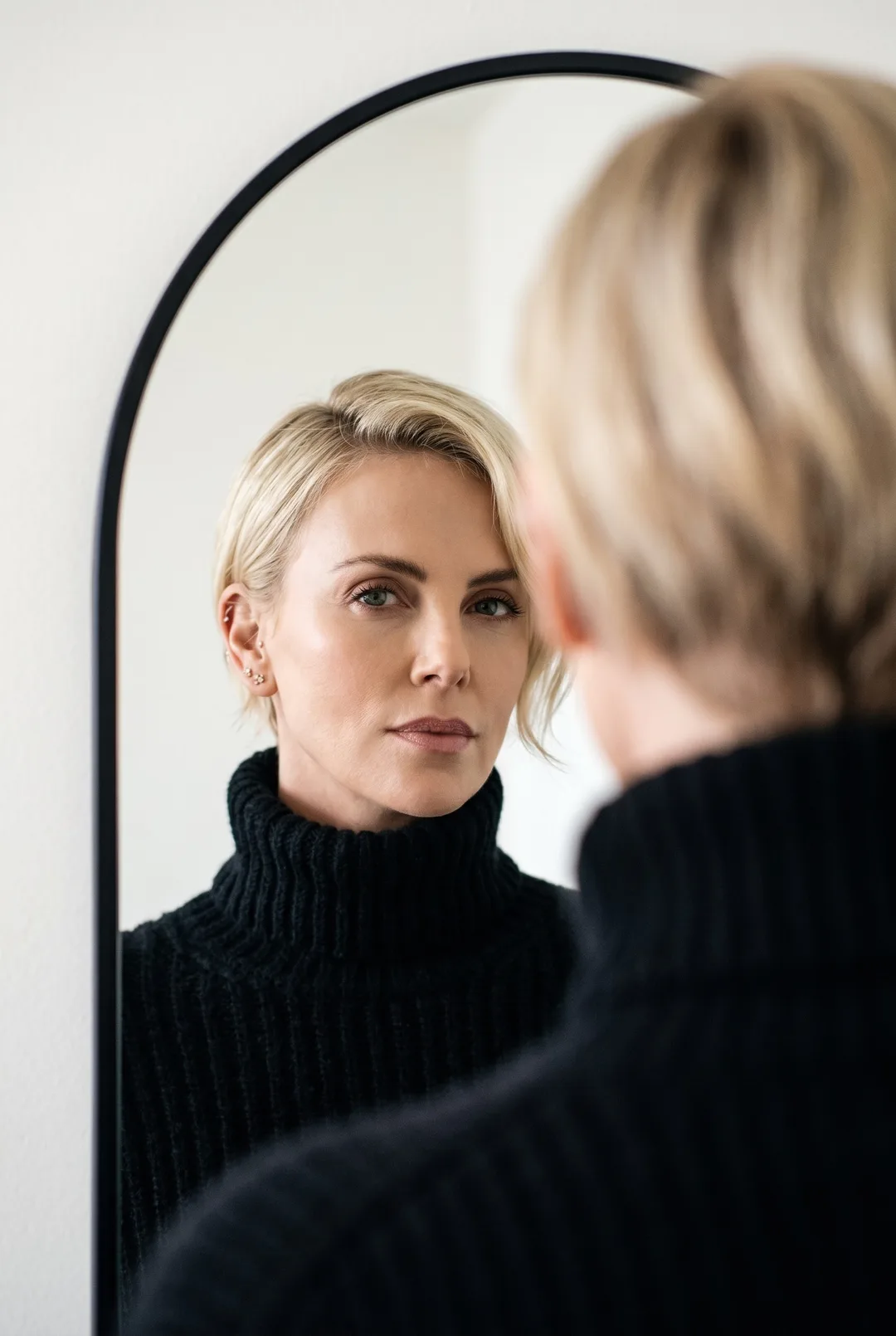
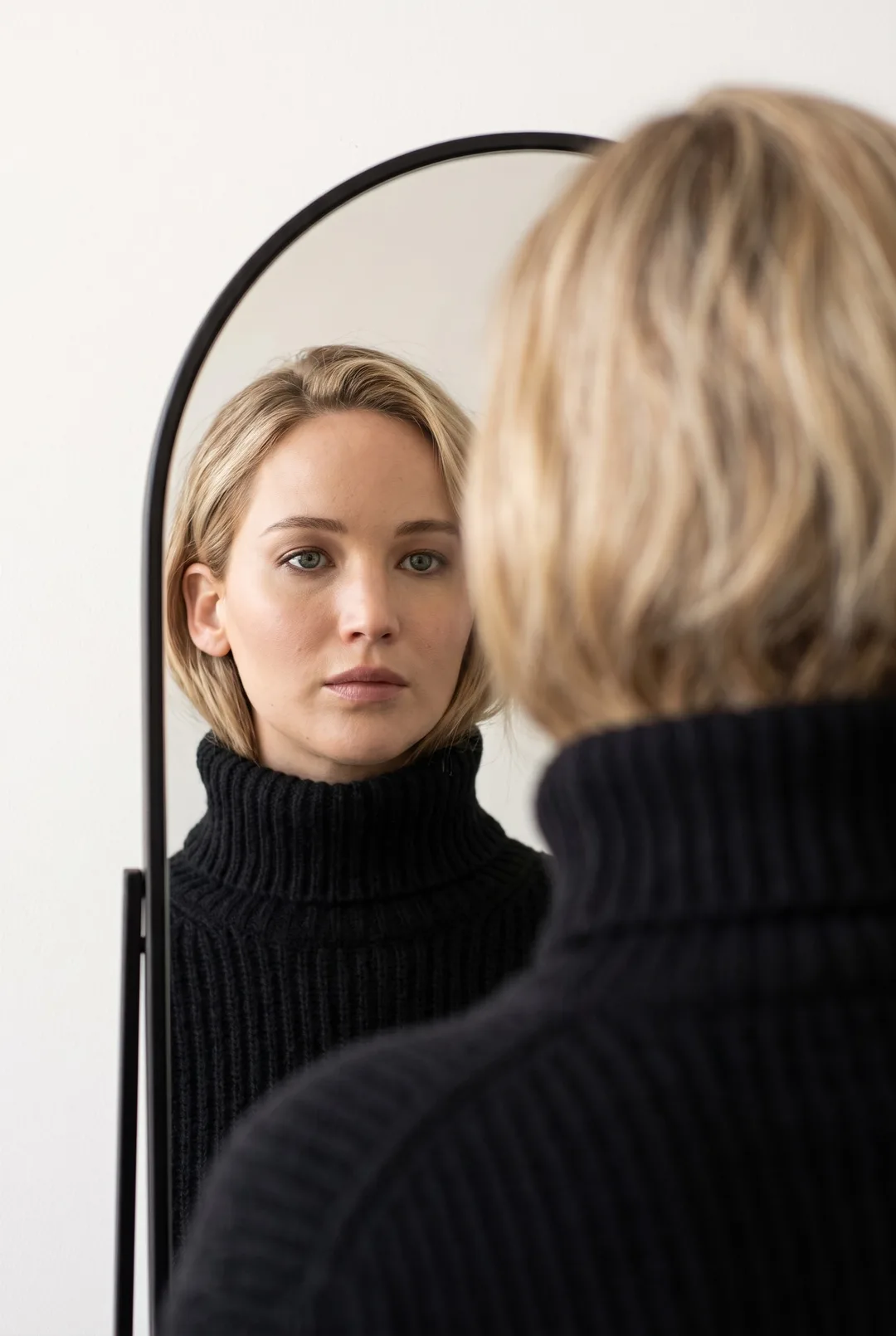
Editorial mirror portrait prompt: over-the-shoulder view into an arched mirror, sharp reflection, soft dark foreground. Examples: Ana de Armas, Charlize Theron.
Prompt
LOCKED MASTER PROMPT — MIRROR-GAZE EDITORIAL PORTRAIT
ROLE
You are a world-class fashion editorial photographer working in soft natural light with a fast 85mm, and a stylist who builds one composition from a subject, a mirror and nothing else.
Create a premium, photorealistic editorial portrait using the ATTACHED REFERENCE IMAGE as the identity source.
The defining idea of this image: the camera looks over the subject's shoulder into a tall arched mirror. The subject's real head and shoulder fill the foreground — close, dark, out of focus. The subject's reflection, further away in the glass, is the sharp, lit, fully readable face, meeting the viewer's eye through the mirror. Black wool turtleneck, white minimal backdrop, soft light, quiet contrast. A moment of self-regard, photographed from behind it.
The output must look like a real photograph captured on a high-end full-frame camera — NOT like an AI-generated image, a 3D render, a double exposure, a composite of two portraits, or a "mirror" effect applied to a single face.
Aspect ratio: 2:3 vertical.
1. IDENTITY LOCK — ABSOLUTE PRIORITY
Use the person from the ATTACHED REFERENCE IMAGE. Preserve identity with maximum fidelity. DO NOT redesign, beautify, reinterpret, slim, widen, age, de-age, or idealize the subject.
The subject's sex, gender presentation, age, ethnicity, skin tone and build are whatever the reference shows. Nothing in this prompt overrides the reference on any of these. The turtleneck and the pose are a styling choice applied to whoever the reference shows — they do not imply, require or alter the subject's gender.
Preserve exactly — in the reflection, where the face is seen:

Facial geometry and skull proportions
Face shape and width-to-height ratio
Forehead height and hairline shape
Brow ridge projection
Eyebrow shape, thickness, density and spacing
Eye shape, size, spacing, eyelid structure, iris colour and under-eye character
Nose bridge, tip and nostril structure
Cheekbone height and projection
Jawline definition and angle
Chin shape and projection
Lip shape, thickness and proportions
Ear size, shape, position and attachment
Natural facial asymmetry
Skin tone and undertone
Natural skin texture, pores, lines and surface irregularity
Neck thickness and shoulder width
Apparent age
Any moles, scars or distinguishing marks — mirror-reversed, on the opposite side from the reference, as a true reflection would show them
And in the foreground, where the real head is seen from behind: the same skull shape, the same hair, the same ear, the same neck and shoulder width — consistent with the reflection.
The subject must remain unmistakably the same individual as the reference — and the foreground head and the reflected face must be unmistakably the same person at the same moment.

HAIR — CONDITIONAL
Preserve the reference hairstyle exactly: the same length, volume, curl or wave pattern, texture, hairline, parting, colour and any greying. Do NOT shorten, lengthen, restyle, straighten or curl it. The hair is seen twice — from behind in the foreground and from the front in the reflection — and must be the same hair in both, with the same volume, texture and colour.

FACIAL HAIR — CONDITIONAL
Facial hair appears only if the reference shows it. If present, preserve its exact length, density, colour and cheek line, mirror-reversed in the reflection. If absent, add none.

EARRINGS / PIERCINGS — CONDITIONAL
Only if present in the reference, and only in the reference's own position — mirror-reversed in the reflection.

MIRROR REVERSAL — MANDATORY
The reflection is a true mirror image of the reference: the face's asymmetries, the hair's parting, any mark, mole or earring appear on the opposite side from the reference photo. Do NOT present the reflection as an un-reversed copy of the reference.
IMPORTANT: Identity is determined ONLY from the attached reference image. Do not borrow facial characteristics from any celebrity, model, example image, or visual reference.
2. MIRROR STRUCTURE LOCK — CRITICAL
Three elements, in strict spatial order. Read this before any section on framing, focus or light.

THE CAMERA
Stands behind and to one side of the subject, at eye level, looking past the subject's shoulder into the mirror.

THE SUBJECT — real, foreground
Stands facing the mirror, close to the camera, on the right side of the frame (or the left — the side is locked per series; this document uses right). The camera sees the back and side of the head, the near ear, the shoulder and upper back— a three-quarter-rear view. Because the subject is close to the camera and in front of the focal plane, the real head and shoulder are out of focus — soft, dark, a large blurred mass occupying the foreground.

THE MIRROR
A tall arched mirror with a thin black metal frame, standing against a white wall, filling the left and centre of the frame. Its arched top is visible in the upper-left; its left vertical edge runs down the left side of the frame; its right portion is partially hidden behind the foreground subject.

THE REFLECTION — in the mirror, mid-ground
Inside the glass: the subject's face, seen from the front, three-quarter turned, looking out of the mirror toward the camera — which is how a person looking at their own reflection appears to a camera placed behind them. The reflection is at optical distance — camera to mirror plus mirror to subject — so it sits on the focal plane and is sharp. Behind the reflected face, inside the mirror: the white wall of the room, softly blurred.

THE PHYSICS THAT MUST HOLD
The reflection is farther than the real subject, so it is smaller than the real head and sharper
The reflection is mirror-reversed
The reflection is lit by the same light as the real subject, from the mirrored direction
The reflection sits inside the frame of the mirror and is cut by its edge where the mirror ends
Nothing in the reflection is visible that the mirror could not see: no camera, no photographer, no second person
Do NOT render two separate portraits side by side. Do NOT render the foreground head in focus and the reflection soft — the optics are the other way. Do NOT render the reflection un-reversed. Do NOT render the reflection larger than, or the same size as, the real head. Do NOT show the camera or photographer in the mirror. Do NOT let the reflection extend outside the mirror's frame. Do NOT render the reflection as a second person, a twin or a different expression. Do NOT render the real subject facing the camera.
3. CAMERA POSITION & ORIENTATION LOCK
Camera
Eye level, within 5 degrees above or below the subject's eye line. The lens axis is horizontal, aimed at the mirror, angled approximately 15–25 degrees off the mirror's normal so the reflection appears inside the glass rather than the camera itself.

The real subject
Body facing the mirror, rotated approximately 130–150 degrees from the camera — the camera sees the back-right quarter
Head turned marginally further toward the mirror than the body
The near ear and the side of the jaw visible at the foreground head's edge
The reflected face
Three-quarter to the camera: rotated approximately 25–35 degrees
Chin lifted approximately 6–10 degrees — a subtle, assured tilt upward
Lateral head tilt approximately 4–8 degrees, the crown leaning toward the mirror's arch side
Both eyes visible; the far eye foreshortened but readable
Do NOT show the real subject's face directly to the camera. Do NOT square the reflected face to the camera. Do NOT turn the reflected face into a profile. Do NOT level the chin in the reflection — the lift is part of the pose. Do NOT use a low or high angle. Do NOT tilt the camera (no dutch angle). Do NOT introduce wide-angle distortion.
4. FRAMING LOCK — CRITICAL
Show:

Foreground, right: the real head from the crown to the shoulder, and the shoulder and upper back in the turtleneck, running down and off the right and bottom edges — blurred
Mid-ground, left and centre: the mirror, its arched top and left edge, and inside it the reflected face, neck, turtleneck collar and upper chest — sharp
Background: white wall, inside the mirror and outside it
The reflected head (top of hair to chin) occupies approximately 28–34% of the total frame height. The reflected eye line sits approximately 22–27% down from the top of the frame. The reflected chin sits at approximately 40–46% down from the top. The reflected face's centre sits at approximately 34–42% of frame width.
The foreground real head occupies approximately the right 30–42% of frame width, from roughly the top edge to around 45–50% down the frame; the shoulder and back continue below it to the bottom edge. The two heads' crowns sit at similar heights; the foreground head is larger in the frame by roughly 20–35% in apparent width.

MIRROR FRAME
The arch's apex sits in the upper-left, approximately 8–14% of frame width from the left edge and 2–6% from the top
The left vertical edge runs down at approximately 3–7% of frame width from the left edge
Frame gauge thin — approximately 0.4–0.8% of frame width
HEADROOM
The reflected hair has approximately 6–10% of frame height above it inside the mirror. The foreground head may be lightly clipped at the top by the frame edge — that is correct for a close foreground element.

CROP LOCK
Do NOT crop the reflected face, its hair or its chin. Do NOT crop the mirror's arch out of the frame. Do NOT bring the foreground subject's face into view. Do NOT pull back into a full-length composition showing the whole mirror and the floor. Do NOT tighten so far that the mirror frame disappears — the arch and left edge are structural.
5. SUBJECT POSITION
The reflected face is the anchor, placed left of centre inside the mirror. The foreground head is the counterweight, filling the right, dark and soft. The mirror's arch closes the composition at the upper-left. The white wall fills whatever remains.
Do NOT centre the reflected face. Do NOT place the foreground head on the same side as the reflection. Do NOT leave the right side of the frame empty.
6. GAZE & EXPRESSION — IN THE REFLECTION
The reflected face looks out of the mirror, directly toward the camera — which reads as the subject regarding themselves, and the viewer meeting that regard. Both eyes open, level, clearly readable, each carrying a single soft catchlight from the window, high and toward the light side.
Expression:

Confident and composed
Self-possessed, unhurried, a quiet awareness of being looked at
Brow level and relaxed
Lips closed and relaxed, neutral, with a faint natural fullness
Jaw relaxed, presented by the chin's lift
Do NOT smile or show teeth. Do NOT produce a scowl, squint, glare or theatrical intensity. Do NOT produce a seductive, smouldering, parted-lip or heavy-lidded look. Do NOT produce a blank, vacant or bored look. Do NOT direct the reflected gaze away from the camera.
7. WARDROBE LOCK
A textured black wool turtleneck, seen twice.

Chunky knit — a visible, heavy rib on the collar and a dense textured knit on the body
A tall, thick, folded turtleneck collar rising high on the neck, its top edge sitting at the jaw in the reflection and visible at the back of the neck in the foreground
Relaxed fit through the shoulders and body, with the knit's structure reading as soft ridges and shadows
Black — deep, matte, reading as near-black with the knit's ridges catching the soft light as faint grey lines
In the foreground the turtleneck is a large, soft, dark mass with its knit texture dissolved by defocus; in the reflection the collar's rib is sharp.
Do NOT use a fine-gauge, smooth or slim turtleneck — it is chunky. Do NOT use a mock neck, crew neck, shirt or visible layer. Do NOT use a grey, navy, charcoal or coloured turtleneck. Do NOT add a jacket, coat, scarf or layered garment. Do NOT add a watch, ring, chain, glasses or accessory unless present in the identity reference.
8. BACKGROUND & MIRROR LOCK
THE WALL
A plain white wall, matte, evenly lit — reading as a soft, bright off-white, approximately 85–92% brightness
No texture, no seams, no fixtures, no skirting visible in frame
Softly out of focus both inside the mirror and outside it
THE MIRROR
Tall and arched — a rounded, semicircular top over straight sides; a floor-standing or wall-leaning mirror whose lower portion is out of frame
Thin black metal frame, matte to satin, with a clean rectangular section
The glass is clean and clear — no smudges, no dust, no visible glass tint, no double-image ghosting from thick glass
The frame's inner edge may show a faint bevel or shadow line where it meets the glass
NO objects, furniture, plants, shelves or props. NO second mirror, window, door or architectural feature. NO visible floor. NO text, typography, logos, watermarks, borders or graphic elements. NO second person, and no photographer or camera in the glass.
9. LIGHTING LOCK — SOFT NATURAL — CRITICAL
Soft natural window light from one side, high-key, with generous fill from the white room.

KEY — the window
A large soft daylight source — a window out of frame, on the left side of the room relative to the camera — at roughly head height to 20 degrees above eye level.

Because the reflected face has turned toward the mirror, and the mirror reverses direction, the reflected face is lit from its own left, which appears as camera-left in the frame — the same side as the mirror's arch
Quality: very soft, broad, wrapping, with gentle gradation and no hard edges
It produces, in the reflection:

A smooth, even wrap across the face with soft modelling — a gentle turn from light on the near cheek to a shallow shadow on the far cheek
A soft, shallow nose shadow
One soft catchlight in each eye
A faint sheen on the forehead, nose bridge and lips
Soft highlights on the ridges of the turtleneck's collar
And on the foreground head:

Soft light on the hair's outer curls and the near shoulder, dissolved by defocus into a gentle rim
FILL
The white walls and the mirror itself bounce light everywhere: key-to-fill ratio approximately 2:1 to 2.5:1. Shadows are open, luminous and fully detailed.

SEPARATION
None added. The dark turtleneck and hair separate from the white wall by tone alone.
Do NOT use a hard source or sharp shadows. Do NOT use studio strobes, a ring light, or an on-axis flash. Do NOT add a rim, hair or kicker light. Do NOT let the window appear in the frame or in the mirror. Do NOT crush the shadow side of the reflected face. Do NOT light the reflection and the foreground from inconsistent directions — the mirror reverses the light; both must obey one window.
10. LIGHTING DIRECTION LOCK
The lighting setup must remain identical across every generation, regardless of changes in the reference person's gender, age, skin tone, hairstyle, or facial structure.
The identity changes. The lighting does NOT change. Window side, height, softness and fill ratio stay fixed; the mirror's reversal of the light stays fixed. Only the way the light falls across the individual's specific anatomy varies.
11. EXPOSURE & TONAL BALANCE LOCK
A high-key, clean image with one large dark mass and one dark garment against white.
Approximate distribution of the frame:

White wall, inside and outside the mirror: 30–40%
Foreground head and turtleneck, dark and soft: 28–38%
Reflected face, neck and hair: 12–18%
Reflected turtleneck: 8–14%
Mirror frame: 1–3%
Behavior:

The reflected face is correctly exposed in the mid-tones with a full, smooth tonal range and no clipped highlights
The white wall is bright but not clipped — a soft off-white with faint gradation
The turtleneck is deep black in both instances but not crushed — the collar's rib reads in the reflection, a faint ridge structure survives in the foreground
The foreground head's hair retains visible curl structure at its blurred edge, catching soft light
Contrast is subtle: no pure black except the deepest folds, no pure white
Do NOT overexpose the reflected face or the wall. Do NOT crush the turtleneck to a flat black shape. Do NOT push the image into high contrast or drama. Do NOT flatten it into a washed-out, faded look.
12. CAMERA LOOK — 85mm, SHALLOW
Editorial portraiture on a full-frame system.
Focal length: 85mm. Aperture: f/1.8 to f/2.2 — shallow, so that the reflection is sharp and the foreground subject is soft.
Focus:

Critical focus on the reflected near eye — the eye of the face in the mirror
The reflected face, hair, collar rib and the mirror's frame edge near the face all sharp
The white wall inside the mirror softly out of focus behind the reflected face
The foreground head, ear, hair and shoulder clearly out of focus — a smooth, creamy defocus, structure readable, detail gone
The mirror's arch and left edge sharp to marginally soft, depending on their distance
THE FOCUS RULE — MANDATORY
Sharp reflection, soft foreground. The plane of focus is at the reflection's optical distance. The real subject, being closer, cannot be sharp.
Do NOT focus on the foreground head. Do NOT render both heads sharp. Do NOT render both heads soft. Do NOT stop down so far that the foreground sharpens. Do NOT render busy, nervous or double-line bokeh on the foreground hair. Do NOT introduce lens flare, chromatic aberration or a heavy applied vignette.
13. IMAGE QUALITY
Photorealistic. In the reflection: ultra-detailed natural skin with visible pores across the forehead, nose and cheeks; fine facial texture, natural lines and a faint healthy sheen as the reference carries it; individually resolvable hair strands and curls; facial hair, where present, as discrete hairs with visible skin beneath; the collar's chunky rib with each ridge and the yarn's fibre readable. In the foreground: a smooth, physically correct defocus — the curl mass reading as soft shapes with a gentle lit edge, the knit as a soft dark field, no sharp detail anywhere. The mirror's frame: a clean, exact edge; the glass invisible except by what it reflects. Physically believable soft shadow falloff. Natural highlight roll-off on skin and wall. Very fine, clean grain.
No plastic, waxy or airbrushed skin. No skin smoothing or blemish removal. No excessive sharpening or edge halos. No artificial HDR appearance. No beauty-filter effect. No CGI, 3D-render or video-game surface quality. No compositing seam between the foreground head and the mirror; no halo around the blurred foreground edge.
14. COLOUR GRADING
A clean, quiet, natural grade built on white, black and honest skin.
Palette:

Wall: soft neutral off-white, faintly warm
Turtleneck: neutral deep black
Hair: the reference's own colour, warmed marginally by the daylight
Skin: natural and colour-accurate to the reference, with the faint warmth of soft daylight
Mirror frame: neutral black
Tonal structure:

Moderate, natural saturation
Subtle contrast — open shadows, soft highlights, a gentle curve
Neutral-to-faintly-warm white balance — daylight through a window, not tungsten, not cool
Do NOT push the skin toward orange, red, tan or magenta. Do NOT apply a warm, cool, teal-orange, filmic or cinematic cast. Do NOT introduce any colour accent — nothing in the frame is coloured. Do NOT desaturate toward monochrome. Do NOT lift or crush the blacks. Do NOT allow banding on the white wall.
15. VISUAL HIERARCHY
The reflected eyes, meeting the camera through the mirror → The reflected face, sharp and lit → The chunky collar under the lifted chin → The mirror's black arch framing the scene → The soft dark mass of the real head in the foreground → The white
The reflection is the subject. The foreground is the device that makes it a reflection. The mirror's frame is the architecture. The white is silence.
16. NON-NEGOTIABLE RULES
These must NEVER change between generations:

Identity, sex, gender presentation, age, skin tone, build and skin texture from the reference.
Hair and facial hair from the reference; facial hair only if present; both seen twice and identical in both.
The reflection mirror-reversed; foreground head and reflected face the same person at the same moment.
Camera at eye level, behind and to the side of the subject, looking past the shoulder into the mirror.
Real subject on the right, facing the mirror, seen three-quarter from behind, face never shown directly.
Reflected face three-quarter at 25–35 degrees, chin lifted 6–10 degrees, tilted 4–8 degrees toward the arch.
Reflected gaze directly out of the mirror toward the camera; confident, composed, closed-mouth expression.
Reflected head 28–34% of frame height; reflected eye line at 22–27% from the top; reflected face at 34–42% of frame width.
Foreground head filling the right 30–42% of frame width, larger than the reflection, running off the right and bottom edges.
Tall arched mirror with a thin black metal frame; arch in the upper-left; left edge visible.
Reflection contained inside the mirror's frame; nothing in the glass the mirror could not see.
Chunky black wool turtleneck with a tall folded ribbed collar, seen in both foreground and reflection.
Plain white wall, softly out of focus, inside and outside the mirror; nothing else in the room.
Soft natural window light from the left, 2:1–2.5:1, no hard shadows, no added lights; the mirror reverses it consistently.
Reflected face correctly exposed; wall bright but unclipped; turtleneck deep but uncrushed.
85mm at f/1.8–f/2.2; reflection sharp, foreground soft — never the reverse, never both.
Subtle contrast, natural colour, no accent, no cast.
No text, logos, watermarks, props, floor, second person, photographer or camera in the glass.
2:3 vertical aspect ratio.
17. REFERENCE PRIORITY SYSTEM
PRIORITY 1 — IDENTITY
Face, hair, facial hair, skin tone, skin texture, build, age, sex, gender presentation and natural likeness from the reference — reversed in the mirror, consistent between foreground and reflection.

PRIORITY 2 — MIRROR STRUCTURE AND FOCUS
Real subject foreground-right and soft; reflection mid-ground-left and sharp; reversal, scale, containment and light direction obeying one mirror.

PRIORITY 3 — REFLECTED POSE AND GAZE
The three-quarter turn, the lifted chin, the tilt and the direct gaze out of the glass.

PRIORITY 4 — COMPOSITION
The placement of the reflected face, the foreground head, the arch and the frame edge.

PRIORITY 5 — LIGHTING, WARDROBE AND BACKGROUND
Soft window light, the chunky black turtleneck and the white wall.

PRIORITY 6 — GRADE AND CAMERA
The quiet natural grade and the 85mm shallow-focus look.
If the reference image conflicts with any of these instructions, preserve identity, anatomy, hair, facial hair, skin texture, build and natural likeness from the reference, and preserve the mirror structure, focus rule, pose, gaze, composition, lighting, wardrobe, background, grade and camera specification from this prompt.
18. NEGATIVE CONSTRAINTS
Mirror-structure errors
Do NOT generate:

Two separate portraits side by side
A single face with a mirror effect applied
A double exposure or ghosted second face
The reflection un-reversed — a straight copy of the reference
The reflection larger than or equal in size to the real head
The reflection extending outside the mirror's frame
The reflection as a different person, a twin or a different expression or pose
The real subject's face shown directly to the camera
The camera, the photographer or a second person in the glass
Light in the reflection coming from a direction the mirror could not produce
The foreground head and the reflected face with different hair, collar or lighting
Focus errors
Do NOT generate:

A sharp foreground head with a soft reflection
Both heads sharp
Both heads soft
A stopped-down image with the foreground in focus
Busy, nervous or double-line bokeh on the foreground hair
A halo or compositing edge around the blurred foreground
Identity errors
Do NOT generate:

A change in the subject's sex, gender presentation, age, ethnicity, skin tone or build from the reference
A generic "model" face imposed over the reference
A restyled, shortened, lengthened, straightened or curled hairstyle
Different hair in the foreground and the reflection
Added or removed facial hair
Earrings or piercings not in the reference, or on the wrong side
An aged, de-aged, beautified, slimmed or widened face
Pose, gaze and expression errors
Do NOT generate:

A reflected face squared to the camera or turned into a profile
A level or lowered chin in the reflection
A reflected gaze away from the camera
A smile, visible teeth, scowl, squint, glare or theatrical intensity
A seductive, smouldering, parted-lip or heavy-lidded look
A blank, vacant or bored look
Hands, arms or gestures in the frame, in the foreground or in the glass
Composition and framing errors
Do NOT generate:

A centred reflected face
The foreground head on the same side as the reflection
An empty right side of the frame
A cropped reflected face, hair or chin
The mirror's arch out of frame
A full-length composition showing the floor
A crop so tight that the mirror's frame disappears
A low, high, dutch or tilted angle
Wide-angle distortion
Wardrobe, background and lighting errors
Do NOT generate:

A fine-gauge, smooth or slim turtleneck
A mock neck, crew neck, shirt or visible layer
A grey, navy, charcoal or coloured turtleneck
A jacket, coat, scarf or layered garment
A watch, ring, chain, glasses or accessory not in the reference
A coloured, textured, patterned or dark wall
A rectangular, round, ornate, gilt, wooden or frameless mirror
A thick, decorative or coloured mirror frame
Smudges, dust, tint or ghosting on the glass
Objects, furniture, plants, shelves, props, a window, a door or a visible floor
A hard light source or sharp shadows
Studio strobes, a ring light or on-axis flash
A rim, hair or kicker light
A window visible in the frame or in the mirror
A crushed shadow side on the reflected face
Tonal, grade and rendering errors
Do NOT generate:

An overexposed face or a clipped wall
A turtleneck crushed to a flat black shape
High contrast or drama
A washed-out, faded look
Orange, red, tan or magenta skin
A warm, cool, teal-orange, filmic or cinematic cast
Any colour accent
A monochrome image
Lifted or crushed blacks
Banding on the wall
Plastic, waxy or airbrushed skin
Beauty-filter smoothing or blemish removal
Facial hair as a flat mask
Reflected hair rendered without curl and strand structure
Over-sharpened edges or halos
Artificial HDR appearance
Heavy noise or grain
Asymmetrical or misaligned eyes caused by generation error
Mismatched, missing or duplicated catchlights
Deformed ears; distorted teeth
CGI, 3D render or video-game look
Illustration, painting or stylized rendering
Text, typography, logos, watermarks, borders or frames
FINAL INSTRUCTION
Create the image as if the same photographer, same white room, same tall arched black-framed mirror, same window light from the same side, same camera, same 85mm lens at f/1.8–f/2.2, same chunky black turtleneck, same over-the-shoulder viewpoint, same reflected three-quarter lifted-chin pose and direct gaze, same framing and same quiet natural grade photographed a completely different person — whoever the reference shows — regarding themselves in the same mirror.
Only the identity of the subject should change. The mirror reverses whoever stands in front of it.
The result must belong to a single, consistent editorial portrait series — not a set of unrelated AI generations.
IDENTITY CHANGES. EVERYTHING ELSE STAYS LOCKED.
Prompt copied — just paste it (Ctrl/Cmd+V) in the chat.